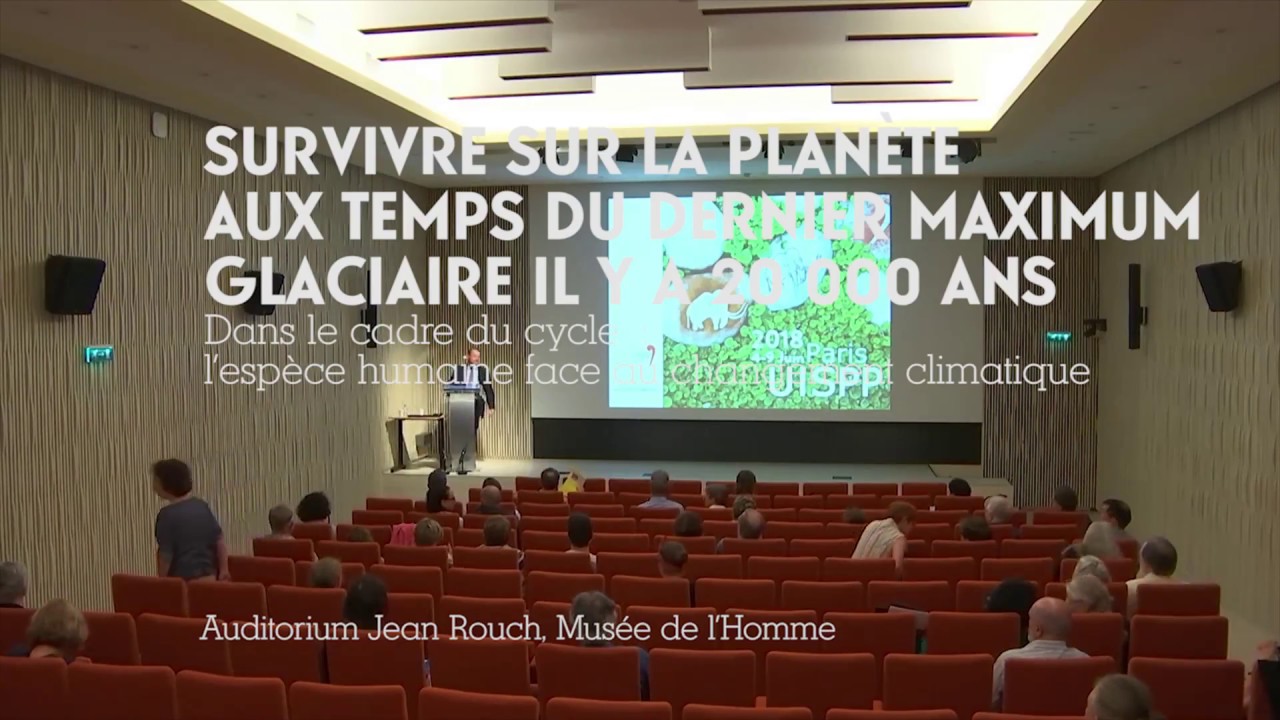
Survivre sur la planète aux temps du dernier maximum glaciaire il y a 20 000 ans
Surviving on the planet during the last glacial maximum 20,000 years ago
Keywords
Summary
137 words
Critical Evaluation
Value of the Information & Strength of the Argument
The lecture provides a comprehensive and detailed overview of human adaptations to climatic fluctuations during the Upper Pleistocene. The argumentation is solid, based on archaeological evidence and paleoclimatic reconstructions. Djindjian presents a nuanced view, challenging simplistic models of Neanderthal replacement and highlighting the dynamism of late Neanderthal cultures. He also discusses methodological issues, such as the reliability of radiocarbon dating beyond 35,000 years and the taphonomic biases in the archaeological record. The speaker’s expertise is evident, and he effectively communicates complex ideas to a non-specialist audience while maintaining scientific rigor.
Scientific Rigor, Source Quality, Title Accuracy
The lecture demonstrates strong scientific rigor, with the speaker referencing ongoing debates and acknowledging uncertainties. He cites specific archaeological sites and cultural complexes (e.g., Châtelperronian, Aurignacian, Gravettian) and discusses genetic and anthropological evidence. The title accurately reflects the content, focusing on the LGM but also providing essential context. The sources are not explicitly cited in the video, but the speaker’s affiliation with CNRS and Paris 1 lends credibility. The description provides a link to a playlist of other lectures, which may contain further references. The title is appropriate and does not overstate the content.
199 words
Title / Content Match
The title accurately reflects the main topic: human survival during the Last Glacial Maximum, with a broader context of the preceding period.
Quality & Reliability
8/10
The lecture is given by a recognized prehistorian from the CNRS and Paris 1 Panthéon-Sorbonne, presenting a synthesis of archaeological and paleoclimatic data. The content is rigorous and nuanced, acknowledging uncertainties and debates. However, it is a conference aimed at a general audience, with some simplifications and a personal viewpoint on certain hypotheses.
Key Moments
Markers derived by PSI from the transcript: the creator did not define chapters.
- Introduction to the Last Glacial Maximum and demographic context
- Description of Marine Isotope Stage 3 and its favorable climate
- Discussion on Neanderthal dynamism and transitional industries
- Emergence of Aurignacian culture and symbolic art
- Onset of the Last Glacial Maximum and population collapse in Europe
- Peopling of Australia and the role of sea-level changes
- Peopling of the Americas and the Clovis debate
- Post-glacial recolonization and the Holocene demographic expansion
Cited Sources
- Playlist of lectures from the Musée de l'Homme — The description provides a link to a playlist of other lectures, which may contain further references.
Concurring Sources
- Wikipedia: Last Glacial Maximum — Provides general information on the LGM, consistent with the lecture's description of glacial conditions.
- Wikipedia: Marine Isotope Stage 3 — Explains the climatic stage that the lecture identifies as a period of human expansion.
Dissenting Sources
Contribution & Novelties
The lecture offers a comprehensive synthesis of human adaptations to the Last Glacial Maximum, integrating archaeological, paleoclimatic, and genetic data. It challenges simplistic narratives of Neanderthal replacement and emphasizes the resilience and dynamism of human populations. The speaker also highlights methodological issues in dating and interpretation, providing a critical perspective on current knowledge.
Pour aller plus loin :
- Last Glacial Maximum — Provides an overview of the climatic period and its global impacts.
- Marine Isotope Stage 3 — Explains the climatic subdivision and its significance for human dispersal.
- Aurignacian — Details the culture associated with early Homo sapiens in Europe and its artistic expressions.
- Peopling of the Americas — Discusses the debates and evidence regarding the first human settlement of the Americas.
122 words
Radar Profile
The radar profile shows high scores in quantity of information and technical level, reflecting the lecture's depth and detail. Quality and reliability are also strong, but slightly lower due to the nature of a general-audience lecture with some personal interpretations.
💬 Très positif. Sur les 30 commentaires analysés, les spectateurs expriment une grande admiration pour la clarté et la passion du conférencier, ainsi que pour la richesse du contenu, malgré quelques remarques sur la qualité du son.