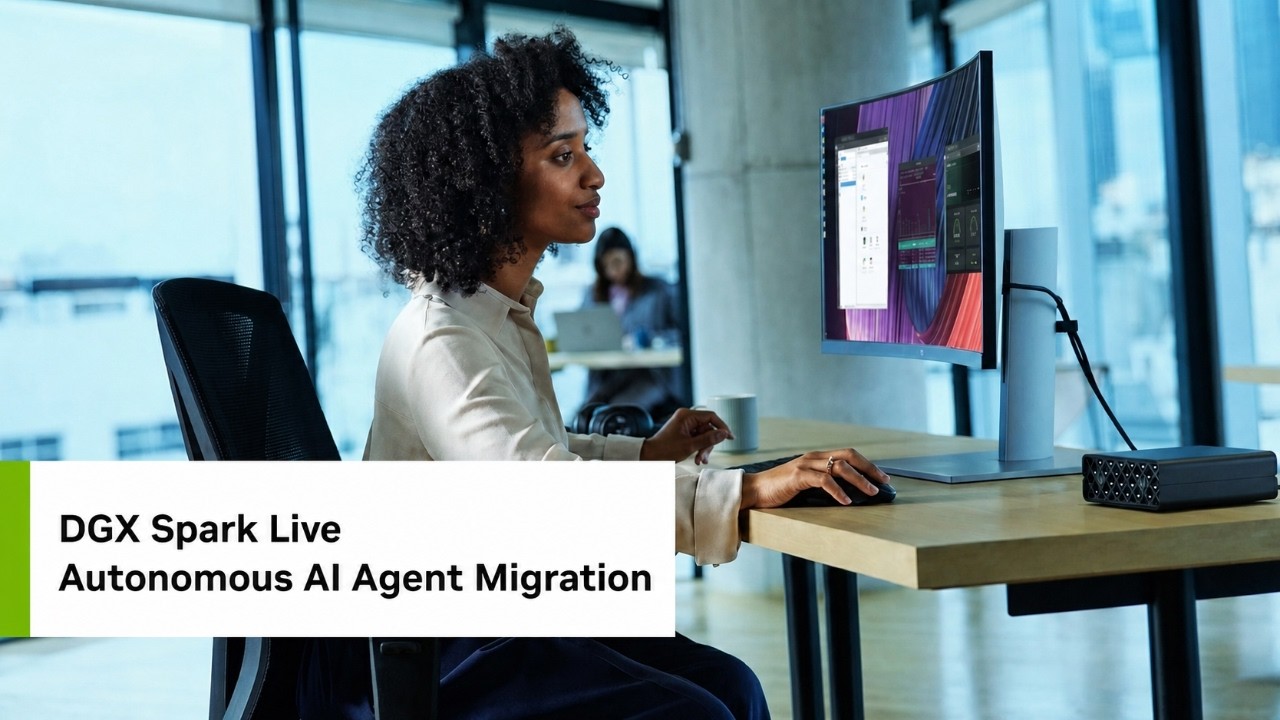
DGX Spark Live: Autonomous AI Agent Migration
Keywords
Summary
159 words
Critical Evaluation
Value of the Information & Strength of the Argument
The video provides a practical, step-by-step tutorial on setting up an autonomous AI agent for code migration, which is valuable for developers interested in local AI workflows. The argumentation is solid, with clear reasoning for each configuration choice, such as increasing the context window to 64K to avoid truncation issues. The presenters demonstrate a ’lie detector’ ritual using Docker logs to verify that the agent actually calls the MCP tools, which strengthens the credibility of the demo. However, the argumentation is largely anecdotal, based on the presenter’s personal experience, and lacks rigorous benchmarking or comparison with alternative approaches. The discussion of trade-offs, such as model selection and the choice between full porting and LLVM-based wrapping, is thoughtful but not exhaustive.
Scientific Rigor, Source Quality, Title Accuracy
The video is a live demo, so it does not cite formal sources. However, the presenters reference specific tools and technologies: NVIDIA NeMoClaw, Arm MCP Server, Qwen3-Coder, and the HP ZGX Nano. The description mentions a blog by Curtis, but no direct URL is provided in the video. The title accurately reflects the content, and the demo is well-structured. The presenters are from Arm and HP, lending some authority, but the content is not peer-reviewed. The video includes a brief mention of the ZGX toolkit, but no detailed sources are given. Overall, the scientific rigor is moderate, with a focus on practical demonstration rather than formal validation.
242 words
Title / Content Match
The title accurately reflects the content: a live demonstration of an autonomous AI agent migrating an x86 application to Arm on DGX Spark hardware.
Quality & Reliability
7/10
The video is a live demo with practical steps, but relies on anecdotal evidence and lacks formal verification. The presenters are from Arm and HP, providing credibility, but the content is not peer-reviewed and includes subjective claims about model reliability.
Key Moments
Markers derived by PSI from the transcript: the creator did not define chapters.
- Introduction and guest introductions
- Setup of NeMoClaw and MCP server
- Configuration of context window and policy
- Verification of MCP server with lie detector test
- Staging the x86 application and initial analysis
- Agent analyzes code and performs migration
- Build and run migrated code, verification
- Q&A: context window management and policy enforcement
- Q&A: local vs cloud, scaling, model selection
- Discussion on alternative approaches and conclusion
Cited Sources
- NVIDIA NeMoClaw — Mentioned as the agent framework used in the demo.
- Arm MCP Server — Used to provide Arm-specific knowledge and tools to the agent.
- Qwen3-Coder — The model used for the agent, running locally via Ollama.
- HP ZGX Nano AI Station — The hardware platform used in the demo.
Concurring Sources
- NVIDIA DGX Spark — The underlying platform for the HP ZGX Nano, providing the compute power.
- Arm Developer Documentation — General reference for Arm architecture and tools, supporting the migration process.
Contribution & Novelties
This video provides a concrete, reproducible example of using an autonomous AI agent to perform a real-world code migration task entirely on-device, which is a relatively novel application. It demonstrates the integration of NVIDIA NeMoClaw with the Arm MCP Server, showing how to configure the agent for reliable tool use and verification. The emphasis on using Docker logs to verify agent actions is a practical contribution. The video also highlights the benefits of local execution, such as privacy and cost predictability, which are relevant for enterprise adoption.
Pour aller plus loin :
- Model Context Protocol (MCP) — Official documentation for MCP, the protocol used by the Arm MCP Server.
- NEON intrinsics — Arm’s SIMD instruction set, central to the migration.
- SSE intrinsics — Intel’s SIMD instructions, the source of the migration.
- Ollama — Local model runner used to serve Qwen3-Coder.
140 words
Radar Profile
The radar profile shows high scores in technical level and information quantity, indicating a detailed and technical tutorial. The quality of information is also high, but the reliability score is slightly lower due to the lack of formal verification and reliance on anecdotal evidence. The overall balance suggests a practical, hands-on resource rather than a rigorous scientific study.
💬 No comments were provided for analysis.