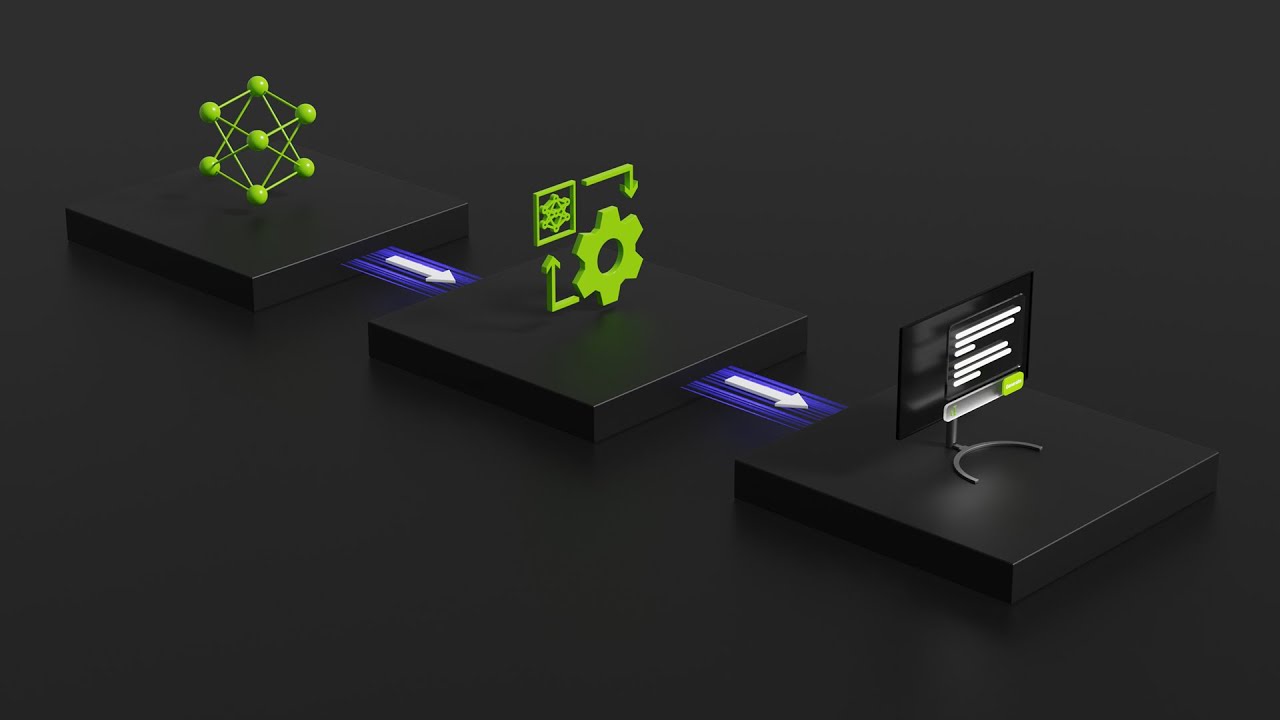
TensorRT LLM 1.0 Livestream: New Easy-To-Use Pythonic Runtime
Keywords
Summary
182 words
Critical Evaluation
Value of the Information & Strength of the Argument
The video provides valuable information for developers and engineers interested in deploying LLMs on NVIDIA hardware. It clearly explains the new Pythonic runtime, emphasizing ease of use and modularity. The argumentation is solid, backed by technical details and demonstrations. The performance claims, such as the 8x improvement, are presented without detailed benchmarks, but they are plausible given NVIDIA’s hardware and software co-optimization. The video effectively argues that TensorRT LLM 1.0 simplifies LLM deployment while maintaining high performance.
Scientific Rigor, Source Quality, Title Accuracy
The video is an official NVIDIA product announcement, so the information is authoritative. The sources cited in the description are official documentation and GitHub repository, which are reliable. The title accurately reflects the content. The presentation is technically rigorous, with clear explanations of the architecture and features. However, as a promotional livestream, it may not include critical evaluation of limitations or comparisons with competing frameworks.
157 words
Title / Content Match
The title accurately reflects the content, which is a livestream introducing the new Pythonic runtime of TensorRT LLM 1.0.
Quality & Reliability
7/10
The video is an official NVIDIA product announcement, providing detailed technical information about TensorRT LLM 1.0. The information is consistent with the official documentation and GitHub repository. However, it is promotional in nature, with performance claims not independently verified.
Key Moments
Markers derived by PSI from the transcript: the creator did not define chapters.
- Introduction to TensorRT LLM 1.0 and its goals
- Overview of three key components: PyTorch model building, Pythonic runtime, and open-source development
- Discussion of performance optimization and co-optimization with hardware
- Explanation of three main ways to interact with TensorRT LLM: CLI, LLM API, and Dynamo
- Technical deep dive: deploying a 120B parameter model using TRT LLM serve
- Demonstration of customizing the runtime with PyTorch and registering custom modules
- Q&A: support for different model architectures, optimization techniques, and hardware compatibility
- Q&A: production deployment, debugging tools, and dynamic input shapes
- Q&A: migration from old architecture, integration with backends, and memory management
Cited Sources
- TensorRT LLM Documentation — Official documentation for TensorRT LLM
- TensorRT LLM GitHub Repository — Source code and development repository
- TensorRT LLM Release Notes — Release notes for TensorRT LLM
- TensorRT LLM Quick Start Guide — Quick start guide for TensorRT LLM
- TensorRT LLM Docs — Comprehensive documentation for TensorRT LLM
Concurring Sources
- TensorRT LLM Documentation — Official documentation aligns with the features described in the video.
- TensorRT LLM GitHub Repository — The repository confirms the open-source nature and Pythonic architecture.
Contribution & Novelties
The video introduces TensorRT LLM 1.0, which represents a significant shift towards a Pythonic and PyTorch-based runtime, making it easier for developers to deploy and customize LLM inference. The main novelty is the modular architecture that allows users to build models in PyTorch and customize the runtime with Python, while still achieving high performance through optimized kernels and runtime components. This approach lowers the barrier to entry for LLM deployment and enables faster iteration.
Pour aller plus loin :
- PyTorch — The underlying framework for the new runtime.
- FlashInfer — A library for integrating kernels, mentioned in the video.
- NVIDIA Dynamo — A tool for orchestrating multi-instance deployments, mentioned in the video.
112 words
Radar Profile
The radar profile shows high scores in quantity of information and technical level, reflecting the detailed technical content. The quality of information and global reliability are slightly lower, likely due to the promotional nature and lack of independent verification. Overall, the video is informative and technically solid, but not without bias.
💬 Sur les 0 commentaires analysés, aucune tendance n'est disponible.