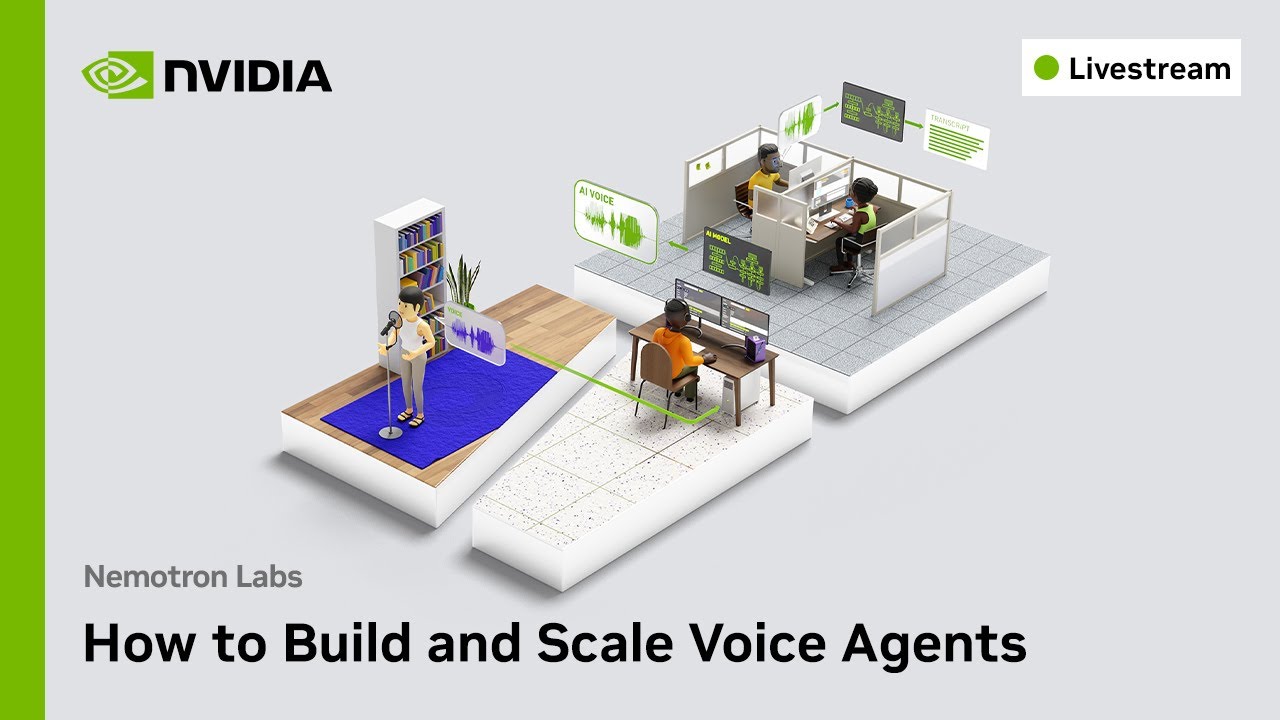
How to Build and Scale Voice Agents Using NVIDIA Nemotron, Modal, and Daily | Nemotron Labs
Keywords
Summary
175 words
Critical Evaluation
Value of the Information & Strength of the Argument
The video provides high practical value for developers interested in building voice agents, offering a step-by-step guide with real code and live demonstrations. The argumentation is solid, grounded in hands-on experience and technical details. The hosts explain the reasoning behind architectural choices, such as running each model as a separate service to allow independent scaling and avoid GPU contention. They also provide a balanced comparison between cascaded pipelines and speech-to-speech models, acknowledging the potential of the latter while justifying the current preference for the former in production due to latency, instruction-following accuracy, and cost. The discussion is well-structured and addresses common concerns, such as information loss in STT and the trade-offs of different model architectures.
Scientific Rigor, Source Quality, Title Accuracy
The scientific rigor is high for a technical tutorial: the hosts demonstrate real working systems and reference open-source projects and documentation. The sources cited are primarily official documentation and repositories from NVIDIA, Modal, and Daily, which are relevant and credible. The title accurately reflects the content, which is a practical guide to building and scaling voice agents. The video does not include formal citations, but the practical demonstrations and references to open-source code provide a solid foundation. The audience comments are not provided, so no analysis of public reception is included.
221 words
Title / Content Match
The title accurately reflects the content, which focuses on building and scaling voice agents using NVIDIA Nemotron, Modal, and Daily.
Quality & Reliability
8/10
High technical quality with live demos and code walkthroughs from industry experts. Claims are supported by practical examples and references to open-source projects. Minor limitations: no formal citations, some claims about model performance are anecdotal.
Key Moments
Markers derived by PSI from the transcript: the creator did not define chapters.
- Live demo of a voice agent using NVIDIA Nemotron, Modal, and Daily.
- Second demo from CES featuring a robot controlled by a voice agent.
- Introduction of guests and discussion of the technology stack.
- Code walkthrough: setting up ASR, LLM, and TTS services on Modal.
- Explanation of PipeCat orchestration and bot implementation.
- Discussion on scaling and concurrency, and the importance of separate services.
- Comparison of cascaded pipelines vs. speech-to-speech models.
- Q&A session addressing audience questions about model selection and latency.
Cited Sources
- Nemotron Voice Agent — Official NVIDIA page for the voice agent demo.
- Nemotron GitHub — Repository for NVIDIA Nemotron models and tools.
- AI Eval — Evaluation framework for voice agents.
- Modal NVIDIA ASR — Modal example for NVIDIA ASR.
- Low Latency Voice Bot — Modal blog post on building low-latency voice bots.
- Building Voice Agents with NVIDIA Open Models — Daily blog post on building voice agents with NVIDIA models.
- Nemotron 3 Nano on HuggingFace — HuggingFace page for Nemotron 3 Nano model.
- Build an AI Agent — NVIDIA learning path for building AI agents.
- Build a RAG Agent — NVIDIA learning path for building RAG agents.
- Nemotron Discord — Discord community for Nemotron developers.
- Developer Resources — NVIDIA developer resources.
- Models & Datasets — NVIDIA models and datasets.
- Community — NVIDIA developer community.
- Tutorials & Livestreams — NVIDIA tutorials and livestreams.
Concurring Sources
- Modal Blog: Low Latency Voice Bot — Supports the discussion on low-latency voice bot architecture.
- Daily Blog: Building Voice Agents with NVIDIA Open Models — Aligns with the video's approach to building voice agents.
Contribution & Novelties
The video provides a practical, hands-on guide to building and scaling voice agents using a combination of NVIDIA Nemotron models, Modal’s serverless infrastructure, and Daily’s real-time communication platform. It demonstrates a working system with live demos and code walkthroughs, offering insights into architectural patterns for low-latency and high-concurrency voice AI. The discussion on cascaded pipelines vs. speech-to-speech models provides a nuanced perspective on current production trade-offs. The video also highlights the importance of using multiple models for different tasks and the benefits of open-source models for self-hosting.
Pour aller plus loin :
- WebRTC — Core technology for real-time audio/video communication used in the demo.
- NVIDIA NIM — Containerized microservices for AI models, central to the deployment.
- Serverless Computing — Concept underlying Modal’s infrastructure.
- Speech-to-Text — Key component of the voice agent pipeline.
- Text-to-Speech — Key component of the voice agent pipeline.
141 words
Radar Profile
The radar profile shows high scores across all dimensions, indicating a well-rounded technical tutorial with strong information content, quality, technical depth, and reliability. The video excels in providing practical, actionable knowledge.