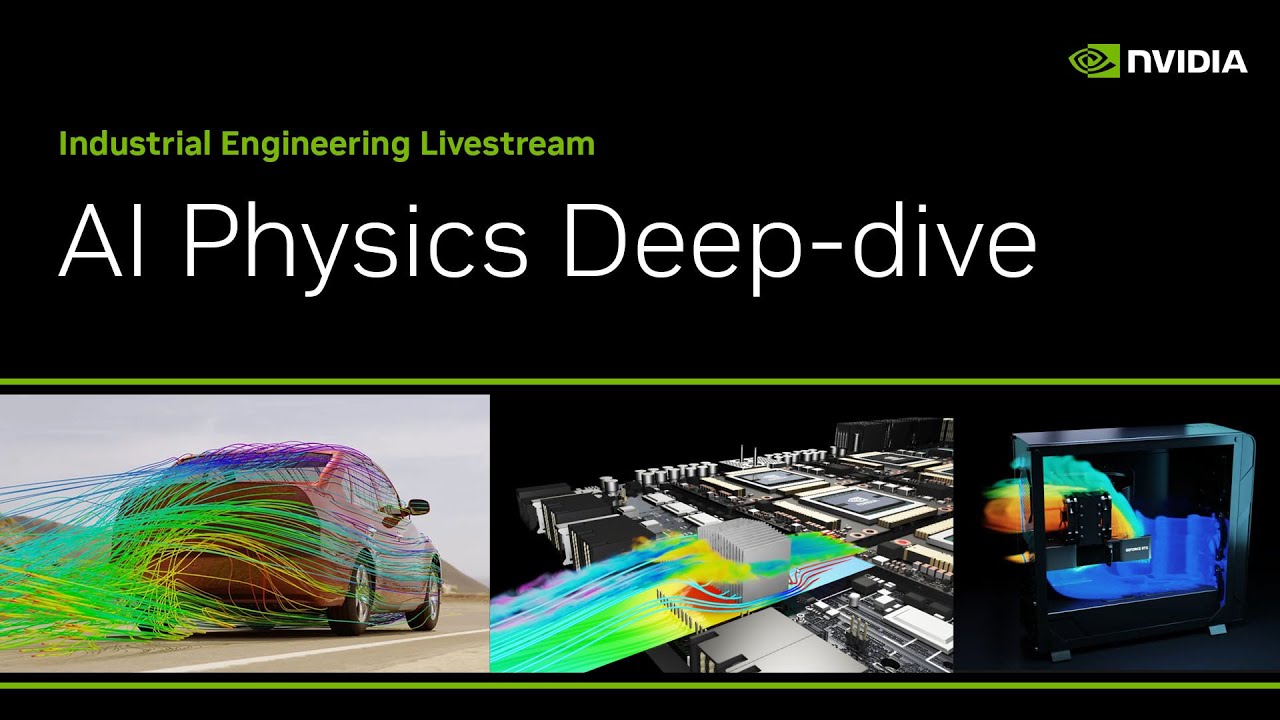
AI Physics Deep Dive | Industrial Engineering Live Stream Series
Keywords
Summary
143 words
Critical Evaluation
Value of the Information & Strength of the Argument
The video provides valuable insights into the practical application of AI in engineering, specifically through NVIDIA’s PhysicsNeMo framework. The hosts effectively argue for the importance of hybrid models that combine data-driven and physics-based approaches, addressing the limitations of purely data-driven methods due to data scarcity. The demonstration is clear and well-structured, offering a step-by-step guide that is both informative and actionable. The argumentation is solid, grounded in the presenters’ expertise and the framework’s capabilities, though it is inherently promotional, which may introduce bias. The discussion of different model architectures (graph nets, neural operators, transformers) is concise but sufficient for an introductory audience.
Scientific Rigor, Source Quality, Title Accuracy
The video maintains a high level of scientific rigor, with the presenters clearly explaining the technical aspects of AI physics and the PhysicsNeMo framework. They reference the open-source DriveML dataset and the OpenFOAM solver, providing a basis for reproducibility. The sources cited in the description (NVIDIA blog and DLI course) are relevant and authoritative. The title accurately reflects the content, and the video stays on topic throughout. The presenters are knowledgeable and transparent about the limitations and trade-offs of different approaches. However, as a promotional live stream, it may not fully address alternative viewpoints or potential drawbacks of the framework.
217 words
Title / Content Match
The title accurately reflects the content: a deep dive into AI physics for industrial engineering, focusing on NVIDIA PhysicsNeMo.
Quality & Reliability
8/10
The video is a live tutorial by NVIDIA engineers, demonstrating the use of PhysicsNeMo for AI-driven engineering simulations. It provides a clear, step-by-step walkthrough of the framework, including data curation, training, and inference. The content is technically accurate and aligns with NVIDIA's official documentation and resources. However, as a promotional live stream, it may present a biased perspective, and the depth of explanation is limited by time constraints.
Key Moments
Markers derived by PSI from the transcript: the creator did not define chapters.
- Introduction and recap of the real-time digital twin demo.
- Discussion on traditional physics-based modeling vs. AI surrogates.
- Overview of different AI architectures: graph nets, neural operators, transformers.
- Introduction to PhysicsNeMo framework and its components.
- Data curation with PhysicsNeMo Curator.
- Training a Domino model with hybrid physics-based losses.
- Inference and benchmarking with PhysicsNeMo CFD.
- Conclusion and Q&A.
Cited Sources
- How to Run AI-Powered CAE Simulations — Referenced as a resource for learning more about AI-powered CAE simulations.
- NVIDIA DLI Course: AI Physics — Mentioned as a practical implementation resource.
Concurring Sources
- PhysicsNeMo Documentation — Official documentation for the framework, consistent with the video's content.
Contribution & Novelties
The video offers a practical, hands-on introduction to NVIDIA’s PhysicsNeMo framework, demonstrating how to train and deploy AI surrogate models for industrial engineering applications. It bridges the gap between theoretical discussions of AI physics and real-world implementation, providing a valuable resource for engineers. The emphasis on hybrid physics-based training and the availability of benchmarking tools are notable contributions.
Pour aller plus loin :
- PhysicsNeMo GitHub — Official repository with documentation and examples.
- Neural Operators — Overview of neural operators, a key architecture discussed.
- Graph Neural Networks — Background on GNNs used in mesh-based models.
94 words
Radar Profile
The radar profile shows high scores in information quantity, quality, and reliability, with a slightly lower technical depth, reflecting the tutorial's practical focus. The video is well-balanced, offering both theoretical context and hands-on guidance.
💬 Sur les 0 commentaires analysés, aucune tendance n'est disponible.