CUDA 13.0—New Features and Beyond | NVIDIA GTC D.C.
Keywords
Summary
115 words
Critical Evaluation
Value of the Information & Strength of the Argument
The talk provides valuable insights into CUDA 13.0’s new features and the strategic direction of the CUDA platform. Armstrong’s arguments are well-structured, emphasizing the need for memory management flexibility, portability across architectures, and improved developer productivity. He convincingly argues that the tile programming model addresses the challenges of evolving tensor cores and the complexity of low-level GPU programming. The presentation is persuasive, backed by concrete examples and a clear rationale for the programming model shift.
Scientific Rigor, Source Quality, Title Accuracy
The talk is a primary source from an NVIDIA technical lead, lending high credibility. However, it is essentially an expert opinion and product announcement, not peer-reviewed research. The title accurately reflects the content. No external sources are cited beyond NVIDIA’s on-demand platform, which is appropriate for a product talk. The presentation is technically rigorous, with detailed explanations of memory management and programming model changes.
154 words
Title / Content Match
The title accurately reflects the content, which focuses on CUDA 13.0 new features and future directions.
Quality & Reliability
8/10
Presentation by NVIDIA's CUDA Technical Product Management Lead, providing authoritative insights into CUDA 13.0 features and future directions. Technical details are consistent with NVIDIA's public roadmap, but some claims (e.g., performance improvements) are not independently verified.
Key Moments
Markers derived by PSI from the transcript: the creator did not define chapters.
- Introduction to CUDA 13.0 and its significance as a major release.
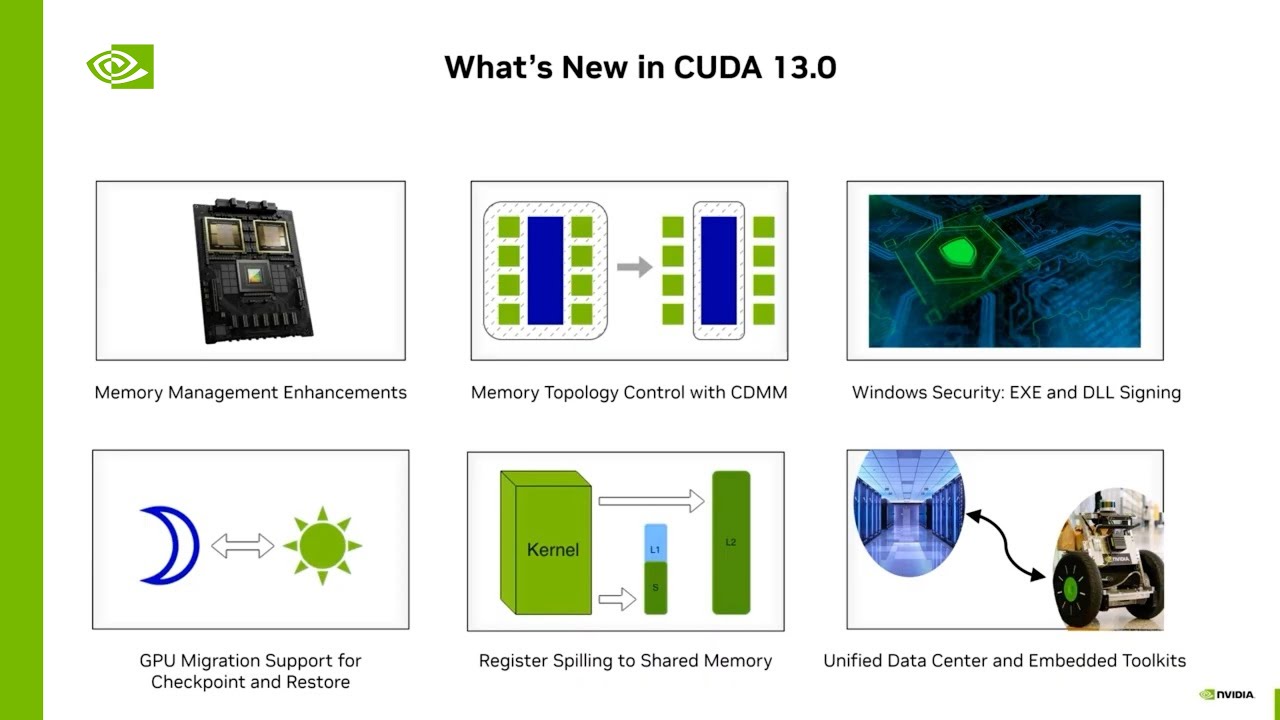
- Memory management enhancements: managed memory discard, UVM, memory allocators, and CDMM.
- Windows signing and checkpoint/restore improvements.
- Unification of embedded and data center platforms.
- Introduction to the tile programming model and its benefits.
- Comparison of tile programming with CUTLASS and SIMT.
- CUDA Tile IR and runtime code generation.
- Cluster-scale orchestration and deterministic scheduling.
- Efforts to improve CUDA education and onboarding.
Cited Sources
- NVIDIA On-Demand — Mentioned as a resource for watching more NVIDIA sessions.
Concurring Sources
- CUDA 13.0 Release Notes — Official release notes for CUDA 13.0, confirming the features mentioned in the talk.
Contribution & Novelties
The talk provides an authoritative overview of CUDA 13.0’s new features and the strategic direction of the CUDA platform, particularly the introduction of the tile programming model and CUDA Tile IR. It offers insights into NVIDIA’s approach to improving developer productivity and portability across GPU architectures.
Pour aller plus loin :
- CUDA Programming Guide — Official documentation for CUDA programming.
- CUTLASS — NVIDIA’s open-source library for high-performance linear algebra on GPUs.
- Numba — A JIT compiler for Python that translates a subset of Python and NumPy code into fast machine code, often used for GPU programming.
96 words
Radar Profile
The radar profile shows high scores across all dimensions, indicating a technically dense and reliable presentation. The talk is rich in information, technically advanced, and credible, with a strong emphasis on future directions.
💬 No comments were provided for analysis.