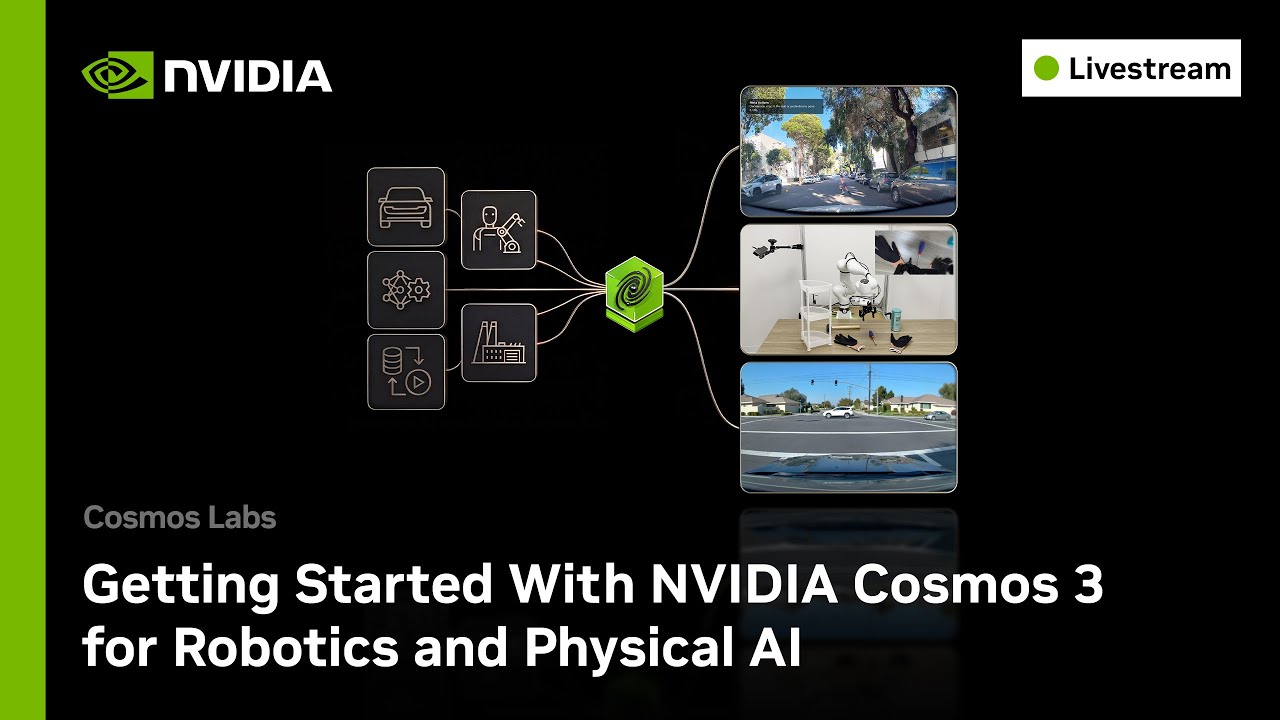
Getting Started with NVIDIA Cosmos 3 for Robotics and Physical AI | Cosmos Labs
Keywords
Summary
181 words
Critical Evaluation
Value of the Information & Strength of the Argument
The video provides substantial value by demystifying a complex AI platform. It clearly explains the problem of data scarcity in physical AI and positions Cosmos 3 as a solution. The argumentation is solid, grounded in the model’s architecture and benchmark results. The speakers effectively convey the platform’s capabilities and open-source nature, making a compelling case for its adoption. However, the presentation is inherently promotional, and the lack of independent evaluation or critical discussion of limitations slightly weakens the argumentation.
Scientific Rigor, Source Quality, Title Accuracy
The scientific rigor is high, as the content is presented by NVIDIA engineers and product managers who are directly involved in the development. The sources cited include the Cosmos 3 technical paper, GitHub repositories, and Hugging Face model cards, all of which are authoritative. The title accurately reflects the content, which is a tutorial-style introduction. The video does not include any sponsored segments. The live chat comments are generally positive, with viewers expressing interest and asking technical questions, indicating a engaged audience.
176 words
Title / Content Match
The title accurately reflects the content: a practical introduction to NVIDIA Cosmos 3 for robotics and physical AI, covering setup, capabilities, and workflows.
Quality & Reliability
8/10
The video is an official NVIDIA developer livestream, featuring product managers and technical marketing engineers. It provides detailed technical information about the Cosmos 3 platform, including architecture, use cases, and open-source resources. The content is consistent with NVIDIA's official documentation and the model's technical paper, and the speakers demonstrate deep expertise. Minor promotional tone and lack of independent verification slightly reduce the score.
Key Moments
Markers derived by PSI from the transcript: the creator did not define chapters.
- Introduction and welcome by host, setting the stage for the livestream.
- Pranjali Joshi introduces herself and the Cosmos platform, discussing the data scarcity problem in physical AI.
- Overview of the Cosmos 3 model: omni-modal capabilities, mixture-of-transformers architecture, and model sizes.
- Discussion of the open-source license (OpenMDW 1.1) and available model variants on Hugging Face.
- Asavari takes over to demonstrate the Cosmos framework, curator, and evaluator repositories on GitHub.
- Deep dive into the Cosmos framework repo, showing how to run inference and post-training.
- Explanation of Cosmos Curator for data processing and Cosmos Evaluator for model evaluation.
- Live Q&A session addressing viewer questions about integration with Omniverse and real-world applications.
- Wrap-up and encouragement for developers to start using Cosmos 3.
Cited Sources
- NVIDIA Cosmos GitHub Repository — Main repository for Cosmos platform, including model cards and documentation.
- Cosmos Framework GitHub Repository — Repository for inference and post-training scripts.
- Cosmos Curator GitHub Repository — Repository for data curation and processing pipelines.
- Cosmos Evaluator GitHub Repository — Repository for evaluating generated data and models.
- Cosmos 3 Model on Hugging Face — Model card for Cosmos 3 Nano variant.
Concurring Sources
- NVIDIA Cosmos 3 Technical Paper — The technical paper describing the architecture and training of Cosmos 3, referenced in the video.
Contribution & Novelties
The video provides a comprehensive introduction to NVIDIA Cosmos 3, highlighting its omni-modal capabilities and the mixture-of-transformers architecture, which is a novel approach for world models. It emphasizes the open-source nature and the availability of extensive data and frameworks, enabling developers to post-train the model for specific applications. The session also demonstrates practical use cases, such as construction robotics, and provides guidance on using the associated GitHub repositories.
Pour aller plus loin :
- World Models in AI — Overview of world models and their applications.
- Mixture of Experts — Background on the mixture-of-experts architecture, related to the mixture-of-transformers used in Cosmos 3.
- NVIDIA Omniverse — Platform for 3D simulation and digital twins, often used with Cosmos for physical AI.
- Robotics and Physical AI at NVIDIA — Official NVIDIA developer resources for robotics and physical AI.
135 words
Radar Profile
The radar profile shows high scores in information quantity, quality, and reliability, with a slightly lower technical level, reflecting the tutorial nature of the video. The content is well-structured and authoritative, but the technical depth is moderate, suitable for a broad developer audience.
💬 Sur les 307 commentaires analysés, les tendances montrent un intérêt marqué pour les applications concrètes de Cosmos 3, notamment dans la robotique et la construction, ainsi que des questions techniques sur l'intégration avec Omniverse et les options de post-entraînement.