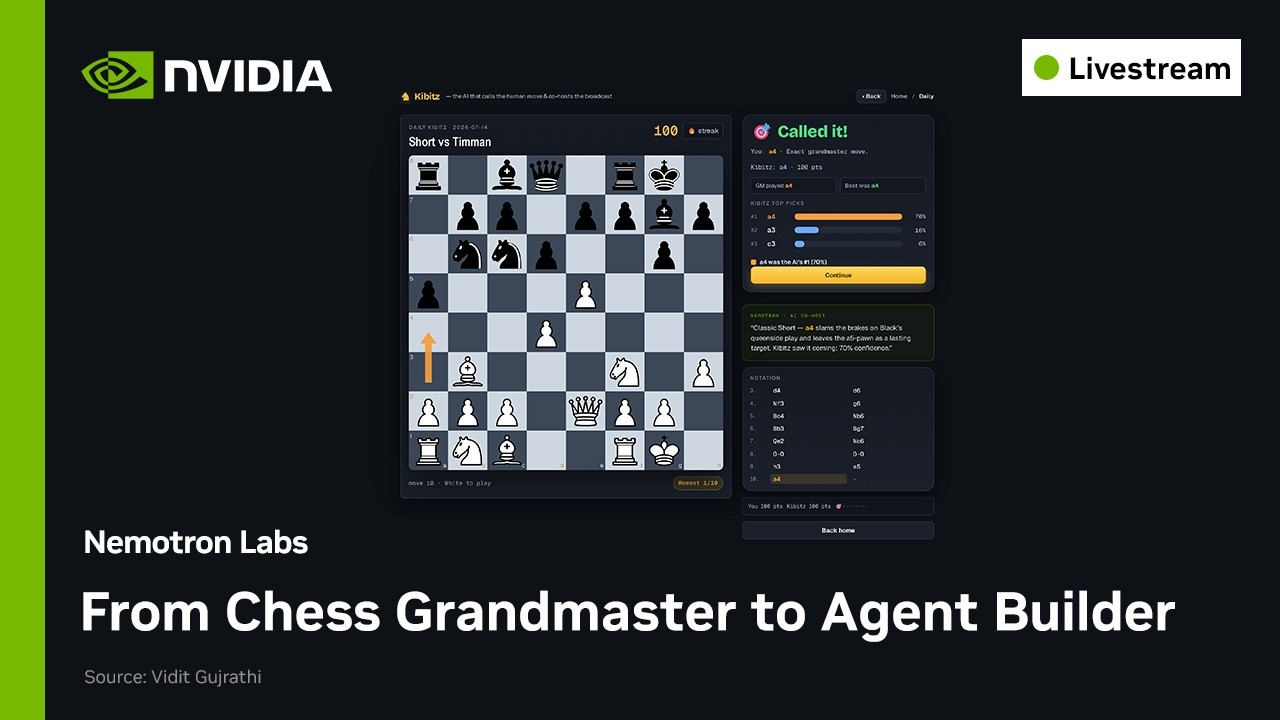
How a Chess Grandmaster Built an Autonomous Business | Nemotron Labs
Keywords
Summary
173 words
Critical Evaluation
Value of the Information & Strength of the Argument
The video provides valuable insights into the practical application of AI in a niche domain. Vidit’s approach to training a model to predict human moves is innovative and well-argued, with clear reasoning for why this is useful. He effectively demonstrates the value of combining domain expertise with AI tools. The argumentation is solid, though it relies heavily on personal experience and anecdotal evidence rather than rigorous scientific data. The discussion on local AI and privacy is thoughtful and adds depth to the conversation.
Scientific Rigor, Source Quality, Title Accuracy
The scientific rigor is moderate. The video is an expert interview rather than a formal presentation of research. Vidit mentions specific tools and models (e.g., Leela Chess, Stockfish, Hermes Agent, Nemotron) but does not provide detailed technical documentation or citations. The title accurately reflects the content, and the video is well-structured. No comments were provided, so no analysis of public reception is possible.
161 words
Title / Content Match
The title accurately reflects the content: the video focuses on how Vidit Gujrathi built an autonomous business using AI, with a strong emphasis on the technical and business aspects.
Quality & Reliability
7/10
The content is an expert interview with a chess grandmaster discussing his AI project. It provides practical insights into model training and agent design, but lacks formal citations and rigorous scientific validation. The information is credible based on the speaker's expertise and the live demonstration, but it is primarily anecdotal and promotional.
Key Moments
Markers derived by PSI from the transcript: the creator did not define chapters.
- Vidit introduces the inspiration for the project: the desire to predict human grandmaster moves rather than engine moves.
- Vidit demonstrates the Kibitz tool on a live game, showing the human move prediction and the prediction bar.
- Discussion on problem decomposition and Vidit's approach to learning new technologies by breaking them down to fundamentals.
- Vidit explains the software stack: the model is a pure transformer trained from scratch on human games, and he plans to integrate an LLM for commentary.
- Vidit discusses the fine-tuning process with Leela Chess and why it was not as effective as training from scratch.
- The conversation shifts to the importance of human-like qualities in AI, using chess as an example.
- Vidit talks about the potential for AI commentary in chess and the need for tools to verify legal moves.
- Vidit shares his personal AI stack and his preference for using multiple models for different tasks.
- Discussion on the importance of local AI for privacy and customization, with Vidit explaining his reasons.
- The host and Vidit discuss the role of chess as a testing ground for AI and the future of autonomous AI businesses.
Cited Sources
- Leela Chess Zero — Vidit mentions fine-tuning a Leela Chess model, an open-source chess engine based on AlphaZero.
- Stockfish — Vidit compares his model's predictions to Stockfish, a popular chess engine.
- Hermes Agent — Vidit used Hermes Agent, developed by Nous Research, to build the autonomous business layer.
- NVIDIA Nemotron — The agent uses Nemotron as a reasoning and narration layer.
Concurring Sources
- Leela Chess Zero — Vidit's use of Leela Chess aligns with the open-source community's efforts to create strong chess engines.
- NVIDIA Nemotron — The video is hosted by NVIDIA Developer, and Nemotron is a key component of the project.
Dissenting Sources
- Stockfish — Vidit's model intentionally deviates from Stockfish's optimal moves, so the two are not directly comparable in terms of objectives.
Contribution & Novelties
The video offers a unique perspective on applying AI to chess by focusing on human-like move prediction rather than optimal play. This approach could be extended to other domains where human touch is valued. The discussion on building an autonomous business with AI agents is also insightful, highlighting the practical steps and considerations.
Pour aller plus loin :
- AlphaZero — The algorithm behind Leela Chess, which uses self-play and reinforcement learning.
- Transformer architecture — The basis of the model Vidit trained from scratch.
- Reinforcement learning — Mentioned as a potential method to improve AI commentary.
- AI alignment — Relevant to the discussion of making AI more human-like.
107 words
Radar Profile
The radar profile shows high scores in information quantity and quality, with moderate technical depth and reliability. This indicates a well-rounded but not deeply technical discussion, suitable for a general audience interested in AI applications.