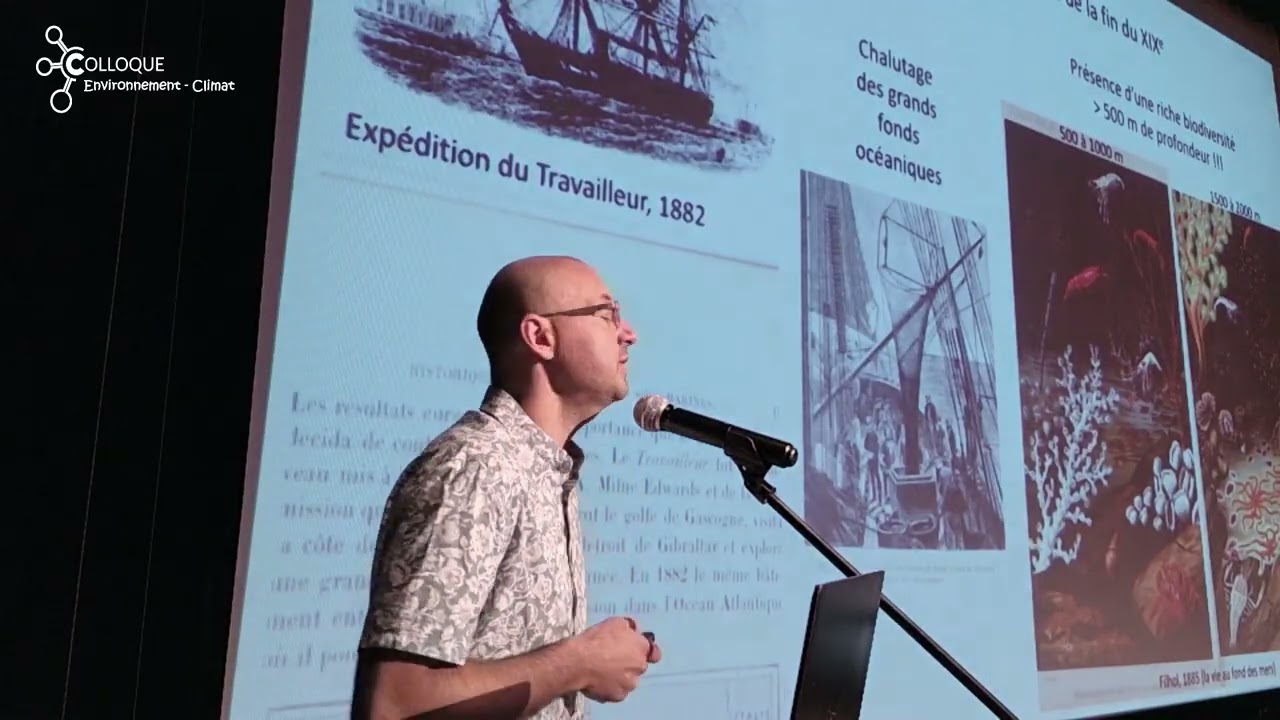
Rupture climatique et pressions cumulées sur les coraux profonds...
Keywords
Summary
150 words
Critical Evaluation
Value of the Information & Strength of the Argument
The presentation provides valuable insights into the often-overlooked deep-sea ecosystems and their vulnerability to climate change. The argumentation is solid, based on observational data and projections from scientific sources. The speaker effectively connects local observations (e.g., temperature records from Banyuls) to broader global trends, and explains complex processes like water mass stratification and ocean acidification in an accessible manner. The ecological and economic importance of cold-water corals is well-argued, highlighting their role as biodiversity hotspots and support for fisheries. However, the talk is more descriptive than analytical, and the restoration aspect mentioned in the title is only briefly touched upon, without concrete examples or methods.
Scientific Rigor, Source Quality, Title Accuracy
The scientific rigor is high, as the speaker is a researcher from Sorbonne University and references ongoing monitoring programs and recent discoveries. The sources are not explicitly cited in the video, but the data presented (e.g., from Meteo France, Oceanographic Observatory of Banyuls) are credible. The title accurately reflects the content, focusing on climate disruption and cumulative pressures on deep-sea corals, with a nod to restoration possibilities. The talk is well-structured and stays on topic. No comments were provided for analysis.
201 words
Title / Content Match
The title accurately reflects the content, focusing on climate disruption and cumulative pressures on deep-sea corals, with a discussion on restoration possibilities.
Quality & Reliability
8/10
Presentation by a researcher from Sorbonne University, based on observational data and projections, with references to ongoing research and monitoring programs. Some technical details are simplified for a general audience, but the core information is scientifically sound.
Key Moments
Markers derived by PSI from the transcript: the creator did not define chapters.
- Introduction to climate change impacts on deep-sea environments, focusing on Mediterranean as a hotspot.
- Presentation of temperature anomalies from Meteo France station and oceanographic data showing warming trends.
- Discussion on deep water warming, with data showing 0.5°C increase at 500m since 2014.
- Explanation of reduced deep water convection and its consequences for nutrient supply.
- Overview of ocean acidification and deoxygenation impacts on deep-sea ecosystems.
- Historical context: discovery of life in deep sea via telegraph cables, leading to scientific expeditions.
- Introduction to cold-water corals as ecosystem engineers, with examples from Mediterranean and Atlantic.
- Comparison of tropical and deep-sea coral reefs, highlighting similar functions and large-scale structures.
- Economic importance: deep-sea corals support commercial fisheries, with examples from Mauritania and Norway.
- Other ecosystem services: carbon storage, pharmaceutical potential, and paleoclimate archives.
Cited Sources
- Météo-France — Cited for regional temperature anomaly data from the Rivesaltes station.
- Observatoire Océanologique de Banyuls-sur-Mer — Cited for long-term temperature measurements in the Mediterranean.
Concurring Sources
- IPCC Special Report on the Ocean and Cryosphere in a Changing Climate — Provides scientific evidence on ocean warming, acidification, and impacts on marine ecosystems, consistent with the talk.
Contribution & Novelties
The presentation provides a comprehensive overview of the current state of knowledge on deep-sea corals and their vulnerability to climate change, synthesizing recent observations and projections. It emphasizes the rapid warming of deep waters, which is often overlooked, and highlights the ecological and economic importance of these ecosystems. The talk also underscores the need for further research and potential restoration efforts, though specific restoration techniques are not detailed.
Pour aller plus loin :
- Deep-sea coral — Overview of deep-sea corals, their biology, and distribution.
- Ocean acidification — Explanation of the process and its impacts on marine life.
- Mediterranean Sea — Context on the Mediterranean as a climate change hotspot.
109 words
Radar Profile
The radar profile shows high scores in quantity and quality of information, and moderate technical level, indicating a well-balanced presentation suitable for a general audience. The reliability is high, reflecting the scientific background of the speaker.