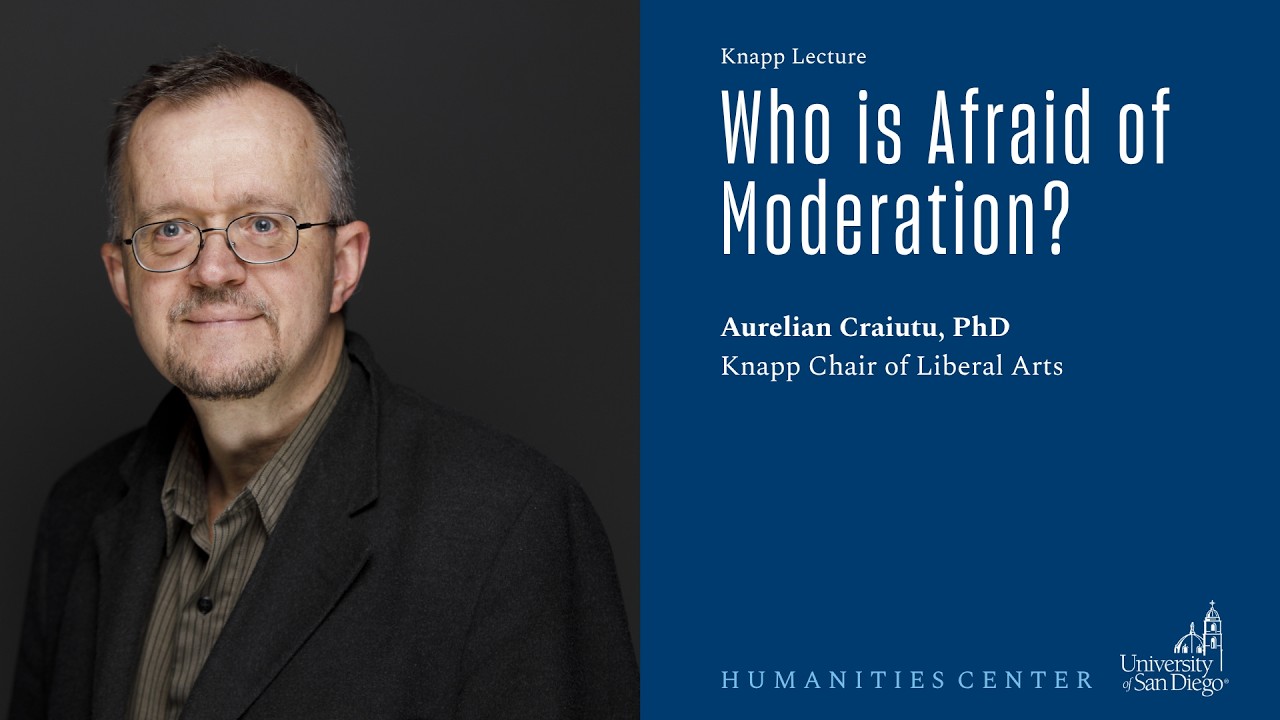
Knapp: Who is Afraid of Moderation? - Aurelian Craiutu, PhD
Keywords
Summary
142 words
Critical Evaluation
Value of the Information & Strength of the Argument
The lecture provides a rich historical overview of the concept of moderation, drawing on a wide range of sources from Confucius to Montesquieu and the Federalist Papers. The argument is well-structured, moving from the problem of moderation’s bad reputation to its classical and modern defenses. Craiutu effectively counters criticisms by distinguishing between moderation as a personal virtue and as an institutional principle. However, the argumentation is primarily historical and descriptive rather than analytical; he does not deeply engage with contemporary political science literature on polarization or moderation. The value lies in its synthesis of historical sources and its clear articulation of moderation’s multifaceted nature.
Scientific Rigor, Source Quality, Title Accuracy
The lecture demonstrates high scholarly rigor, with references to primary texts and historical figures. Craiutu cites specific works such as Aristotle’s Nicomachean Ethics, Montesquieu’s Spirit of the Laws, and the Federalist Papers, though without precise citations. The sources are credible and relevant. The title accurately reflects the content, as the lecture directly addresses the fear of moderation and its historical context. The lecture is an expert opinion, not a peer-reviewed study, but it is grounded in extensive scholarship.
197 words
Title / Content Match
The title accurately reflects the content: the lecture directly addresses the question 'Who is afraid of moderation?' and explores the concept's history and relevance.
Quality & Reliability
8/10
The lecture is delivered by a recognized scholar (Arthur F. Bentley Professor of Political Science) with extensive publications on moderation. The content is well-structured, historically grounded, and references primary sources (Aristotle, Montesquieu, Federalist Papers). However, it is an opinion/expert lecture, not peer-reviewed, and lacks direct citations to specific editions or page numbers.
Key Moments
Markers derived by PSI from the transcript: the creator did not define chapters.
- Introduction by Katherine Statatler and Brian Clack, introducing Aurelian Craiutu.
- Craiutu begins his lecture, posing the question 'Who needs moderation today?' and discussing the current political climate.
- Discussion of the negative image of moderation, citing Barry Goldwater and Rush Limbaugh.
- Craiutu introduces the classical roots of moderation, including Aristotle's golden mean and Confucius's doctrine of the mean.
- Exploration of early modern thinkers: Montaigne, Pascal, and Joseph Hall's definition of moderation as 'the silken string that runs through the pearl chain of all virtues.'
- Discussion of the Enlightenment and Montesquieu's concept of moderate government and the separation of powers.
- Craiutu connects moderation to the American Founding, referencing the Federalist Papers and George Washington's Farewell Address.
- Summary of the three components of moderation: ethical, institutional, and stylistic.
- Craiutu addresses the criticism that moderation is not democratic enough, referencing Martin Luther King Jr.'s Letter from Birmingham Jail.
- Conclusion: Craiutu argues that moderation is a complex virtue that requires historical analysis and remains relevant today.
Cited Sources
- Nicomachean Ethics — Aristotle's discussion of the golden mean as a virtue.
- The Spirit of the Laws — Montesquieu's definition of moderate government and the separation of powers.
- The Federalist Papers — References to moderation in the context of checks and balances.
- Letter from Birmingham Jail — Martin Luther King Jr.'s criticism of moderate white men.
- Faces of Moderation — Craiutu's own book on the topic.
Concurring Sources
- Why Not Moderation? — Craiutu's latest book, which argues for the viability of moderation in times of polarization.
Dissenting Sources
- Letter from Birmingham Jail — Martin Luther King Jr. criticizes the 'white moderate' for being more devoted to order than to justice, which challenges the value of moderation in the face of injustice.
Contribution & Novelties
The lecture offers a comprehensive historical synthesis of the concept of moderation, highlighting its ethical, institutional, and stylistic dimensions. It argues that moderation is not merely a personal virtue but also a principle of institutional design, as seen in mixed government and checks and balances. This perspective is valuable in the context of contemporary political polarization.
Pour aller plus loin :
- Moderation (political) — Wikipedia article providing an overview of moderation in politics.
- Mixed government — Wikipedia article on the concept of mixed government, central to Craiutu’s argument.
- The Federalist Papers — Wikipedia article on the Federalist Papers, which Craiutu references as a key source for moderation in American political thought.
111 words
Radar Profile
The radar profile shows high scores in information quantity, quality, and reliability, reflecting the lecture's rich historical content and scholarly grounding. The technical level is moderate, making it accessible to a general academic audience. The overall profile indicates a well-rounded, credible presentation.
💬 Sur les 0 commentaires analysés, aucune tendance n'est disponible.