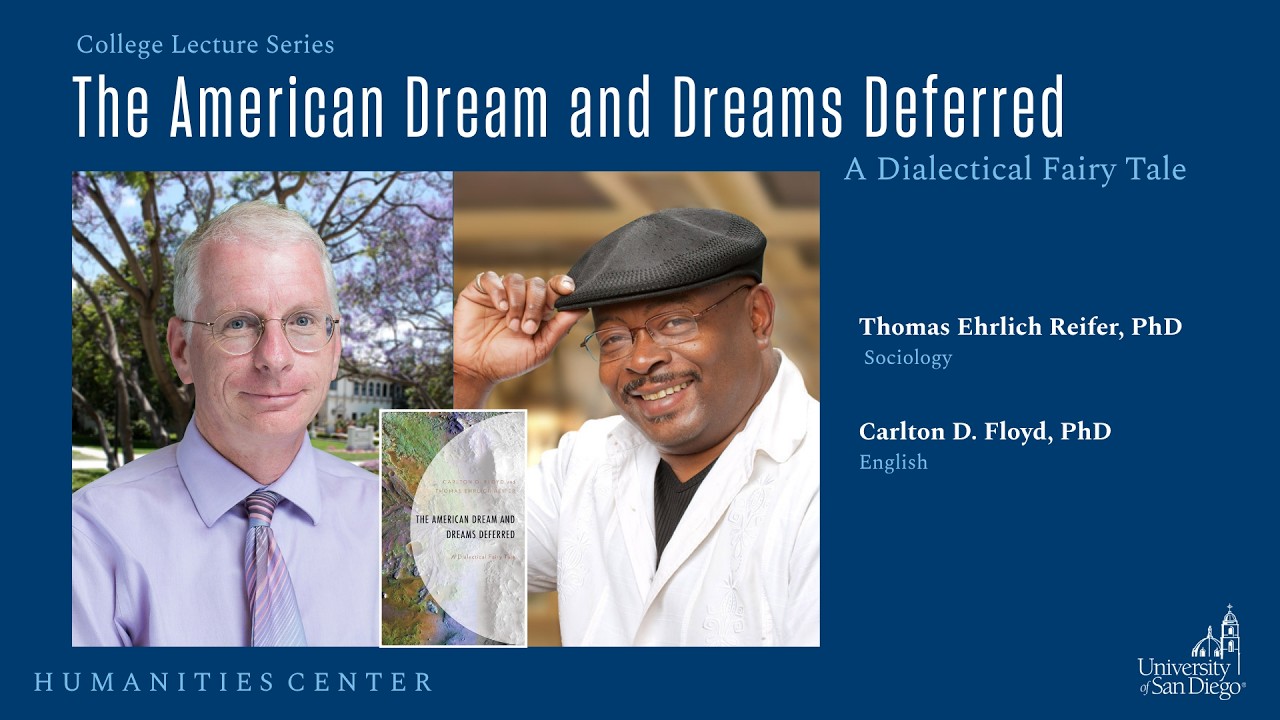
College Lecture Series: The American Dream and Dreams Deferred
Keywords
Summary
121 words
Critical Evaluation
Value of the Information & Strength of the Argument
The lecture provides valuable insights into the American Dream from an interdisciplinary perspective, combining literary analysis with sociological theory. The speakers argue that the American Dream is inherently contradictory, often excluding certain groups, and they support this with historical evidence and literary examples. The argumentation is solid, as they draw on well-known scholars and texts, and they present a nuanced view that acknowledges both the possibility and the deferral of the dream. The collaborative approach between an English professor and a sociologist enriches the discussion, offering a unique lens. However, the lecture is more of an overview of their book rather than a deep dive into specific evidence, which might limit its depth for a specialized audience.
Scientific Rigor, Source Quality, Title Accuracy
The lecture demonstrates scientific rigor through the use of primary sources such as the works of Langston Hughes, Gwendolyn Brooks, and James Truslow Adams, as well as theoretical frameworks from Walter Benjamin and Immanuel Wallerstein. The speakers are credible academics, and the content is well-structured. The title accurately reflects the content, which is a lecture on the American Dream and its deferred realization. The lecture does not include citations to external sources beyond those mentioned in the description, but the references to literature and theory are appropriate. The discussion of the book’s reception, including Chomsky’s praise, adds to its credibility. The title is appropriate, and the content aligns with it.
242 words
Title / Content Match
The title accurately reflects the content, which is a lecture on the American Dream and its deferred realization, as discussed in the book.
Quality & Reliability
8/10
The lecture is delivered by two professors with strong academic credentials, and the content is grounded in their book, which has been praised by Noam Chomsky. The arguments are supported by references to historical and literary sources, and the interdisciplinary approach is methodologically sound.
Key Moments
Markers derived by PSI from the transcript: the creator did not define chapters.
- Introduction of the speakers and their book by the host.
- Carlton Floyd discusses the origins of the American Dream and its exclusionary nature.
- Floyd reads Langston Hughes's poem 'Harlem' and discusses its relevance.
- Thomas Reifer talks about the interdisciplinary approach and the influence of Immanuel Wallerstein.
- Discussion of the elective affinities between Frederick Douglass and Walter Benjamin.
- Exploration of the American Civil War and different versions of the American Dream.
- Introduction of the concept of multidirectional memory and its application.
- Conclusion and call for a new collective dream based on social justice and sustainability.
Cited Sources
- The American Dream and Dreams Deferred: A Dialectical Fairy Tale — The book authored by the speakers, which is the main subject of the lecture.
- Montage of a Dream Deferred — A work by Langston Hughes that includes the poem 'Harlem' and is referenced in the lecture.
- One-Way Street — A book by Walter Benjamin, mentioned in the lecture for its connection to Langston Hughes's 'One-Way Ticket'.
- The Epic of America — A book by James Truslow Adams, which popularized the term 'American Dream' and is discussed in the lecture.
Concurring Sources
- The American Dream and Dreams Deferred: A Dialectical Fairy Tale — The book itself, which aligns with the lecture's content.
Contribution & Novelties
The lecture offers a novel interdisciplinary perspective on the American Dream by combining literary analysis with world-systems theory. It highlights the dialectical tensions within the concept and brings together voices that are rarely in dialogue, such as Frederick Douglass and Walter Benjamin. The book’s approach of using montage and collage as a method is innovative, and the call for a new collective dream based on social justice and ecological sustainability is timely.
Pour aller plus loin :
- World-systems theory — Provides background on the theoretical framework used by Reifer.
- Langston Hughes — Key literary figure discussed in the lecture.
- Walter Benjamin — Philosopher whose ideas on montage and aesthetics are central to the book.
114 words
Radar Profile
The radar profile shows high scores in quality of information and reliability, reflecting the academic rigor and credibility of the speakers. The quantity of information is also high, but the technical level is moderate, indicating that the content is accessible to a general audience. The overall balance suggests a well-rounded and trustworthy presentation.