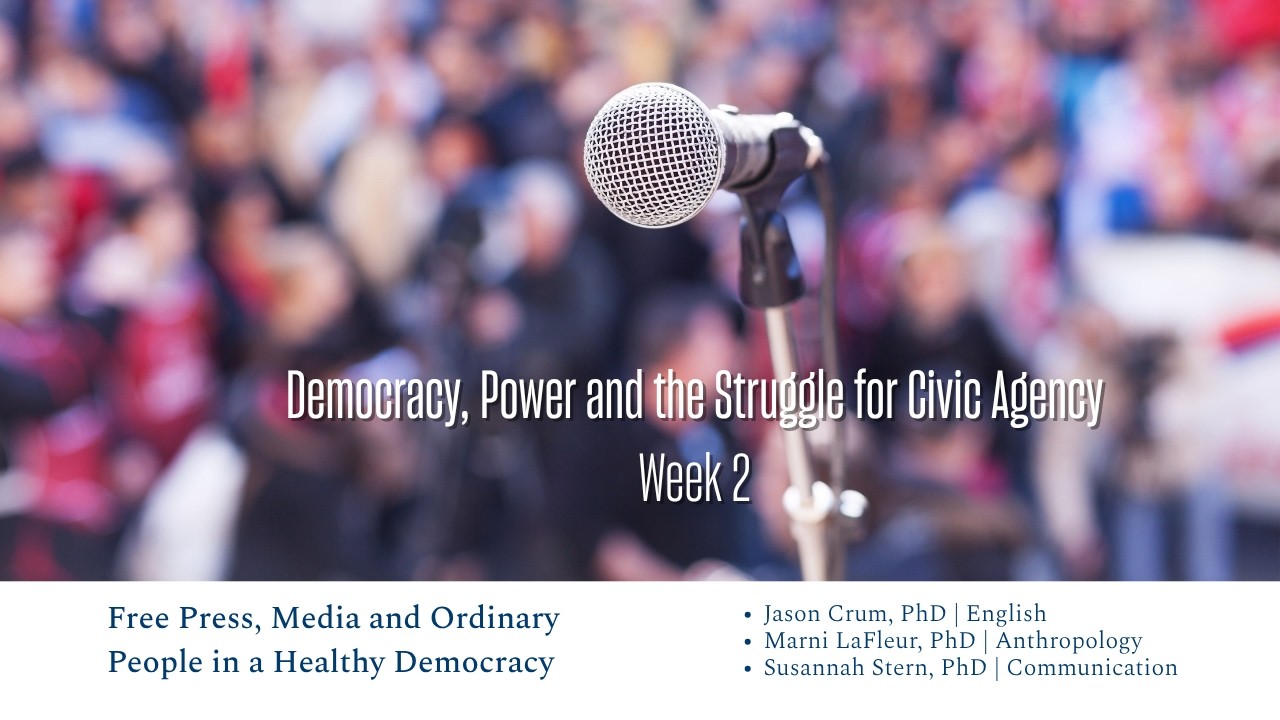
Democracy, Power the Struggle for Civic Agency | Week 2 - Free Press, Media and a Healthy Democracy
Keywords
Summary
189 words
Critical Evaluation
Value of the Information & Strength of the Argument
The value of the information lies in its clear, structured explanation of journalism’s democratic functions, supported by well-known historical examples. The argumentation is solid, building logically from defining quality journalism to its societal roles and then to current threats. The speakers use rhetorical questions and audience interaction to engage viewers, but the arguments are primarily based on established theories and anecdotal evidence rather than new research. The inclusion of multiple disciplinary perspectives enriches the discussion, but the depth of analysis is limited by the seminar format.
Scientific Rigor, Source Quality, Title Accuracy
The scientific rigor is moderate. The speakers are credible academics, and they reference well-documented historical cases (e.g., Watergate, Silent Spring) and legal protections (First Amendment). However, they do not provide formal citations or data to support their claims, and the presentation is more of an expert opinion than a peer-reviewed analysis. The title accurately reflects the content, which is a focused discussion on free press and media within the broader course theme. The description provides a link to a movie clip used in one lecture, but no additional sources are cited.
192 words
Title / Content Match
The title accurately reflects the content: a seminar on democracy, power, and civic agency, specifically focusing on free press and media's role in a healthy democracy.
Quality & Reliability
7/10
The video features three academic experts (PhD holders) from relevant disciplines (English, Anthropology, Communication) presenting a well-structured seminar on journalism's role in democracy. The content is grounded in established concepts (watchdog role, fourth estate, First Amendment) and historical examples (Watergate, Nelly Bly, Rachel Carson). However, the presentation is largely opinion-based and lacks formal citations or empirical data, and the low view count and lack of engagement limit external validation.
Key Moments
Markers derived by PSI from the transcript: the creator did not define chapters.
- Introduction by Susannah Stern, setting the agenda for the session on journalism and democracy.
- Stern defines quality journalism: accuracy, fairness, thoroughness, and processes like verification, transparency, and accountability.
- Discussion of journalism's roles: public forum, information provider, and watchdog (fourth estate).
- Historical examples of impactful journalism: Nelly Bly, Rachel Carson, Watergate, Boston Globe, etc.
- Threats to journalism today, focusing on the funding crisis and the impact of the internet.
- Jason Crum presents on authoritarian veins in American dystopian fiction.
- Marni LaFleur discusses true crime, democracy, and the politics of visibility.
- Q&A session and further discussion on media's role in democracy.
Cited Sources
- Movie clip presented by Dr. Crum — Referenced in the video description as the clip shown during Dr. Crum's lecture.
Concurring Sources
- Fourth Estate — The concept of the press as a fourth estate is central to the seminar's discussion of journalism's watchdog role.
- Watchdog journalism — The seminar explicitly describes journalism's watchdog function, which is a well-established concept in media studies.
Contribution & Novelties
The seminar provides a concise, interdisciplinary overview of journalism’s role in democracy, synthesizing perspectives from communication, literature, and anthropology. It offers a clear framework for evaluating journalism quality and highlights the funding crisis as a key threat. The inclusion of dystopian fiction and true crime analysis adds a cultural dimension often missing in media studies.
Pour aller plus loin :
- Fourth Estate — Explains the concept of the press as a fourth branch of government.
- Watchdog journalism — Details the watchdog role of journalism in holding power accountable.
- Silent Spring — Rachel Carson’s influential work on pesticides and environmental regulation.
- Watergate scandal — The investigative journalism that led to President Nixon’s resignation.
- First Amendment to the United States Constitution — The constitutional protection of press freedom.
126 words
Radar Profile
The radar profile shows a balanced but moderate performance across all dimensions. The video scores highest on information quantity and quality, reflecting its educational content, while technical depth is lower due to its introductory nature. The overall reliability is solid, supported by the academic credentials of the speakers.