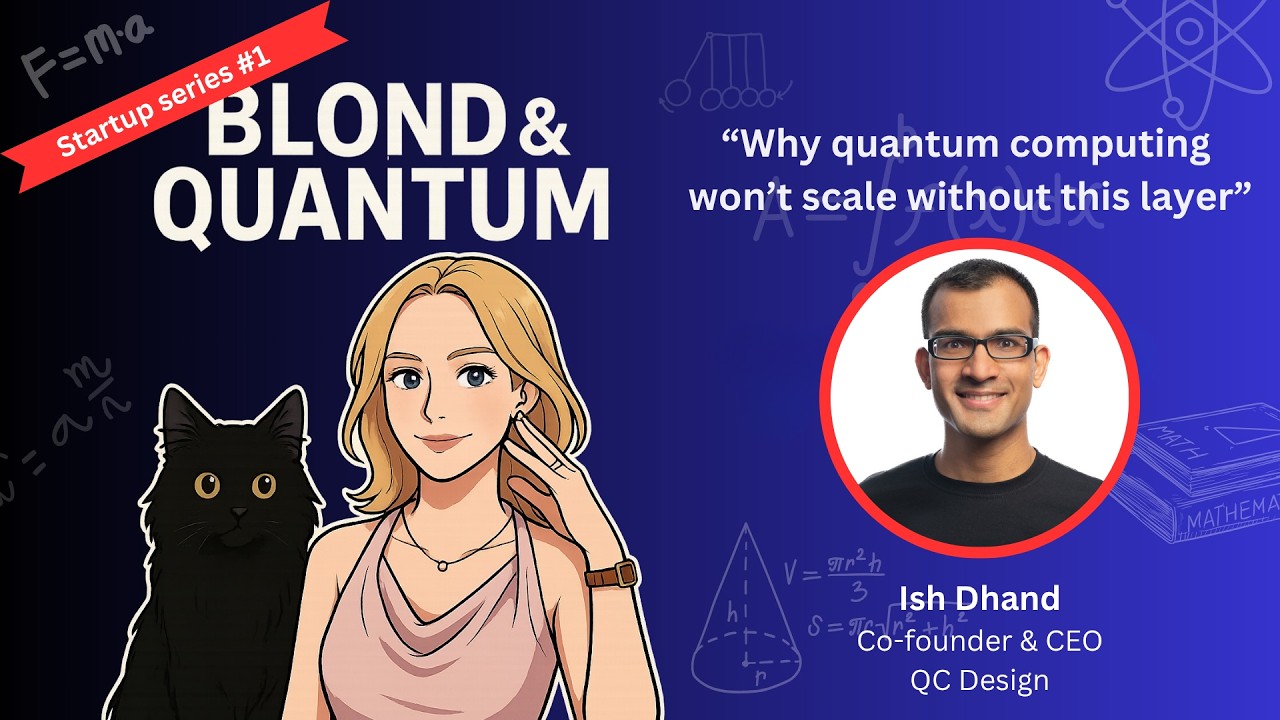
Blond & Quantum: Early-Stage Startups — Featuring Ish Dhand | QC Design
Keywords
Summary
155 words
Critical Evaluation
Value of the Information & Strength of the Argument
The interview provides valuable insights into the quantum computing startup ecosystem, particularly the role of EDA software in scaling fault-tolerant systems. Ish Dhand’s arguments are well-structured, drawing on his experience at Xanadu and current work at QC Design. He effectively explains complex concepts like logical qubits and fault tolerance in accessible terms. The discussion on competition with in-house teams and the importance of platform agnosticism is compelling. However, the argumentation is primarily from the founder’s perspective, lacking independent validation of claims such as product-market fit and customer traction.
Scientific Rigor, Source Quality, Title Accuracy
The video does not cite specific academic sources, but references industry examples like Google and Quantinuum. The description mentions partnerships with Q-CTRL and customers like C12, but no URLs are provided. The title accurately reflects the content, focusing on early-stage startups and featuring Ish Dhand. The discussion is scientifically plausible, but the lack of verifiable sources limits the rigor. The content is not misleading, but viewers should seek additional sources for deeper technical details.
177 words
Title / Content Match
The title accurately reflects the content: an interview with Ish Dhand, founder of QC Design, focusing on early-stage startup challenges and solutions in quantum computing.
Quality & Reliability
7/10
The interview provides a clear, expert-led overview of QC Design's approach to quantum error correction software, with specific technical details and business insights. However, claims are not independently verified and some statements are promotional in nature.
Key Moments
Markers derived by PSI from the transcript: the creator did not define chapters.
- Introduction to the podcast and guest Ish Dhand, founder of QC Design.
- Ish explains the problem QC Design solves: designing scalable, fault-tolerant quantum computers.
- Discussion on the EDA layer analogy and why it's indispensable for quantum computing.
- Ish describes Plaquette's capabilities, simulating 20+ hardware imperfections.
- Ish talks about the ideal customer profile and how Plaquette helps small teams scale.
- Discussion on business model, annual subscriptions, and pricing structure.
- Ish addresses competition, positioning QC Design against in-house teams rather than other startups.
- Why now is the right time for fault-tolerant quantum computing and QC Design's product-market fit.
- Future milestones and roadmap to 100+ logical qubits in 3-5 years.
- Discussion on risks, including hardware timelines, and funding history.
Cited Sources
- QC Design website — Mentioned as the company's website, providing product information.
- Q-CTRL partnership announcement — Referenced as a recent partnership to demonstrate compounding effects of error suppression and correction.
Concurring Sources
- Quantum error correction — Provides background on the principles of quantum error correction, aligning with the video's discussion.
- Fault-tolerant quantum computer — Explains the concept of fault tolerance, which is central to the video's content.
Dissenting Sources
- Quantum computing hype vs. reality — Some experts argue that fault-tolerant quantum computers are further away than claimed, which contrasts with the optimistic timeline presented in the video.
Contribution & Novelties
The video offers a unique perspective on the emerging field of quantum design automation, highlighting the need for specialized software to address the complexity of fault-tolerant quantum computers. It provides insights into the business strategy of a startup in this niche, including the importance of platform agnosticism and competing with in-house teams. The discussion on the EDA analogy and the challenges of hiring rare PhD experts adds value for entrepreneurs and investors.
Pour aller plus loin :
- Quantum error correction — Overview of the fundamental concepts.
- Fault-tolerant quantum computing — Detailed explanation of fault tolerance.
- Electronic design automation — Background on EDA in semiconductors, relevant to the analogy.
108 words
Radar Profile
The radar profile shows high scores in information quantity and technical level, indicating a content-rich interview with substantial depth. The quality and reliability scores are moderate, reflecting the promotional nature of the discussion. Overall, the video is informative for those interested in quantum startups but should be complemented with independent sources.
💬 Sur les 0 commentaires analysés, aucune tendance n'est disponible.