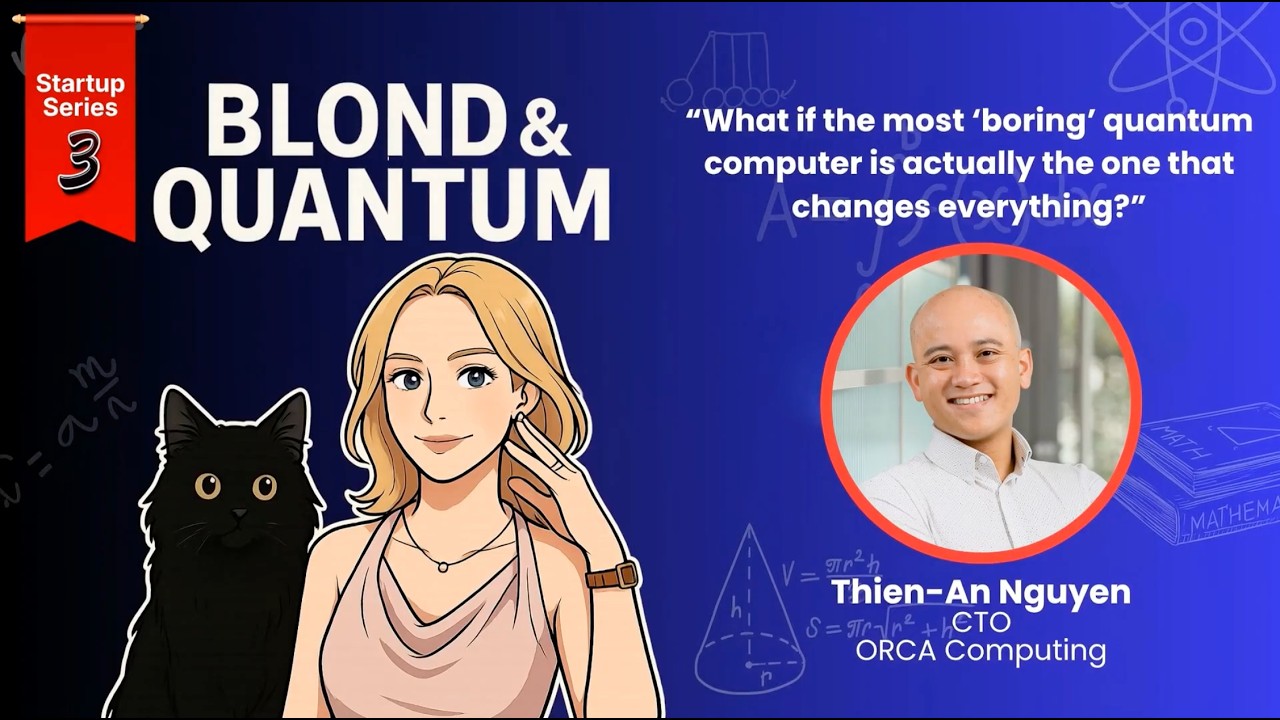
Blond & Quantum Start-up Series Episode 3: Thien-An Nguyen Orca Computing🐋⚛️
Keywords
Summary
152 words
Critical Evaluation
Value of the Information & Strength of the Argument
The video provides valuable insights into the practical aspects of commercializing quantum computing, particularly from the perspective of a photonic startup. Nguyen argues convincingly that focusing on qubit counts is less relevant than addressing real-world applications and ease of integration. He supports his points with examples of collaborations and deployments, such as with BP and DTU, and emphasizes the importance of customer feedback in guiding product development. The argumentation is coherent and grounded in the company’s experience, though it is naturally promotional. The discussion on the future of quantum modalities is thoughtful, acknowledging the role of connectivity and application-specific requirements.
Scientific Rigor, Source Quality, Title Accuracy
The video is an interview, so the primary source is the guest’s testimony. Nguyen mentions specific collaborations and deployments, but no detailed technical data or peer-reviewed references are provided. The title accurately reflects the content, and the description includes relevant links (though not provided in the transcript). The discussion is scientifically plausible but lacks rigorous sourcing. The video does not include a publicité sequence. No comments were provided for analysis.
185 words
Title / Content Match
The title accurately reflects the content: an interview with Thien-An Nguyen, CTO of Orca Computing, as part of the Blond & Quantum startup series.
Quality & Reliability
7/10
The video is an interview with the CTO of Orca Computing, providing insights into the company's technology and commercialization strategy. Claims are plausible and align with known developments in photonic quantum computing, but lack detailed technical evidence or peer-reviewed references. The discussion is high-level and promotional in nature.
Key Moments
Markers derived by PSI from the transcript: the creator did not define chapters.
- Introduction to Orca Computing and its focus on commercialization.
- Explanation of photonic quantum computing and its advantages.
- Discussion on room-temperature operation and data center integration.
- Overview of Orca's philosophy of delivering early and often.
- Mention of collaborations with BP, DTU, and NQCC.
- Discussion on the importance of applications over qubit counts.
- Predictions on the coexistence of multiple quantum modalities.
- Focus on hybrid quantum-classical AI and quantum AI accelerators.
- Closing remarks on the future of quantum computing and fundraising.
Cited Sources
- Orca Computing — Company website mentioned as the source of information about their technology and products.
- National Quantum Computing Centre (NQCC) — Mentioned as a customer to whom Orca delivered systems.
- Poznan Supercomputing and Networking Center (PSC) — Mentioned as a collaborator in a project with Nvidia.
- BP — Mentioned as a collaborator on molecular conformation problem.
- DTU (Technical University of Denmark) — Mentioned as a collaborator on peptide generation.
Concurring Sources
- Orca Computing — Company website aligns with the claims made in the interview.
- NQCC — Public information about the NQCC confirms collaboration with Orca.
Contribution & Novelties
The video offers a unique perspective on the commercialization of quantum computing, emphasizing practical deployment and customer collaboration. It highlights the advantages of photonic quantum computers for data center integration and discusses the importance of applications over qubit counts. The discussion on the coexistence of multiple quantum modalities and the role of connectivity is insightful.
Pour aller plus loin :
- Photonic quantum computing — Overview of photonic quantum computing principles and challenges.
- Quantum machine learning — Introduction to hybrid quantum-classical AI approaches.
- Orca Computing — Official website with details on their technology and products.
94 words
Radar Profile
The radar profile shows balanced scores across all dimensions, with slightly lower technical depth and source rigor, reflecting the interview's focus on commercialization rather than deep technical details. The high scores in information quantity and quality indicate a substantive discussion, while the moderate technical level suggests accessibility to a broad audience.