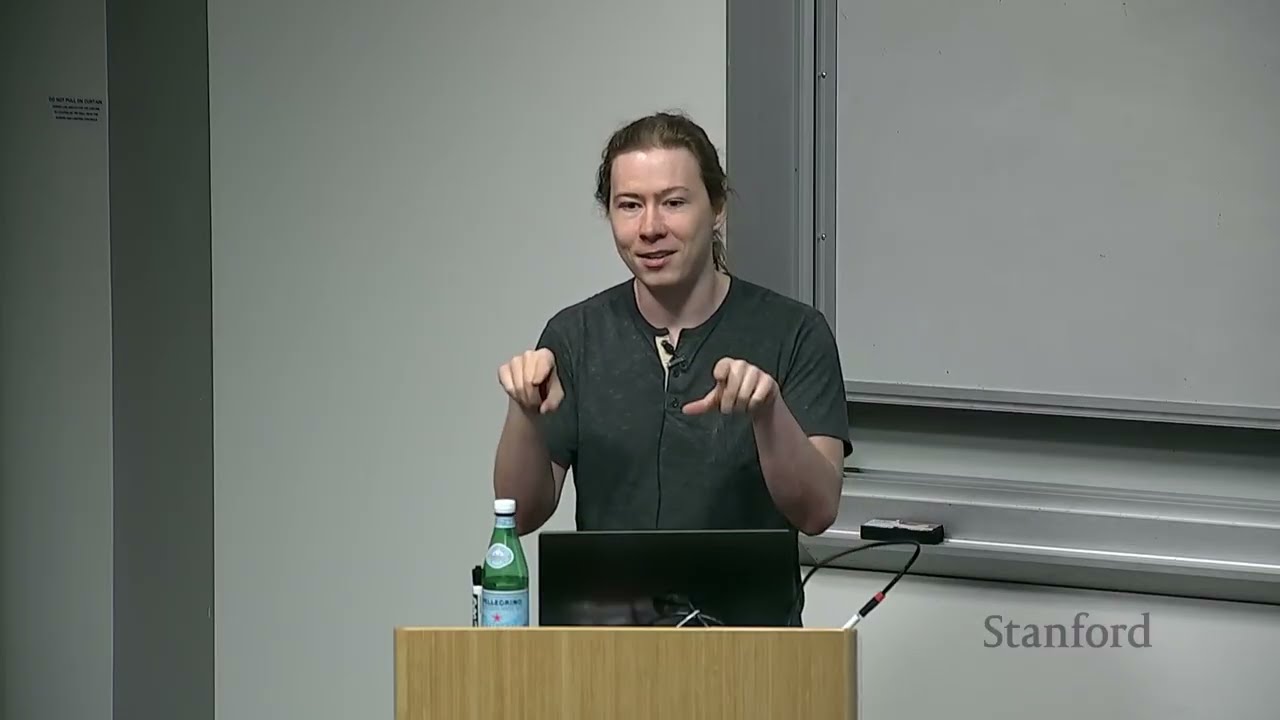
Stanford CS231N Deep Learning for Computer Vision | Spring 2025 | Lecture 13: Generative Models 1
Keywords
Summary
190 words
Critical Evaluation
The lecture provides a solid introduction to generative models, a core topic in modern deep learning. Justin Johnson, an experienced instructor and researcher, delivers the content with clarity and pedagogical skill. The explanations of VAEs, GANs, and autoregressive models are accurate and well-illustrated, making complex concepts accessible. The lecture also benefits from its placement within the CS231N course, assuming prior knowledge of neural networks and computer vision, which allows for a focused treatment of generative models.
One of the strengths is the emphasis on the intuition behind each method. For instance, the explanation of the reparameterization trick in VAEs is particularly clear, helping students understand why it is necessary for backpropagation. Similarly, the discussion of GAN training dynamics, including the minimax game and the challenges of mode collapse, provides valuable insights. The mention of autoregressive models like PixelCNN and PixelRNN rounds out the coverage, showing the diversity of approaches in generative modeling.
However, the lecture is not without limitations. It is an introductory lecture, so it does not cover more recent advances such as diffusion models, which have become state-of-the-art in image generation. This omission is understandable given the course schedule, but it means the content is somewhat dated. Additionally, while the lecture mentions key papers and models, it does not provide detailed mathematical derivations or in-depth comparisons, which might be expected in a more advanced course. The reliance on intuition over rigorous formalism could be a drawback for students seeking a deeper understanding.
The sources cited are primarily the course materials and Stanford’s online resources, which are reliable but not exhaustive. The lecture does not include a comprehensive list of references, but it does mention influential works like SimCLR, MoCo, and DINOv2 in the self-supervised learning recap. For generative models, it references the original VAE paper by Kingma and Welling, the GAN paper by Goodfellow et al., and PixelRNN/PixelCNN, which are foundational.
The title accurately reflects the content, and the lecture is well-structured, with clear transitions between topics. The pacing is appropriate, and the use of visual examples enhances understanding. Overall, this is a high-quality educational resource that effectively introduces generative models to a technical audience. While it may not be at the cutting edge, it provides a strong foundation for further study.
374 words
Title / Content Match
The title accurately reflects the content: a lecture on generative models as part of the CS231N course.
Quality & Reliability
8/10
Lecture by a recognized expert (Justin Johnson) from a prestigious university, covering established methods (VAEs, GANs, autoregressive models) with clear explanations and references to key papers. The content is accurate and well-structured, though it is an introductory lecture and does not delve into the latest state-of-the-art.
Key Moments
Markers derived by PSI from the transcript: the creator did not define chapters.
- Introduction and recap of self-supervised learning, including contrastive learning methods like SimCLR, MoCo, and DINOv2.
- Transition to generative models: overview of the field and its rapid progress.
- Introduction to Variational Autoencoders (VAEs): architecture, latent variables, and training objective.
- Detailed explanation of the reparameterization trick and the VAE loss function.
- Introduction to Generative Adversarial Networks (GANs): generator and discriminator, adversarial training.
- Discussion of GAN training challenges, including mode collapse and instability.
- Introduction to autoregressive models: PixelRNN and PixelCNN, generating images pixel by pixel.
- Conclusion and summary of the lecture, with pointers to further resources.
Cited Sources
- CS231N Course Website — Official course page with syllabus, assignments, and lecture notes.
- CS231N Online Course (Professional Education) — Information about the professional education version of the course.
- XCS231N Enrollment Page — Link for enrollment in the professional education course.
- Stanford AI Programs — Overview of Stanford's online AI programs.
- CS231N Lecture Playlist — Full playlist of CS231N lectures.
Concurring Sources
- Kingma & Welling, Auto-Encoding Variational Bayes — Original VAE paper, consistent with the lecture's explanation.
- Goodfellow et al., Generative Adversarial Networks — Original GAN paper, consistent with the lecture's description.
- van den Oord et al., Pixel Recurrent Neural Networks — Original PixelRNN paper, consistent with the lecture's coverage.
Dissenting Sources
- Ho et al., Denoising Diffusion Probabilistic Models — Diffusion models are not covered in the lecture but represent a major advancement in generative modeling, potentially superseding some of the discussed methods in certain applications.
Contribution & Novelties
The lecture provides a clear and structured introduction to three major classes of generative models: VAEs, GANs, and autoregressive models. It explains the core concepts, training objectives, and challenges, making it a valuable resource for students and practitioners. The lecture also connects generative models to broader deep learning trends, such as self-supervised learning and large-scale training.
Pour aller plus loin :
- Variational Autoencoders (Kingma & Welling, 2013) — Foundational paper introducing VAEs.
- Generative Adversarial Networks (Goodfellow et al., 2014) — Original GAN paper.
- Pixel Recurrent Neural Networks (van den Oord et al., 2016) — Introduces PixelRNN.
- Conditional Image Generation with PixelCNN Decoders (van den Oord et al., 2016) — Extends PixelCNN to conditional generation.
- Diffusion Models: Denoising Diffusion Probabilistic Models (Ho et al., 2020) — Modern state-of-the-art generative models, not covered in the lecture but essential for current understanding.
139 words
Radar Profile
The radar profile shows high scores across all dimensions, indicating a well-balanced and informative lecture. The strongest aspects are the quantity and quality of information, with a slightly lower but still solid technical depth, reflecting its introductory nature.
💬 No comments were provided for analysis.