Stanford AA203 Optimal and Learning-Based Control | Spring 2026 | Lecture 15: Imitation Learning
Keywords
Summary
152 words
Critical Evaluation
Value of the Information & Strength of the Argument
The lecture provides a solid introduction to imitation learning, clearly explaining the core concepts and challenges. The argumentation is logical and well-structured, building from basic definitions to specific algorithms and practical examples. The discussion of Dagger is particularly valuable, as it includes a pseudo-code walkthrough and addresses practical considerations like querying experts and data efficiency. The use of the NVIDIA DAVE-2 case study effectively illustrates how data augmentation can address covariate shift. The instructor also engages with student questions, clarifying nuances and connecting concepts to broader applications. However, the lecture is introductory and does not delve deeply into advanced variants or theoretical proofs, which might be expected in a graduate course.
Scientific Rigor, Source Quality, Title Accuracy
The lecture demonstrates scientific rigor by referencing established methods (Dagger, DAVE-2) and providing theoretical context for covariate shift. The sources cited in the description include the course website, a companion textbook, and lecture slides, which are appropriate for a university course. The title accurately reflects the content. The instructor’s credentials and affiliation with Stanford lend credibility. However, the lecture does not provide a comprehensive literature review or cite specific papers for all claims, and the sources are primarily course materials rather than peer-reviewed publications.
210 words
Title / Content Match
The title accurately reflects the content: a lecture on imitation learning within the context of optimal and learning-based control.
Quality & Reliability
8/10
The lecture is delivered by a Stanford researcher with a PhD in machine learning and mathematical optimization, and is part of a formal university course. The content is well-structured, references standard literature (e.g., Dagger, NVIDIA DAVE-2), and includes theoretical foundations and practical considerations. However, it is a single lecture without peer review or external validation, and some claims are presented without detailed citations.
Key Moments
Markers derived by PSI from the transcript: the creator did not define chapters.
- Introduction to imitation learning and its two main paradigms: behavior cloning and inverse reinforcement learning.
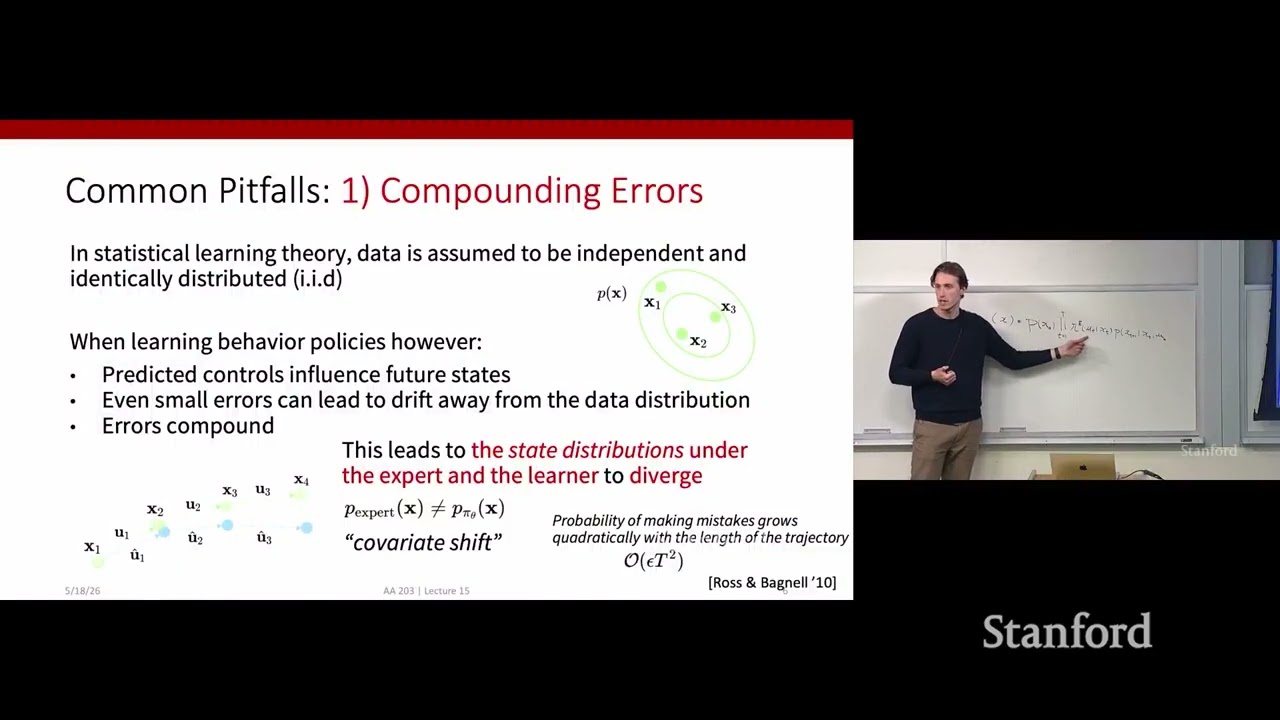
- Discussion of compounding errors and covariate shift in behavior cloning.
- Explanation of multimodal behavior and the problem of fitting with mean squared error.
- Introduction to Dagger algorithm and its iterative data aggregation approach.
- Discussion of human-gated Dagger and confidence-based querying.
- Case study: NVIDIA DAVE-2 autonomous driving and data augmentation from side cameras.
- Conclusion and transition to inverse reinforcement learning.
Cited Sources
- AA203 Course Page — Course information and enrollment details.
- Principles of Robot Autonomy (Companion Textbook) — Free online textbook referenced as companion reading.
- AA203 Course Schedule and Syllabus — Course schedule and syllabus.
- Lecture Slides (Lecture 4) — Slides for this lecture.
- Full Playlist — Playlist of all lectures in the course.
Concurring Sources
- Dagger: Dataset Aggregation — The lecture discusses Dagger, and this paper is the original source.
- End to End Learning for Self-Driving Cars — The NVIDIA DAVE-2 system is based on this paper.
Contribution & Novelties
The lecture provides a clear and structured introduction to imitation learning, emphasizing practical challenges and solutions. It highlights the importance of corrective data and introduces Dagger as a key algorithm. The NVIDIA case study offers a concrete example of data augmentation for autonomous driving. The lecture also sets the stage for inverse reinforcement learning, which is covered in subsequent lectures.
Pour aller plus loin :
- Dagger: Dataset Aggregation — Original paper introducing Dagger, a foundational algorithm for addressing covariate shift.
- NVIDIA DAVE-2 — Paper describing the end-to-end learning approach for self-driving cars, including data augmentation techniques.
- Inverse Reinforcement Learning — Overview of inverse reinforcement learning, a key topic mentioned in the lecture.
112 words
Radar Profile
The radar profile shows high scores in quantity and quality of information, with a slightly lower technical level, indicating a well-balanced lecture that is accessible yet informative. The high reliability score reflects the credibility of the instructor and course.
💬 Sur les 0 commentaires analysés, aucune tendance n'est disponible.