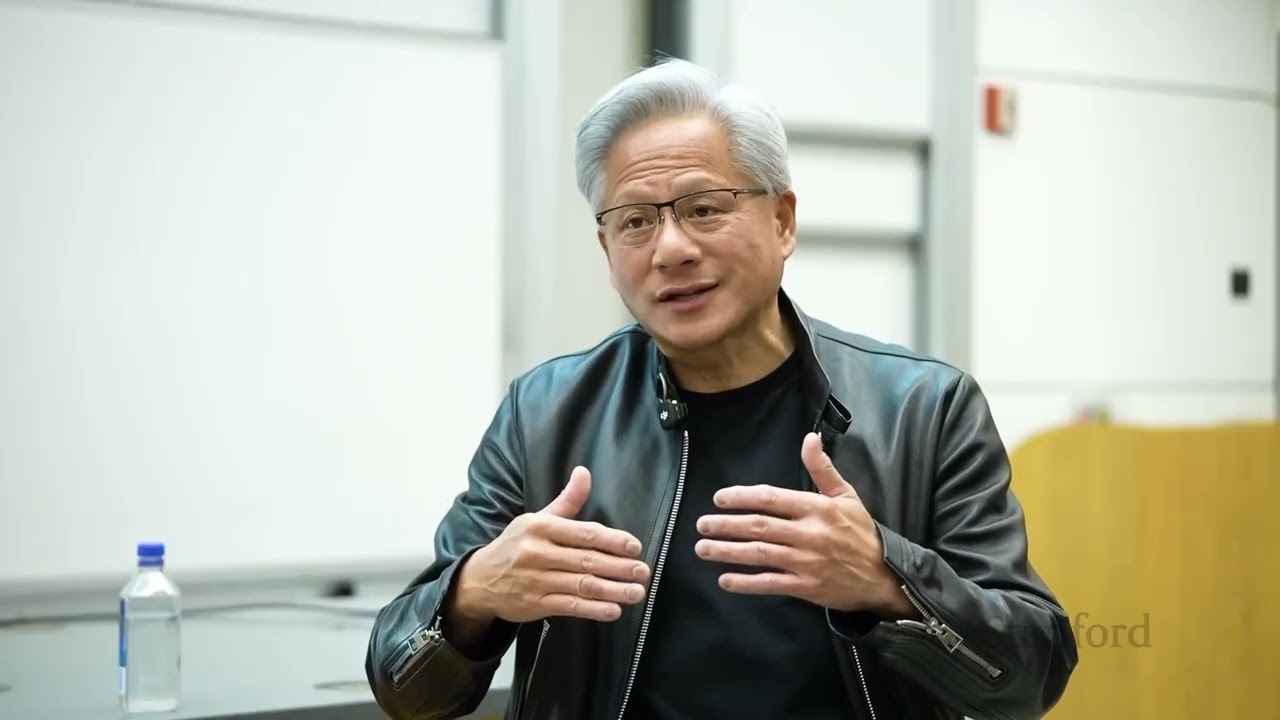
Stanford CS153 Frontier Systems | Jensen Huang from NVIDIA on the Compute Behind Intelligence
Keywords
Summary
151 words
Critical Evaluation
The lecture provides a compelling vision of the future of computing from one of the industry’s most influential figures. Jensen Huang’s arguments are logically structured and grounded in NVIDIA’s engineering achievements, lending credibility to his claims. The emphasis on co-design as a key driver of performance is well-supported by historical context, such as the RISC architecture pioneered by John Hennessy. However, the talk is inherently promotional, presenting NVIDIA’s approach as the definitive path forward without acknowledging potential limitations or alternative strategies. The discussion of metrics like tokens-per-watt is insightful, but the dismissal of MFU may oversimplify a complex evaluation landscape. The forecast of a thousandfold increase in energy demand is striking but lacks detailed justification, and while it underscores the need for sustainable energy, it does not address the feasibility or environmental impact in depth. The defense of open models is a notable stance, though it is framed within NVIDIA’s commercial interests. Overall, the content is highly informative and technically rich, but it should be viewed as an expert opinion rather than an unbiased analysis. The title accurately reflects the content, and the lecture offers valuable insights for those interested in AI infrastructure and strategy.
195 words
Title / Content Match
The title accurately reflects the content: a lecture on frontier systems with Jensen Huang discussing the compute behind intelligence.
Quality & Reliability
8/10
High credibility due to Jensen Huang's authoritative position as NVIDIA CEO, but the content is largely opinion and forward-looking statements without peer-reviewed evidence. The talk is a lecture format, providing insights into NVIDIA's strategy and technical direction.
Key Moments
Markers derived by PSI from the transcript: the creator did not define chapters.
- Jensen Huang introduces the concept of computing being reinvented for the first time in 64 years, shifting from pre-recorded to generated software.
- Huang explains the significance of generative AI enabling thinking and reasoning, leading to agentic systems.
- Discussion on co-design, referencing John Hennessy's RISC work and NVIDIA's extreme co-design approach.
- Huang highlights the million-fold speedup achieved by NVIDIA over the past decade, contrasting with Moore's Law's 100x.
- Huang discusses the architectural evolution: Hopper for pre-training, Grace Blackwell NVLink72 for inference, Vera Rubin for agents, and Feynman for agent swarms.
- Huang criticizes MFU as a misleading metric, advocating for tokens-per-watt and real evals.
- Huang defends open models like Nemotron, BioNemo, and Alpamayo for safety and democratization.
- Huang forecasts a thousandfold increase in compute energy demand, emphasizing the need for sustainable energy investment.
- Q&A session begins, addressing education's evolution with AI and the importance of co-design.
Cited Sources
- CS153 Course Website — Course schedule and syllabus for Stanford CS153 Frontier Systems.
- Stanford Online AI Programs — Information about Stanford's online AI programs.
- CS153 Playlist — Playlist of CS153 lectures on YouTube.
Concurring Sources
- NVIDIA Official Website — Official NVIDIA site providing information on their products and technologies.
Dissenting Sources
- Critique of MFU as a metric — Some researchers argue that MFU is still useful for comparing hardware efficiency, contrary to Huang's dismissal.
Contribution & Novelties
The lecture provides unique insights into NVIDIA’s strategic vision for AI compute, emphasizing extreme co-design and the shift to agentic systems. It introduces the concept of tokens-per-watt as a key metric and discusses the architectural roadmap from Hopper to Feynman. The defense of open models and the forecast of energy demand are notable contributions to the discourse.
Pour aller plus loin :
- NVIDIA Grace Blackwell — Official page for the Grace Blackwell platform.
- RISC Architecture — Background on RISC, relevant to co-design discussion.
- Moore’s Law — Context for the performance comparisons.
- Dennard Scaling — Explanation of the scaling limits mentioned.
100 words
Radar Profile
The radar profile shows high scores in information quantity, quality, technical level, and reliability, indicating a dense and authoritative lecture. The lowest score is technical level, but it remains high, reflecting the advanced nature of the content.
💬 Positif. Sur les 30 commentaires analysés, le climat est très positif, avec des éloges pour la clarté et la profondeur des propos de Jensen Huang, et une appréciation particulière pour ses conseils sur la stratégie et la philosophie.