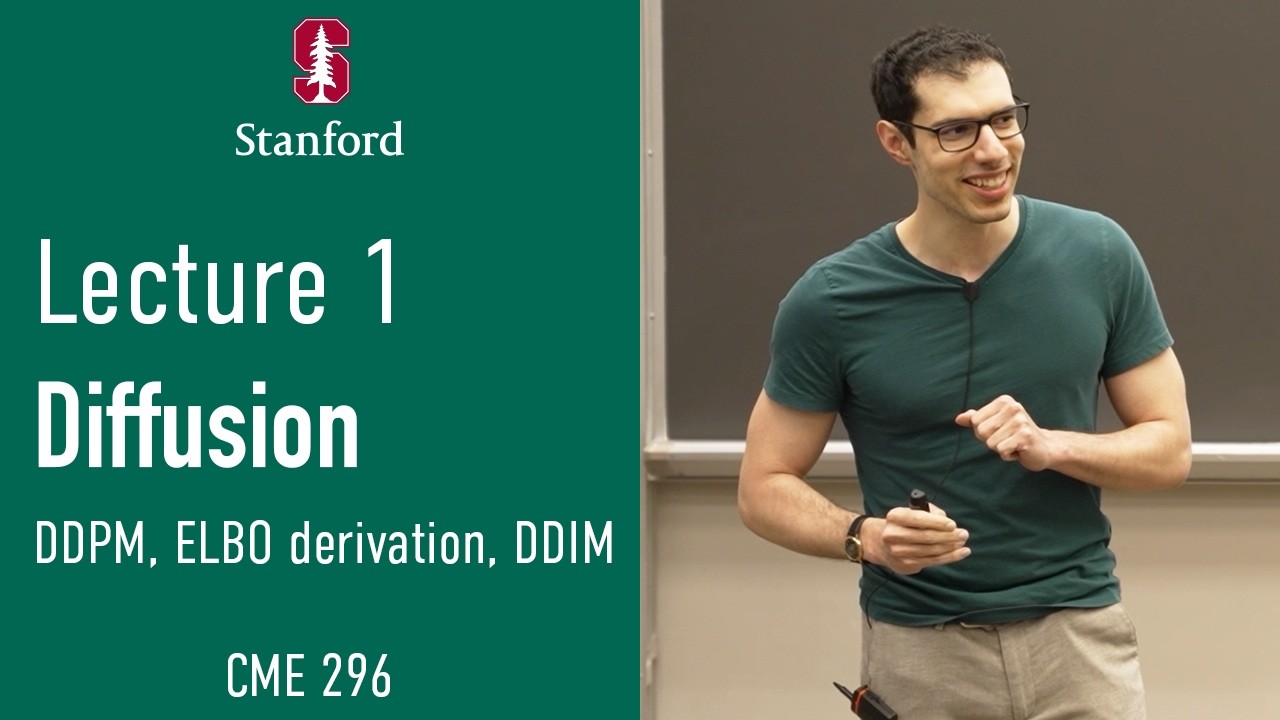
Stanford CME296 Diffusion & Large Vision Models | Spring 2026 | Lecture 1 - Diffusion
Keywords
Summary
125 words
Critical Evaluation
The lecture provides a comprehensive and rigorous introduction to diffusion models, balancing mathematical depth with intuitive explanations. The instructors, both with strong academic and industry backgrounds, effectively convey the core concepts. The structure is logical, starting with motivation and intuition before moving into the variational formulation and ELBO derivation. The use of a running example (teddy bears) helps ground abstract ideas. The mathematical derivations are clear and well-paced, making the content accessible to those with the stated prerequisites. The lecture references key papers and provides a syllabus for further study, enhancing its credibility. The quality of information is high, with accurate explanations of the underlying theory. The argumentation is solid, building from first principles. The sources cited are appropriate and authoritative. The title accurately reflects the content. Overall, this is an excellent introductory lecture for anyone interested in understanding diffusion models.
141 words
Title / Content Match
The title accurately reflects the content: a lecture on diffusion models for image generation.
Quality & Reliability
9/10
Lecture by Stanford lecturers with clear mathematical derivations, references to papers, and a structured syllabus. High reliability due to academic setting and expertise.
Chapters
Cited Sources
- Course Syllabus — Official syllabus for the course, providing schedule and topics.
- Course Page — Official course page on Stanford Online.
- Stanford Graduate Education — Information about Stanford's graduate programs.
- Course Playlist — YouTube playlist containing all lectures of the course.
Concurring Sources
- Denoising Diffusion Probabilistic Models — Foundational paper on DDPM, referenced in the lecture.
Contribution & Novelties
The lecture provides a clear and structured introduction to diffusion models, emphasizing intuition alongside mathematical derivations. It covers the ELBO derivation and the variational formulation in a way that is accessible yet rigorous. The course structure, with a focus on both theory and practical aspects, is valuable for learners.
Pour aller plus loin :
- Diffusion Models Beat GANs on Image Synthesis — Key paper on diffusion models’ performance.
- Denoising Diffusion Probabilistic Models — Original DDPM paper.
- Variational Inference — Background on variational inference.
83 words
Radar Profile
The radar profile shows high scores across all dimensions, indicating a well-rounded and reliable educational resource. The lecture excels in information quality and reliability, with strong technical depth.