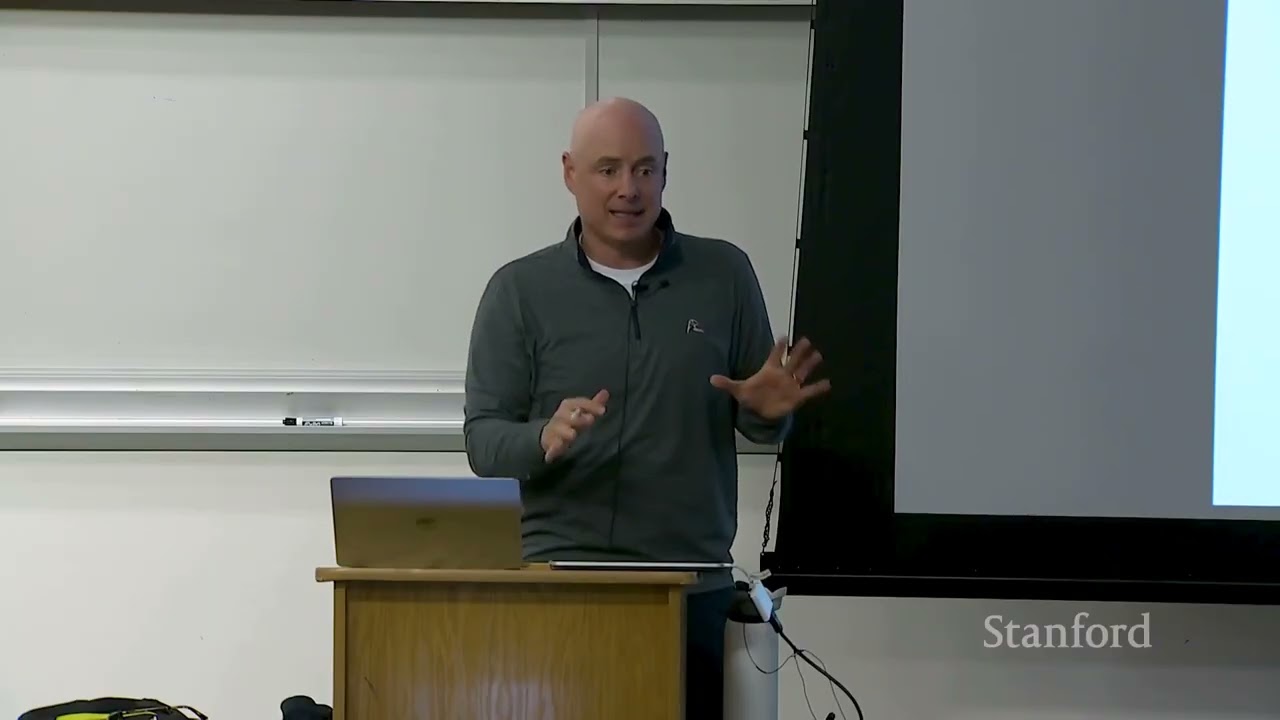
Stanford CS229 Machine Learning | Spring 2026 | Lecture 10: GMM (EM), PCA
Keywords
Summary
145 words
Critical Evaluation
The lecture is an excellent exposition of two core machine learning algorithms. The instructor, Chris Ré, demonstrates deep expertise and pedagogical skill. The explanation of the EM algorithm is particularly strong: he builds intuition with the geometric picture of lower bounds and then carefully derives the algorithm, making the mathematical steps clear. The use of Jensen’s inequality is well-motivated, and the connection to the ad-hoc GMM updates from the previous lecture is explicitly made, reinforcing the principled nature of EM. The transition to PCA is smooth, and the instructor provides a clear conceptual foundation for dimensionality reduction. He emphasizes the geometric interpretation of PCA as finding principal axes of variation, and connects it to the covariance matrix and eigenvectors. The lecture also includes practical insights, such as the use of PCA in high-dimensional settings and its relationship to SVD. The quality of the content is high, with rigorous mathematical treatment and clear explanations. The sources cited are the official course website and Stanford’s AI program page, which are authoritative. The lecture is well-structured, and the instructor’s enthusiasm is engaging. The only minor critique is that the lecture could benefit from more concrete examples or visualizations to illustrate the concepts, but this is a minor point given the depth of the mathematical treatment. Overall, this is an outstanding lecture that provides a solid foundation in these essential algorithms.
227 words
Title / Content Match
The title accurately reflects the lecture content, covering Gaussian Mixture Models (EM) and Principal Component Analysis.
Quality & Reliability
9/10
Lecture from Stanford CS229, taught by renowned professors, with rigorous mathematical derivations and references to course materials. The content is well-structured and aligns with established machine learning theory.
Key Moments
Markers derived by PSI from the transcript: the creator did not define chapters.
- Introduction and overview of the lecture topics: EM algorithm and PCA.
- Review of GMM setup with latent variables and soft assignments.
- Introduction to the EM algorithm and its geometric interpretation.
- Derivation of the EM lower bound using Jensen's inequality.
- Detailed explanation of the E-step and M-step.
- Transition to PCA and its motivation as a dimensionality reduction technique.
- Geometric interpretation of PCA: finding directions of maximum variance.
- Connection between PCA and the covariance matrix and eigenvectors.
- Discussion of PCA in high-dimensional settings and its relationship to SVD.
- Conclusion and summary of key takeaways.
Cited Sources
- CS229 Course Website (Spring 2026) — Official course website with syllabus and materials.
- Stanford AI Professional and Graduate Programs — Information about Stanford's AI programs.
Concurring Sources
- CS229 Course Website (Spring 2026) — Official course materials align with the lecture content.
Contribution & Novelties
The lecture provides a rigorous and intuitive derivation of the EM algorithm, connecting it to the ad-hoc GMM updates from the previous lecture. It also offers a clear geometric interpretation of PCA and its relationship to the covariance matrix. The lecture is a valuable resource for students and practitioners seeking a deep understanding of these foundational algorithms.
Pour aller plus loin :
- Expectation-Maximization algorithm — Overview of EM and its applications.
- Principal component analysis — Comprehensive introduction to PCA.
- Jensen’s inequality — Mathematical foundation used in the derivation.
88 words
Radar Profile
The radar profile shows high scores across all dimensions, indicating a lecture that is both information-dense and technically rigorous. The balance between quantity and quality of information is excellent, and the technical level is appropriate for an advanced audience.