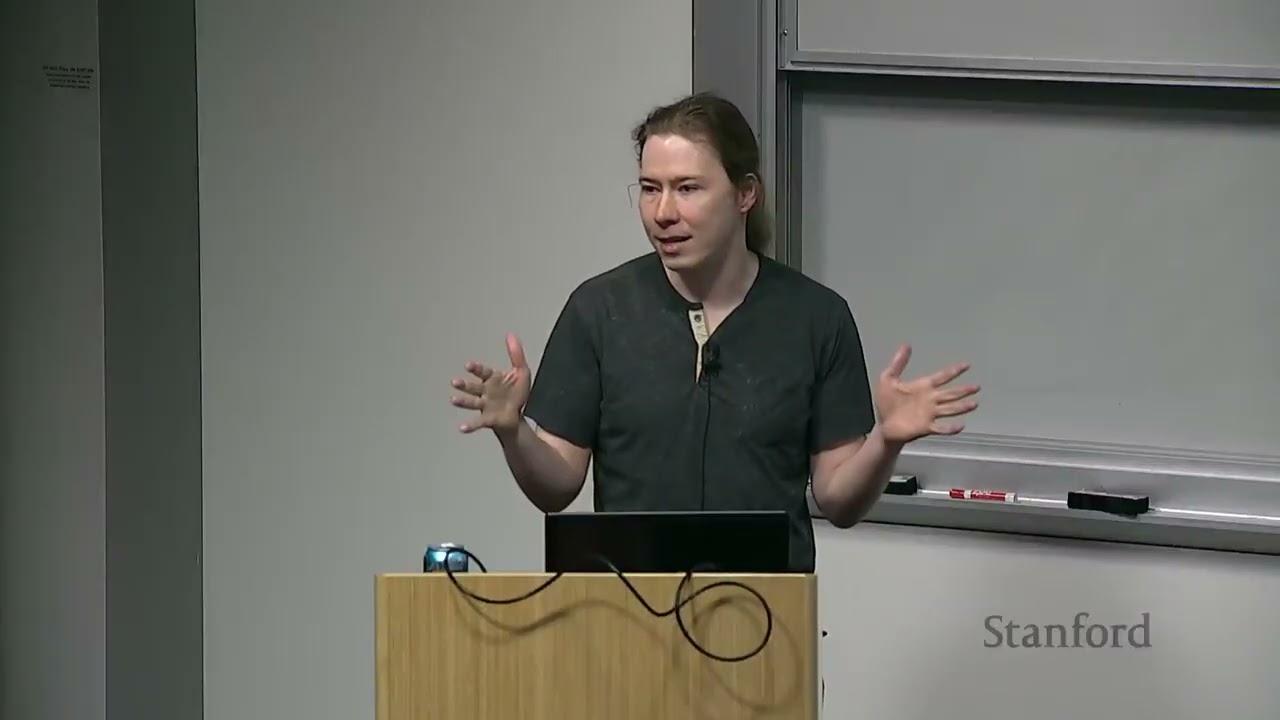
Stanford CS231N | Spring 2025 | Lecture 8: Attention and Transformers
Keywords
Summary
152 words
Critical Evaluation
The lecture provides a comprehensive and pedagogically effective introduction to attention and transformers. The instructor, Justin Johnson, demonstrates deep expertise and clarity in explaining complex concepts, building intuitively from RNNs to attention and then to the transformer architecture. The motivation for attention as a solution to the fixed-length bottleneck is well-articulated, and the step-by-step derivation of attention mechanisms is rigorous. The explanation of scaled dot-product attention, multi-head attention, and positional encodings is accurate and aligns with the original transformer paper (Vaswani et al., 2017). The lecture also highlights the practical advantages of transformers, such as parallelization and scalability, which are crucial for modern large-scale models. The use of diagrams and examples enhances understanding. However, the lecture is introductory and does not delve into advanced topics like training stability, optimization tricks, or variations of transformers (e.g., BERT, GPT). The sources cited are primarily course materials and official Stanford pages, which are reliable but not exhaustive. The title accurately reflects the content, and the lecture is well-structured. Overall, this is an excellent educational resource for students and practitioners seeking a solid foundation in attention and transformers.
184 words
Title / Content Match
The title accurately reflects the content, which focuses on attention mechanisms and transformer architectures.
Quality & Reliability
9/10
Lecture from a renowned Stanford course, delivered by an expert (Justin Johnson), with clear explanations and references to foundational concepts. The content is well-structured and aligns with established knowledge in deep learning.
Key Moments
Markers derived by PSI from the transcript: the creator did not define chapters.
- Introduction and recap of RNNs for sequence processing
- Motivation for attention: bottleneck of fixed-length context vector
- Introducing alignment scores and softmax for attention
- Formal definition of attention as queries, keys, and values
- Scaled dot-product attention and its computation
- Multi-head attention and its benefits
- Positional encodings and handling sequence order
- Transformer architecture: encoder and decoder blocks
- Residual connections and layer normalization in transformers
- Applications and advantages of transformers in deep learning
Cited Sources
- CS231n Course Website — Official course page with syllabus and materials.
- Stanford Online CS231n Course Page — Information about the online version of the course.
- XCS231N Professional Education — Details about the professional education version of the course.
- Stanford Online AI Programs — Overview of Stanford's online AI programs.
- Course Playlist — Playlist of all lectures in the course.
Concurring Sources
- Attention Is All You Need — The original transformer paper, which the lecture's content aligns with.
- Deep Learning Book (Goodfellow et al.) — A comprehensive reference on deep learning, including sequence models.
Contribution & Novelties
This lecture provides a clear and accessible introduction to attention and transformers, building on the historical development from RNNs. It explains the motivation for attention as a solution to the fixed-length bottleneck and formalizes the attention mechanism with queries, keys, and values. The lecture also covers the transformer architecture, including multi-head attention and positional encodings, and highlights its advantages in scalability and parallelization. This serves as a foundational resource for understanding modern deep learning models.
Pour aller plus loin :
- Attention Is All You Need (Vaswani et al., 2017) — The original transformer paper, essential for understanding the architecture.
- The Illustrated Transformer — A visual and intuitive explanation of transformers.
- CS231n Lecture Notes on Attention — Additional course notes on attention mechanisms.
122 words
Radar Profile
The radar profile shows high scores across all dimensions, indicating a well-rounded and reliable lecture with strong information content, technical depth, and credibility.
💬 No comments were provided for analysis.