Stanford AA203 Optimal and Learning-Based Control | Spring 2026 | Lecture 5: Computational Methods
Keywords
Summary
149 words
Critical Evaluation
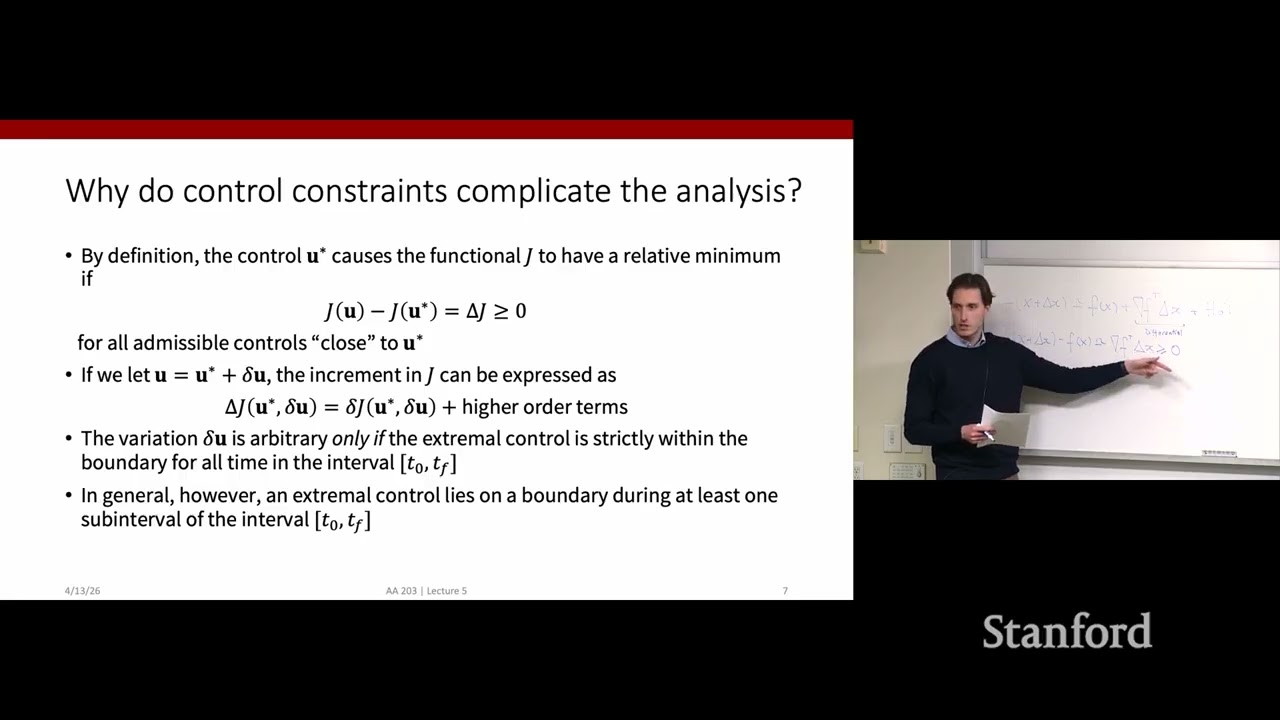
The lecture provides a solid and rigorous introduction to Pontryagin’s Minimum Principle and computational methods for optimal control, particularly in the context of bounded controls. The instructor, Dr. Daniele Gammelli, demonstrates deep expertise in the subject, and the presentation is well-structured, building from the unbounded case to the bounded case with clear mathematical derivations. The use of a finite-dimensional analogy to explain the failure of the gradient condition at boundaries is pedagogically effective. The examples, such as the bang-bang control problem, help to concretize the abstract concepts. The lecture is part of a Stanford course and is supported by a companion textbook and official course materials, which enhances its credibility. However, as a lecture, it does not present new research findings, and the content is standard for a graduate-level optimal control course. The technical depth is high, but the presentation assumes prior knowledge of calculus of variations and optimal control basics. The sources cited are primarily the course materials and textbook, which are appropriate. The title accurately reflects the content, and the lecture fulfills its promise of covering computational methods. Overall, this is a high-quality educational resource, though it is not groundbreaking in terms of novel contributions.
197 words
Title / Content Match
The title accurately reflects the content: the lecture covers computational methods for optimal control, specifically Pontryagin's Minimum Principle and numerical techniques.
Quality & Reliability
8/10
Lecture by a Stanford researcher with a PhD in machine learning and mathematical optimization, based on a companion textbook and official course materials. The content is rigorous and well-structured, but it is a lecture, not peer-reviewed research.
Key Moments
Markers derived by PSI from the transcript: the creator did not define chapters.
- Introduction and roadmap for the lecture
- Recap of unbounded control optimality conditions
- Motivation for bounded controls and finite-dimensional analogy
- Introduction of Pontryagin's Minimum Principle
- Example: bang-bang control
- Discussion of computational methods for solving boundary value problems
- Conclusion and summary
Cited Sources
- AA203 Optimal and Learning-Based Control course page — Course information and enrollment details
- Principles of Robot Autonomy (companion textbook) — Free online textbook accompanying the course
- Course schedule and syllabus — Official course website with schedule and materials
- Lecture 5 slides — Slides used in the lecture
Concurring Sources
- Pontryagin's maximum principle — Wikipedia article providing background and formulation of PMP, consistent with the lecture's content.
- Optimal control — General overview of optimal control, including indirect methods and PMP.
Contribution & Novelties
The lecture provides a clear and rigorous exposition of Pontryagin’s Minimum Principle for bounded controls, with practical examples and computational methods. It serves as an educational resource rather than presenting novel research.
Pour aller plus loin :
- Pontryagin’s minimum principle — The core principle discussed, with mathematical formulation and historical context.
- Bang-bang control — A common optimal control strategy that arises from PMP with bounded controls.
- Shooting method — A numerical technique for solving boundary value problems, relevant to the computational methods discussed.
- Collocation method — Another numerical approach for solving differential equations, applicable to optimal control problems.
98 words
Radar Profile
The radar profile shows high scores across all dimensions, indicating a well-balanced and reliable lecture. The technical depth and information quality are particularly strong, making it suitable for advanced students and practitioners.