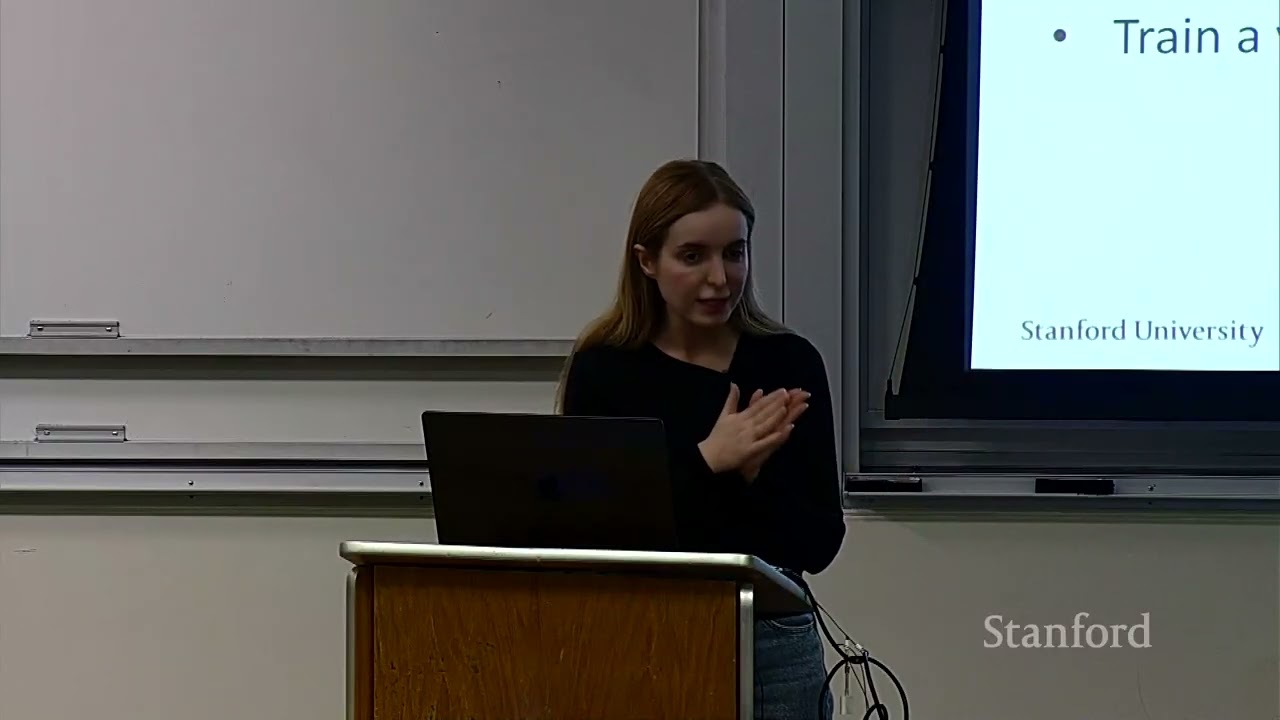
Stanford CS329A Self-Improving AI Agents | Part 3 | Robust Verification
Keywords
Summary
141 words
Critical Evaluation
The lecture provides a comprehensive and technically rigorous overview of verification methods for LLMs, grounded in seminal research papers. The instructor, Azalia Mirhoseini, is a recognized expert in the field, and the content is well-structured, progressing logically from early outcome-based verifiers to more sophisticated process-supervised and ensemble approaches. The discussion of GSM8K and PRM800K datasets offers concrete examples, and the analysis of ablation studies, such as the impact of verifier size and sample count, adds depth. The lecture also touches on important practical considerations, such as the generation-verification gap and reward hacking, which are critical for real-world applications. However, the lecture is limited by its reliance on a single perspective and the absence of visual aids in the transcript, which may hinder full comprehension of complex diagrams and results. Additionally, while the papers cited are foundational, the lecture does not critically evaluate potential biases or limitations in the datasets or methods. The adéquation between title and content is strong, as the lecture directly addresses robust verification. Overall, the lecture is a valuable resource for graduate students and researchers, offering both theoretical foundations and practical insights.
185 words
Title / Content Match
The title accurately reflects the content: a lecture on verification methods for self-improving AI agents.
Quality & Reliability
8/10
Lecture from a Stanford graduate course by a recognized expert, covering seminal papers in AI verification. Content is technically accurate and well-structured, but limited by the absence of visual aids in the transcript and the lack of independent verification of claims.
Key Moments
Markers derived by PSI from the transcript: the creator did not define chapters.
- Introduction to verification and the generation-verification gap
- Overview of the four papers to be covered
- Paper 1: Training Verifiers to Solve Math Word Problems - GSM8K dataset and outcome-based verifiers
- Training verifiers with token-level labels and language modeling objective
- Ablation studies: verifier vs fine-tuning, generator/verifier size trade-off
- Test-time scaling: number of samples and verifier performance
- Paper 2: Let's Verify Step by Step - process-supervised reward models (PRM800K)
- Comparison of outcome vs process supervision and credit assignment
- Paper 3: Math-Shepherd - automatic step-level annotation
- Paper 4: Weaver - ensembles of weak verifiers
- Discussion of reward hacking and using verifiers for RL fine-tuning
- Q&A and concluding remarks
Cited Sources
- CS329A Course Website — Course syllabus and schedule
- Agentic AI Professional Education Program — Related professional education program
- CS329A Online Course — Graduate course page
- Course Playlist — YouTube playlist of lectures
Concurring Sources
- Training Verifiers to Solve Math Word Problems — Original paper by OpenAI on outcome-based verifiers and GSM8K.
- Let's Verify Step by Step — Paper comparing outcome and process supervision.
- Math-Shepherd — Paper on automatic step-level annotation.
- Weaver — Stanford paper on ensembles of weak verifiers.
Dissenting Sources
- No discordant sources identified — The lecture presents a coherent narrative without conflicting sources.
Contribution & Novelties
The lecture synthesizes key developments in verification for LLMs, highlighting the shift from outcome-based to process-based supervision and the use of ensembles. It provides a clear framework for understanding the generation-verification gap and practical guidance on training and using verifiers.
Pour aller plus loin :
- GSM8K dataset — The benchmark introduced in the first paper, widely used for evaluating reasoning.
- PRM800K dataset — Human-labeled reasoning steps for process supervision.
- Reward hacking in RL — A phenomenon discussed in the lecture, relevant to verifier training.
84 words
Radar Profile
The radar profile shows high scores across all dimensions, indicating a well-rounded lecture with substantial information, strong technical depth, and reliable content. The balance between quantity and quality is particularly notable.