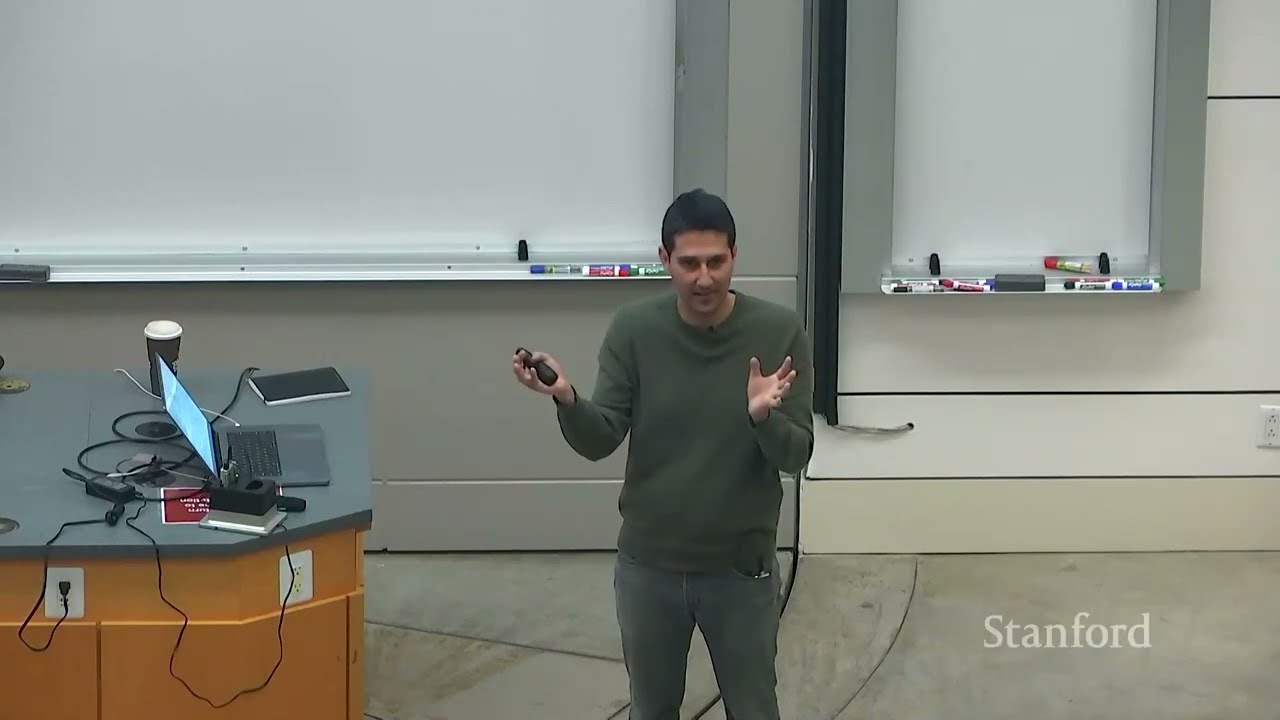
Stanford CS230 | Autumn 2025 | Lecture 10: What’s Going On Inside My Model?
Keywords
Summary
180 words
Critical Evaluation
The lecture provides a comprehensive overview of model interpretability, balancing foundational CNN techniques with current challenges in frontier models. The pedagogical approach is effective: the opening case study engages students in practical problem-solving, and the subsequent discussion systematically covers key diagnostic tools. The content is scientifically sound, with clear explanations of concepts like attention maps, scaling laws, and data diagnostics. However, the lecture lacks formal citations or references to specific research papers, which limits its utility for deeper academic exploration. The discussion of frontier model interpretability is necessarily speculative, as the field is rapidly evolving, but the instructors appropriately frame it as an open research area. The title accurately reflects the content, and the lecture serves as a valuable wrap-up for the course. The interactive elements, such as student brainstorming, add practical insight but may not be as structured as a formal lecture. Overall, the lecture is highly informative and well-presented, though it could benefit from more concrete examples and references to recent literature.
164 words
Title / Content Match
The title accurately reflects the lecture's focus on model interpretability and internal mechanisms, with a wrap-up of the course.
Quality & Reliability
8/10
Lecture from Stanford University by established experts (Andrew Ng, Kian Katanforoosh) covering established methods (CNN interpretability) and current research areas (frontier model interpretability). Content is well-structured, references standard practices, and includes interactive brainstorming. No formal citations, but the academic context and expertise lend high credibility.
Key Moments
Markers derived by PSI from the transcript: the creator did not define chapters.
- Introduction and agenda overview
- Case study: diagnosing issues in a large language model
- Discussion of training loss, validation loss, and error analysis
- Introduction to CNN interpretability methods
- Visualizing filters and feature maps in CNNs
- Saliency maps and input-output relationship analysis
- Transition to frontier models and modern representation analysis
- Scaling laws and capability benchmarking
- Data diagnostics and benchmark contamination
- Closing remarks and course wrap-up
Cited Sources
- CS230 Course Syllabus — Course syllabus and schedule referenced for following along with the lecture.
- CS230 Deep Learning Course Page — Information about enrolling in the course.
- Stanford AI Programs — General information about Stanford's AI professional and graduate programs.
- CS230 Lecture Playlist — Playlist of all CS230 lectures.
Concurring Sources
- CS230 Course Syllabus — The syllabus aligns with the lecture topics and structure.
- Stanford AI Programs — General context for the course's academic setting.
Contribution & Novelties
This lecture provides a structured overview of model interpretability, bridging classical CNN techniques with modern frontier model challenges. It emphasizes practical diagnostic methods for model training and evaluation, such as error analysis, attention map inspection, and scaling law analysis. The interactive case study encourages critical thinking about model debugging.
Pour aller plus loin :
- Interpretability in Machine Learning — Overview of interpretability concepts and methods.
- Scaling Laws for Neural Language Models — Key paper on scaling laws for transformers.
- Attention Maps in Transformers — Explanation of attention mechanisms and their visualization.
91 words
Radar Profile
The radar profile shows high scores in information quantity, quality, and technical level, with slightly lower reliability due to lack of formal citations. This indicates a well-structured, informative lecture that is technically solid but could benefit from more rigorous referencing.