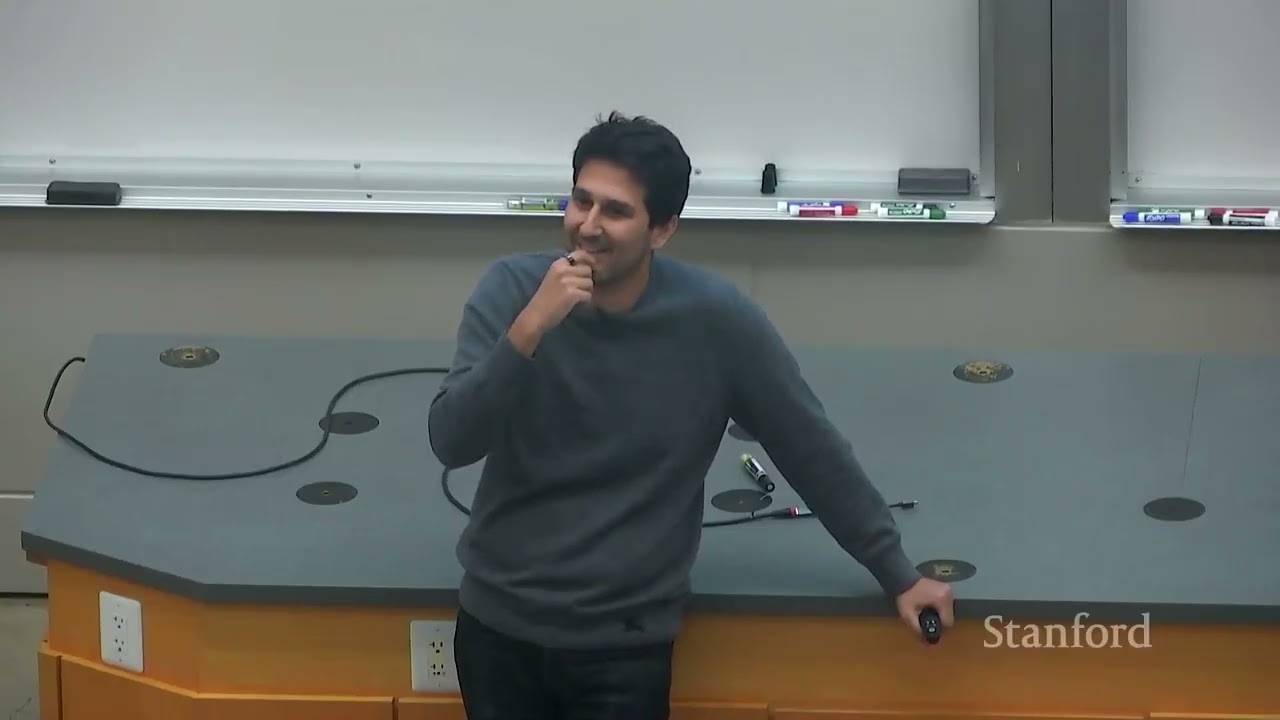
Stanford CS230 | Autumn 2025 | Lecture 8: Agents, Prompts, and RAG
Keywords
Summary
150 words
Critical Evaluation
This lecture is an excellent resource for anyone seeking a practical understanding of modern LLM application development. The instructors, Andrew Ng and Kian Katanforoosh, are highly credible figures in the AI community, and their expertise shines through in the clarity and depth of the content. The lecture is well-structured, starting with the limitations of base models and progressively building up to advanced concepts like RAG and agentic workflows. The explanations are clear, and the use of real-world examples and live demonstrations helps to ground the theoretical concepts. The discussion on fine-tuning is particularly valuable, as it provides a balanced perspective on when it is necessary and when it should be avoided. The lecture also addresses important considerations such as evaluation, latency, and sourcing, which are often overlooked in introductory materials. The content is up-to-date, reflecting the latest trends in the field, and the instructors are careful to distinguish between established techniques and emerging ideas. The interactive Q&A format adds to the engagement and allows for clarification of common questions. The only minor criticism is that the lecture could have benefited from more detailed coverage of specific prompting techniques, but this is a minor issue given the breadth of topics covered. Overall, this is a high-quality lecture that provides a solid foundation for anyone looking to build LLM-based applications.
218 words
Title / Content Match
The title accurately reflects the content, which focuses on agents, prompts, and RAG, as part of the CS230 lecture series.
Quality & Reliability
9/10
Lecture by renowned AI experts Andrew Ng and Kian Katanforoosh, part of Stanford's CS230 course. Content is well-structured, up-to-date, and covers both theoretical foundations and practical techniques. The lecture includes live demonstrations and interactive Q&A, enhancing credibility. Sources are referenced implicitly through course materials and linked resources.
Key Moments
Markers derived by PSI from the transcript: the creator did not define chapters.
- Introduction and agenda overview
- Challenges of base models: lack of domain knowledge, outdated info, control issues
- Discussion on controlling LLMs and examples of failures
- Limited context handling and needle-in-a-haystack problem
- Introduction to RAG and its advantages
- Prompting methods: few-shot, chain-of-thought, ReAct
- Fine-tuning: why avoid it and alternatives
- Deep dive into RAG: embedding, retrieval, and generation
- Agentic AI workflows: definition and examples
- Case study: evaluating agent performance
- Multi-agent systems and future directions
Cited Sources
- CS230 Syllabus — Course syllabus and schedule for CS230, providing context for the lecture.
- CS230 Deep Learning Course Page — Official course page for enrollment and further information.
- Stanford AI Programs — Information about Stanford's AI professional and graduate programs.
- CS230 Lecture Playlist — Playlist containing all CS230 lectures.
Concurring Sources
- Stanford CS230 Syllabus — The syllabus outlines the course structure and confirms the lecture topics.
Contribution & Novelties
This lecture provides a comprehensive and up-to-date overview of techniques for enhancing LLM applications, with a strong emphasis on practical implementation. It offers a clear framework for understanding the trade-offs between prompting, fine-tuning, and RAG, and introduces agentic workflows as a paradigm shift. The lecture stands out for its balanced perspective, acknowledging the hype while providing concrete guidance.
Pour aller plus loin :
- Retrieval-Augmented Generation for Large Language Models: A Survey — A comprehensive survey of RAG methods and applications.
- ReAct: Synergizing Reasoning and Acting in Language Models — The paper introducing the ReAct prompting method.
- Chain-of-Thought Prompting Elicits Reasoning in Large Language Models — The paper on chain-of-thought prompting.
- Agentic AI: A New Paradigm — An article by Andrew Ng discussing agentic AI workflows.
125 words
Radar Profile
The radar profile shows high scores across all dimensions, indicating a well-rounded and reliable lecture. The strong scores in information quantity and quality reflect the comprehensive coverage and expert presentation, while the technical level is appropriately high for an advanced course. The overall reliability is excellent, making this a valuable resource for learners.
💬 Très positif. Sur les 30 commentaires analysés, les spectateurs expriment une admiration unanime pour la clarté et la pertinence de la conférence, la qualifiant de 'meilleure vidéo sur l'IA' et la recommandant vivement.