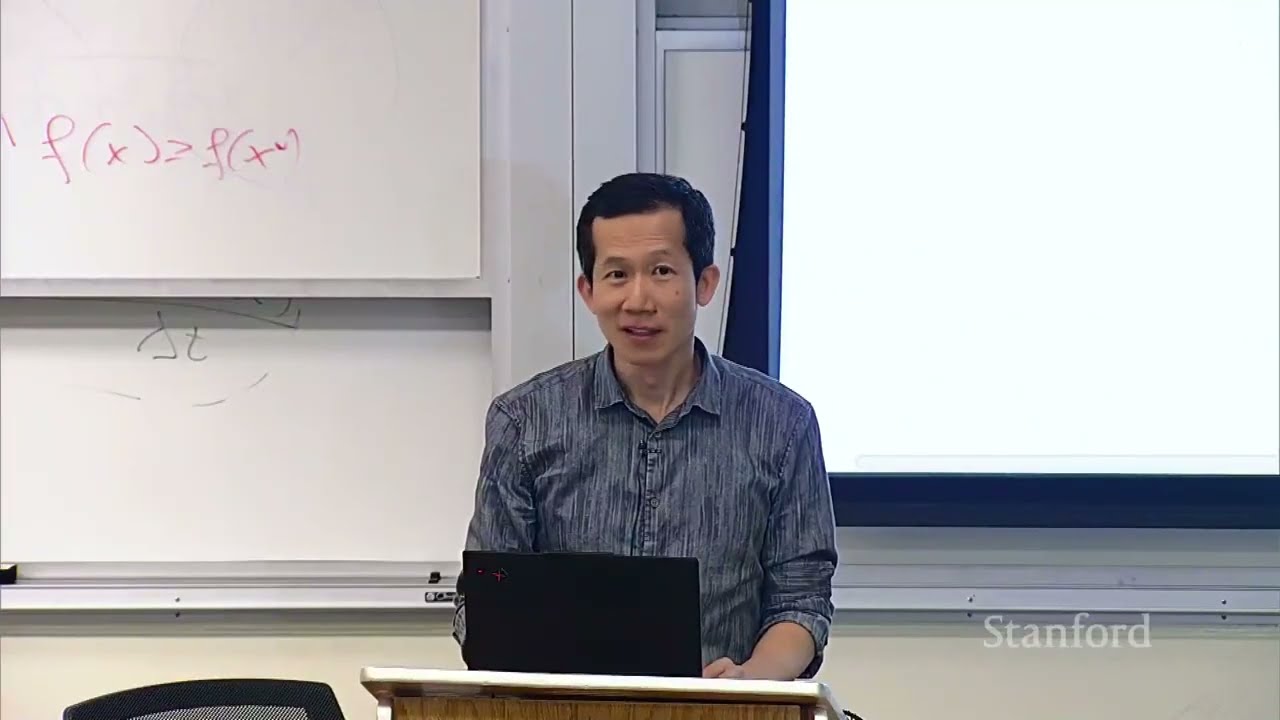
Stanford CS336 Language Modeling from Scratch | Spring 2026 | Lecture 1: Overview, Tokenization
Keywords
Summary
163 words
Critical Evaluation
This lecture provides an excellent introduction to the field of language modeling, delivered by leading experts. The content is scientifically rigorous, with a clear emphasis on understanding the underlying mechanisms rather than just using pre-trained models. The instructors successfully convey the importance of building models from scratch to gain deep insights, and they honestly address the limitations of small-scale experiments in predicting large-scale behavior. The discussion of the bitter lesson is particularly nuanced, correcting common misconceptions and emphasizing the role of algorithmic efficiency. The historical overview is well-contextualized, tracing key developments from Shannon to GPT-3. The technical section on tokenization is thorough, covering both theoretical foundations and practical implementation details. The lecture is well-structured, with clear learning objectives and a logical flow. The use of concrete examples and references to seminal papers enhances credibility. However, the lecture is primarily an overview, and some topics are only briefly touched upon, which is expected for an introductory session. The instructors’ enthusiasm and expertise are evident, making the content engaging. Overall, this is a high-quality educational resource that provides a solid foundation for understanding language models.
183 words
Title / Content Match
The title accurately reflects the content: a course lecture on building language models from scratch, covering overview and tokenization.
Quality & Reliability
9/10
Lecture by Stanford professors with deep expertise in language models. Content is well-structured, references key papers and concepts, and emphasizes empirical rigor. No obvious errors or unsupported claims.
Key Moments
Markers derived by PSI from the transcript: the creator did not define chapters.
- Introduction and course staff introductions
- Course philosophy: building from scratch
- Discussion on why understanding language models is necessary for fundamental research
- Challenges of industrialization and frontier models
- Three types of knowledge: mechanics, mindset, intuitions
- The bitter lesson and algorithmic efficiency
- History of language models from Shannon to GPT-3
- Introduction to tokenization and its importance
- Tokenization algorithms: BPE, unigram, and practical considerations
- Course structure and assignments overview
Cited Sources
- CS336 Course Website — Course syllabus and materials
- Stanford Online Course Page — Enrollment and course information
- Stanford AI Programs — Information about Stanford's AI programs
- CS336 YouTube Playlist — All course lectures
Concurring Sources
- CS336 Course Website — Official course materials and syllabus
Contribution & Novelties
This lecture provides a comprehensive overview of language modeling from scratch, emphasizing the importance of understanding the full stack. It offers a clear framework for categorizing knowledge (mechanics, mindset, intuitions) and discusses the transferability of these across scales. The historical context and the discussion of the bitter lesson provide valuable insights for researchers.
Pour aller plus loin :
- The Bitter Lesson — Richard Sutton’s essay on the importance of general-purpose methods that scale.
- Scaling Laws for Neural Language Models — Kaplan et al. paper on scaling laws.
- Language Models are Few-Shot Learners — GPT-3 paper.
- Attention Is All You Need — Transformer architecture paper.
- SwiGLU: Gated Linear Units — Shazeer’s paper on SwiGLU activation.
114 words
Radar Profile
The radar profile shows high scores across all dimensions, indicating a well-balanced and comprehensive lecture. The strongest aspects are the quantity and quality of information, with slightly lower but still high scores for technical depth and reliability.