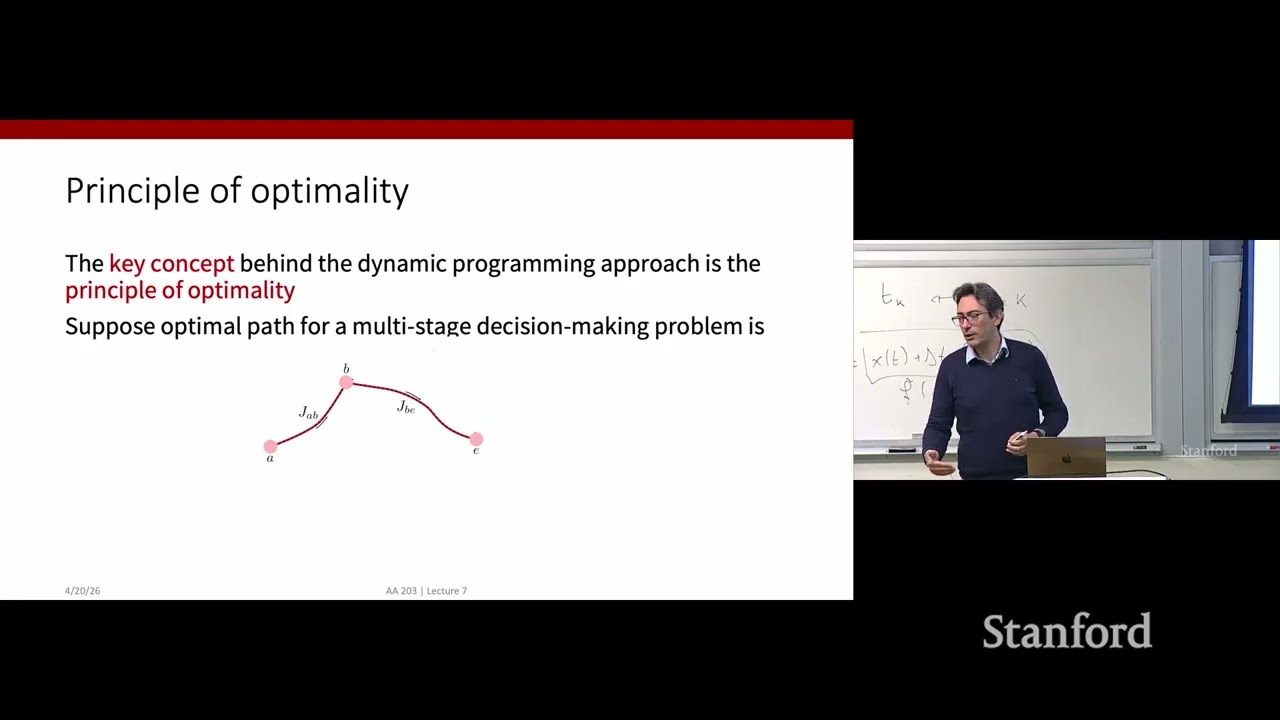
Stanford AA203 Optimal and Learning-Based Control | Spring 2026 | Lecture 7: Dynamic Programming
Keywords
Summary
156 words
Critical Evaluation
The lecture provides a rigorous and well-structured introduction to dynamic programming for optimal control. The instructor, Prof. Marco Pavone, is a leading expert in the field, and his expertise is evident in the clarity of the presentation. The content is mathematically sound, with derivations and proofs that are accessible to graduate students. The use of a shortest path example effectively illustrates the mechanics of DP and the computational savings it offers. The derivation of the LQR solution is particularly valuable, as it demonstrates how DP can be applied to a classic problem and yields a closed-form solution. The lecture also touches on important practical considerations, such as the curse of dimensionality and the need for approximations. The sources cited are the course materials and the companion textbook, which are appropriate for a university lecture. The title accurately reflects the content, and the lecture fulfills its educational objectives. The only minor weakness is that the lecture does not provide external references beyond the course materials, but this is typical for a lecture and does not detract from the quality. Overall, this is an excellent lecture that provides a solid foundation for further study in optimal control.
195 words
Title / Content Match
The title accurately reflects the content: the lecture covers dynamic programming and discrete-time LQR, as part of the AA203 course.
Quality & Reliability
9/10
Lecture by a recognized expert (Prof. Marco Pavone) from Stanford University, part of a formal course. The content is mathematically rigorous, with derivations and proofs. The presentation is clear and well-structured. The source is a university channel, and the lecture is based on a companion textbook. Minor limitations: no external sources cited beyond course materials, and the lecture is an introduction to the topic.
Key Moments
Markers derived by PSI from the transcript: the creator did not define chapters.
- Introduction and recap of open-loop optimal control methods
- Motivation for closed-loop control and introduction to dynamic programming
- Formulation of discrete-time optimal control problem
- Principle of optimality and its proof
- Illustration of DP with a shortest path example
- Discussion of curse of dimensionality and computational challenges
- Derivation of LQR solution using DP
- Riccati equations and linear feedback form
- Summary and outlook for future lectures
Cited Sources
- AA203 Course Page — Course information and enrollment details
- Principles of Robot Autonomy (Companion Textbook) — Free online textbook accompanying the course
- AA203 Course Schedule and Syllabus — Course schedule and syllabus for Spring 2026
- Lecture 7 Slides — Slides for this lecture
- AA203 Full Playlist — Full playlist of lectures for the course
Concurring Sources
- Principles of Robot Autonomy — Companion textbook that covers similar material in depth.
Contribution & Novelties
This lecture provides a clear and rigorous introduction to dynamic programming for optimal control, emphasizing the principle of optimality and its application to derive the DP recursion. The LQR derivation is particularly valuable, showing how DP simplifies to matrix recursions and yields a linear feedback policy. The lecture also highlights the computational challenges and the need for approximations, setting the stage for learning-based control.
Pour aller plus loin :
- Dynamic Programming (Wikipedia) — General overview of dynamic programming.
- Bellman equation (Wikipedia) — The fundamental equation underlying dynamic programming.
- Linear–quadratic regulator (Wikipedia) — Detailed treatment of LQR.
- Riccati equation (Wikipedia) — Mathematical background on Riccati equations.
- Model Predictive Control (Wikipedia) — Related method for closed-loop control.
115 words
Radar Profile
The radar profile shows high scores across all dimensions, indicating a well-rounded and reliable lecture. The strongest aspects are the quantity and quality of information, as well as the technical level, which are appropriate for a graduate course. The reliability is also high due to the expertise of the instructor and the academic context.
💬 No comments were provided for analysis.