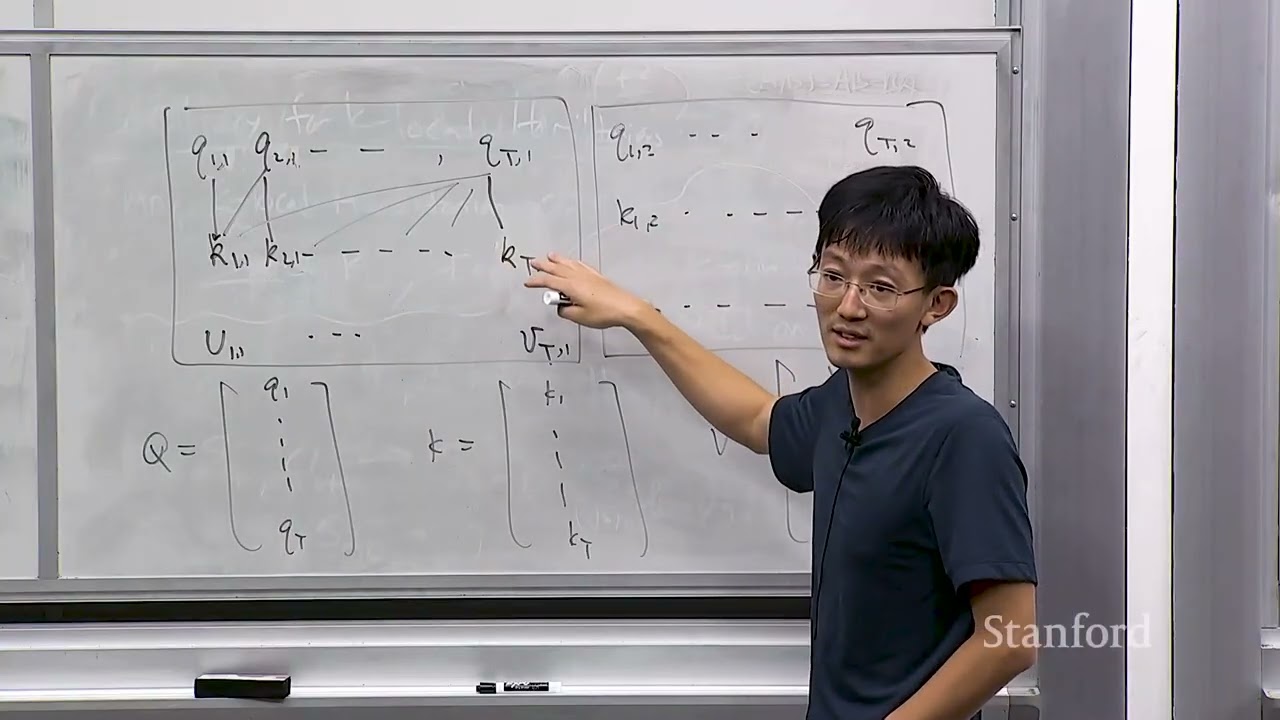
Stanford CS229 Machine Learning | Spring 2026 | Lecture 16: Basic Concept in RL, Policy Gradient
Keywords
Summary
147 words
Critical Evaluation
The lecture provides a solid introduction to reinforcement learning, building on previous knowledge of machine learning and neural networks. The instructor’s explanations are clear and well-structured, with a logical progression from basic concepts to more advanced policy gradient methods. The use of mathematical notation and derivations adds rigor, though the transcription may miss some visual details. The content is accurate and aligns with standard RL literature. The lecture references specific techniques like GQA and mentions models like Qwen and DeepSeek, grounding the discussion in current research. However, the lecture assumes prior knowledge of calculus, probability, and optimization, making it suitable for advanced students. The adéquation between title and content is high, as the lecture indeed covers basic RL concepts and policy gradients. The main limitation is the incomplete transcription, which may omit important visual explanations. Overall, this is a high-quality educational resource from a reputable institution.
146 words
Title / Content Match
The title accurately reflects the lecture content, which covers basic concepts in reinforcement learning and policy gradient methods.
Quality & Reliability
8/10
Lecture by Stanford professors (Chris Ré and Tengyu Ma) from a reputable university course. The content is technical and based on established research in machine learning, with references to specific models (e.g., GQA, MQA) and concepts. However, the transcription is incomplete and lacks visual aids, limiting full evaluation.
Key Moments
Markers derived by PSI from the transcript: the creator did not define chapters.
- Introduction and overview of the lecture topics.
- Review of transformer architecture and attention mechanism.
- Discussion of KV cache and memory constraints in inference.
- Introduction to group query attention (GQA) and its benefits.
- Transition to reinforcement learning: definition of MDP.
- Explanation of value functions and policies.
- Introduction to policy gradient methods and the policy gradient theorem.
- Derivation of the policy gradient and Monte Carlo estimation.
- Discussion of variance reduction techniques: baselines and advantage functions.
- Overview of actor-critic methods and REINFORCE algorithm.
Cited Sources
- CS229 Course Website — Official course page with syllabus and materials.
- Stanford AI Professional Programs — Information about Stanford's AI programs.
Concurring Sources
- Reinforcement Learning: An Introduction — Standard textbook that aligns with the concepts presented in the lecture.
- Policy Gradient Methods for Reinforcement Learning with Function Approximation — Foundational paper on policy gradient methods.
Contribution & Novelties
The lecture provides a clear and rigorous introduction to reinforcement learning, particularly focusing on policy gradient methods. It bridges the gap between theoretical foundations and practical implementation, making it valuable for students and practitioners. The instructor’s emphasis on variance reduction and the derivation of the policy gradient theorem is particularly instructive.
Pour aller plus loin :
- Reinforcement Learning: An Introduction — The classic textbook by Sutton and Barto, providing comprehensive coverage of RL.
- Policy Gradient Methods — Original paper by Sutton et al. introducing policy gradient methods.
- Trust Region Policy Optimization — A popular policy gradient algorithm that improves stability.
- Proximal Policy Optimization — A widely used policy gradient method in practice.
112 words
Radar Profile
The radar profile shows high scores in technical level and information quality, indicating a rigorous and detailed lecture. The lower score in information quantity suggests that the lecture may not cover a wide range of topics but focuses deeply on the core concepts.