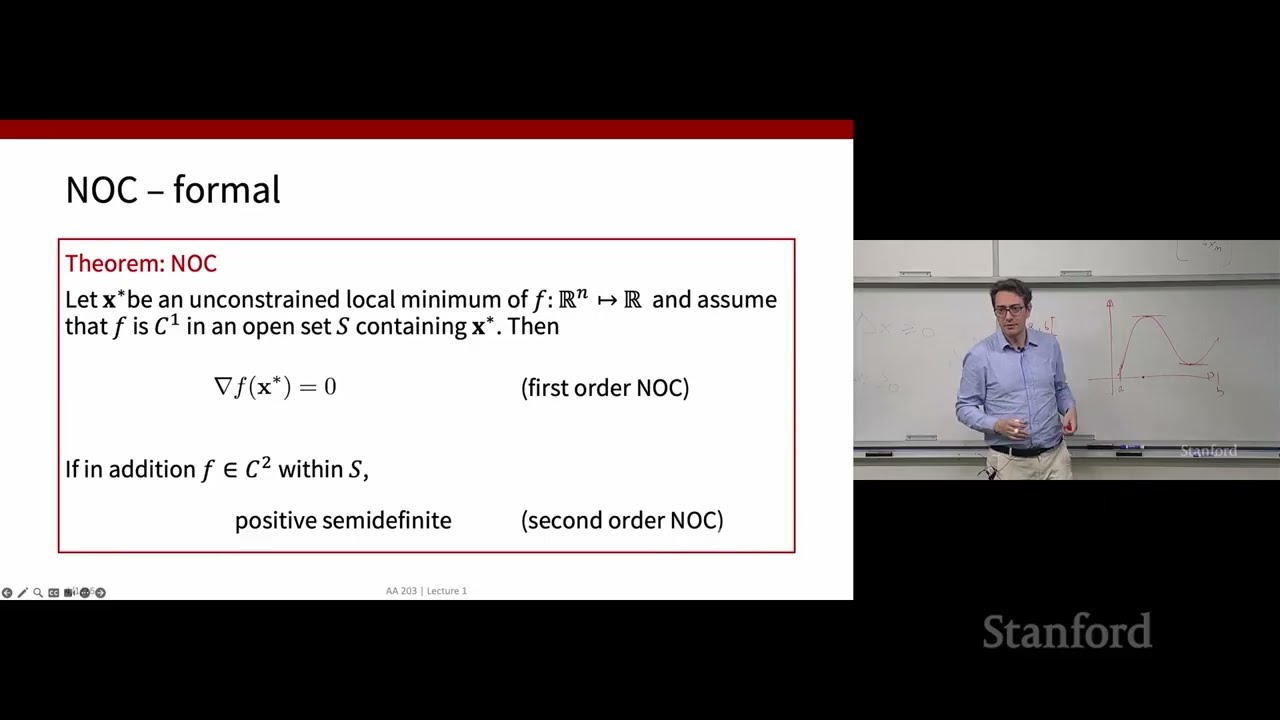
Stanford AA203 Optimal and Learning-Based Control | Spring 2026 | Lecture 2: Optimization Theory
Keywords
Summary
151 words
Critical Evaluation
The lecture provides a rigorous and well-structured introduction to optimization theory, essential for the course’s focus on optimal control. Professor Pavone’s derivations are clear and methodical, building from first principles. The use of necessary and sufficient conditions is well-explained, with a concrete example illustrating the insufficiency of the gradient condition. The introduction of convexity is timely and sets the stage for later topics. The mathematical rigor is high, with careful attention to technical details such as the requirement of an open set for the necessary conditions. The lecture is interactive, with students asking clarifying questions, which enhances understanding. The content is accurate and aligns with standard optimization theory. The sources cited are authoritative, including the companion textbook and course materials. The only minor weakness is that the lecture is introductory and does not delve into advanced topics, but that is appropriate for the course structure. Overall, this is an excellent lecture that effectively conveys the foundational concepts needed for optimal control.
161 words
Title / Content Match
The title accurately reflects the content: a lecture on optimization theory within an optimal control course.
Quality & Reliability
9/10
Lecture by a renowned professor from Stanford, part of an official course, with rigorous mathematical derivations and references to a companion textbook.
Key Moments
Markers derived by PSI from the transcript: the creator did not define chapters.
- Introduction and overview of the lecture's focus on classical optimization.
- Definition of local and global minima and the goal of deriving necessary conditions.
- First-order Taylor expansion and derivation of the gradient condition.
- Proof that gradient must be zero at a local minimum using perturbation arguments.
- Introduction of second-order conditions and positive semidefinite Hessian.
- Statement of the necessary optimality conditions theorem.
- Discussion of sufficient conditions with positive definite Hessian.
- Introduction to convex sets and functions.
- Definition of convex functions and their properties.
- Wrap-up and transition to next topics.
Cited Sources
- AA203 Course Page — Course information and enrollment details.
- Principles of Robot Autonomy (Companion Textbook) — Recommended reading for the course.
- AA203 Course Schedule and Syllabus — Course schedule and syllabus.
- Lecture 2 Slides — Slides used in this lecture.
- AA203 Full Playlist — All lectures in the course.
Concurring Sources
- Principles of Robot Autonomy — Companion textbook that likely covers similar optimization fundamentals.
Contribution & Novelties
This lecture provides a rigorous foundation in optimization theory tailored for optimal control, emphasizing necessary and sufficient conditions and introducing convexity. It bridges classical optimization with learning-based control, setting the stage for advanced topics.
Pour aller plus loin :
- Convex optimization — Relevant for understanding the importance of convexity in optimization.
- Karush–Kuhn–Tucker conditions — Extends necessary conditions to constrained problems.
- Positive-definite matrix — Key concept for second-order conditions.
68 words
Radar Profile
The radar profile shows high scores across all dimensions, indicating a technically rigorous and well-sourced lecture. The balance between information quantity and quality is strong, with a high level of technical depth appropriate for the intended audience.