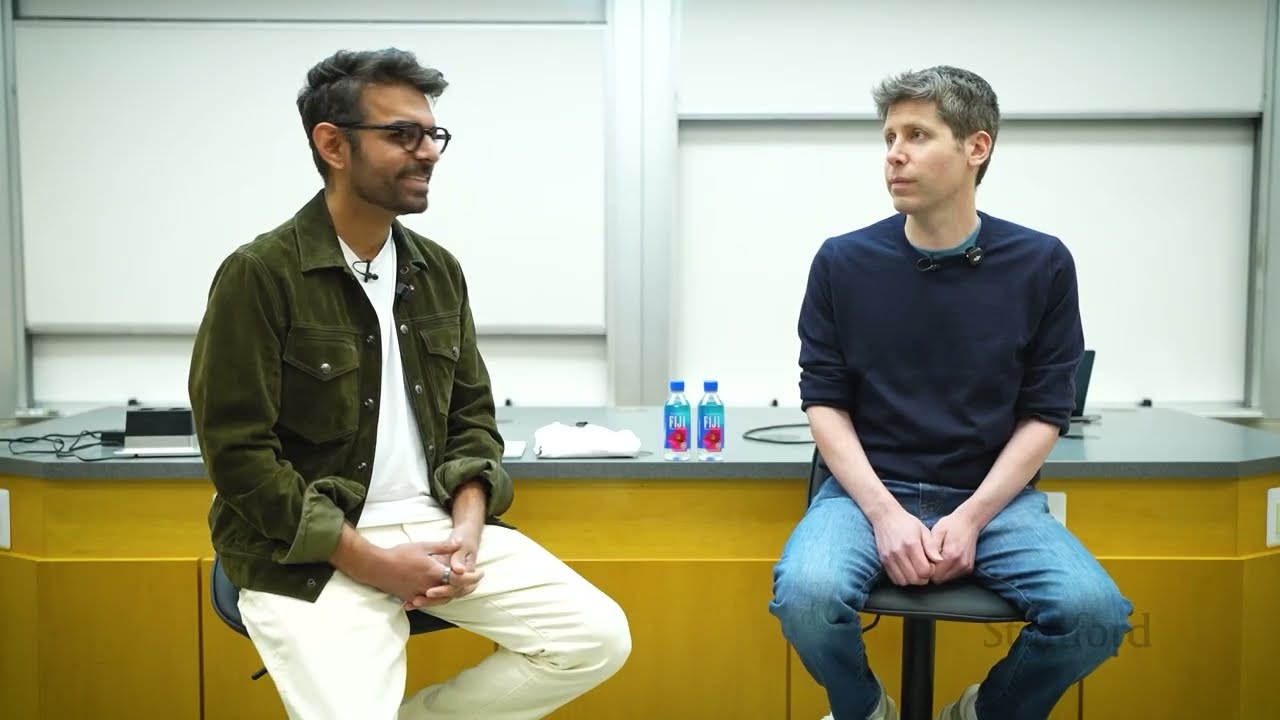
Stanford CS153 Frontier Systems | Scale, AGI, and the Future of Everything
Keywords
Summary
141 words
Critical Evaluation
The lecture provides valuable insights from a leading figure in AI, offering a unique perspective on scaling and strategic decision-making. Altman’s emphasis on empirical observations over theoretical explanations is refreshing, though it lacks rigorous scientific validation. The discussion on emergent properties is compelling but relies on anecdotal evidence. The comparison between ChatGPT and Codex offers practical lessons in product development and market timing. The electricity analogy for AI is thought-provoking, but its implications for regulation and societal impact are not deeply explored. The warning about compute shortage is timely and highlights an often-overlooked bottleneck. The Q&A format allows for spontaneous and candid responses, enhancing authenticity. However, the content is opinion-based and may not be suitable for those seeking technical details. The production quality is high, with clear audio and video. Overall, the lecture is intellectually stimulating and provides a strategic overview of AI development, but it lacks the depth of a formal scientific analysis.
154 words
Title / Content Match
The title accurately reflects the content, focusing on frontier systems, scale, and AGI implications.
Quality & Reliability
8/10
The content is an expert lecture by Sam Altman, CEO of OpenAI, sharing empirical insights and strategic perspectives. The information is anecdotal and opinion-based, but the speaker is highly credible in the field. The video is produced by Stanford Online, adding institutional credibility. However, the claims are not peer-reviewed and rely on personal experience.
Key Moments
Markers derived by PSI from the transcript: the creator did not define chapters.
- Altman reflects on teaching CS183 in 2014 and how startup playbook has changed.
- Discussion on scale and emergent properties, with Y Combinator example.
- Altman explains the origin of ChatGPT and its unexpected viral success.
- Comparison between ChatGPT and Codex, highlighting different paths to success.
- Altman discusses the need for a fundamental rewrite of the training pipeline.
- Electricity analogy for AI as a utility and the challenge of democratization.
- Warning about compute shortage and its implications for AI development.
- Advice for students to consider working on inference infrastructure.
Cited Sources
- CS153 Course Website — Course syllabus and schedule for Stanford CS153 Frontier Systems.
- Stanford Online AI Programs — Information about Stanford's online AI programs.
Concurring Sources
- Scaling Laws for Neural Language Models — Empirical scaling laws that support Altman's claims about scale.
- Emergent Abilities of Large Language Models — Research on emergent properties in large models, consistent with Altman's observations.
Dissenting Sources
- On the Dangers of Stochastic Parrots — This paper criticizes the scale-focused approach, arguing that large language models can perpetuate biases and have environmental costs, contrasting with Altman's optimistic view.
Contribution & Novelties
The lecture offers a unique insider perspective on scaling AI systems and the strategic decisions behind OpenAI’s success. Altman’s emphasis on empirical observations over theoretical models provides a pragmatic approach to AI development. The discussion on the electricity analogy for AI is a novel framing that could influence how we think about AI’s societal role.
Pour aller plus loin :
- Scaling Laws for Neural Language Models — This paper by Kaplan et al. provides the foundational empirical scaling laws that Altman references.
- Emergent Abilities of Large Language Models — This paper discusses emergent properties in large models, aligning with Altman’s observations.
- The Bitter Lesson — Rich Sutton’s essay on the importance of scale and computation in AI, complementing Altman’s views.
120 words
Radar Profile
The radar profile shows high scores in information quantity and quality, reflecting the depth of insights shared. The technical level is moderate, suitable for a general audience, while reliability is slightly lower due to the opinion-based nature. Overall, the lecture is informative and credible, but not a rigorous scientific analysis.
💬 Positif. Sur les 30 commentaires analysés, la majorité exprime gratitude et admiration pour le contenu, avec quelques critiques sur la durabilité du modèle économique d'OpenAI.