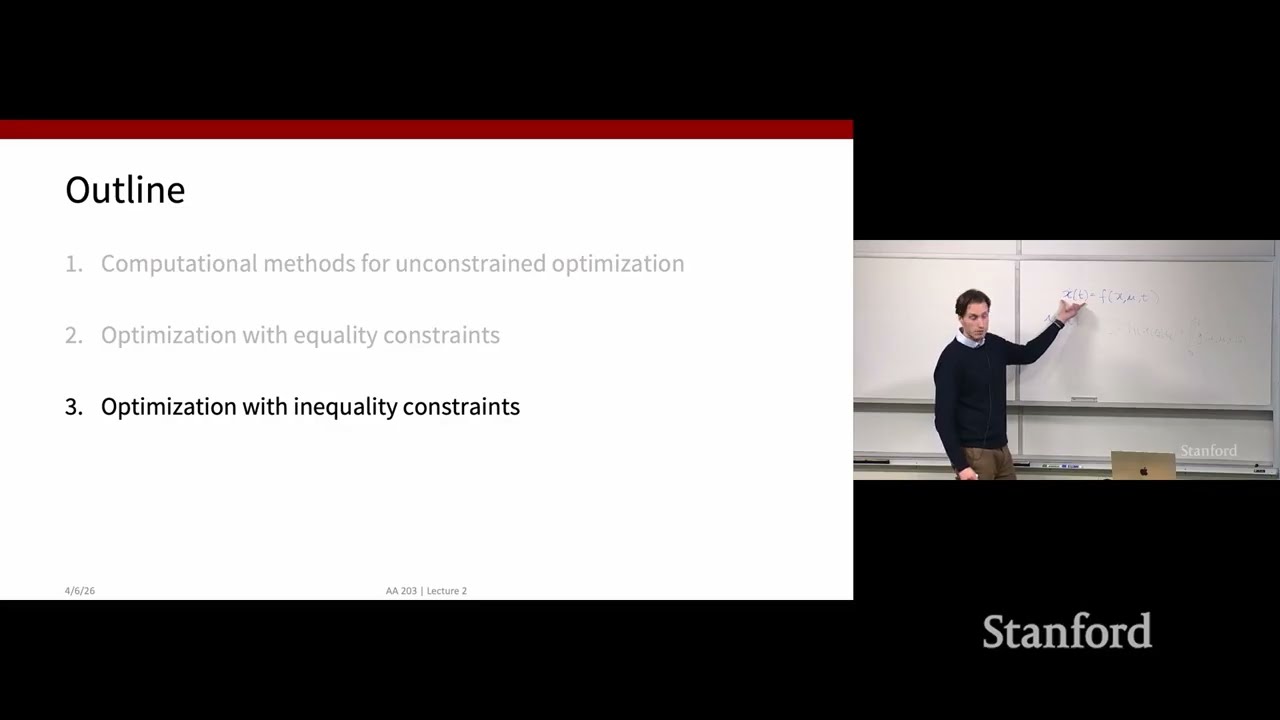
Stanford AA203 Optimal and Learning-Based Control | Spring 2026 | Lecture 3: Calculus of Variations
Keywords
Summary
122 words
Critical Evaluation
The lecture provides a solid introduction to the calculus of variations within the context of optimal control. The instructor, Dr. Daniele Gammelli, demonstrates deep expertise in the subject, and the content is mathematically rigorous. The progression from finite-dimensional optimization to infinite-dimensional problems is logical and helps build intuition. The treatment of inequality constraints via active sets is standard and well-explained, though the discussion with a student about boundary conditions could be clearer. The lecture effectively bridges the gap between optimization theory and control, setting the stage for more advanced topics. The use of a companion textbook and course materials adds credibility. However, the lecture is quite technical and may be challenging for those without a strong background in calculus and optimization. The video quality is good, and the instructor’s explanations are clear, though the pacing is brisk. Overall, this is a high-quality educational resource for graduate students in engineering or applied mathematics.
152 words
Title / Content Match
The title accurately reflects the content: a lecture on calculus of variations within an optimal control course.
Quality & Reliability
8/10
Lecture by a Stanford-affiliated researcher, part of a formal course, with references to a companion textbook and course materials. Content is rigorous and mathematically sound, but not peer-reviewed.
Key Moments
Markers derived by PSI from the transcript: the creator did not define chapters.
- Introduction and review of optimal control problem formulation.
- Discussion of inequality constraints and active/inactive sets.
- Derivation of necessary optimality conditions for inequality constraints.
- Transition to infinite-dimensional optimal control and calculus of variations.
- Introduction to the Euler-Lagrange equation.
- Discussion of transversality conditions and boundary conditions.
- Examples illustrating the calculus of variations.
- Summary and connection to next lectures.
Cited Sources
- AA203 Course Page — Course information and enrollment details.
- Principles of Robot Autonomy — Companion textbook referenced in the lecture.
- Course Schedule and Syllabus — Course schedule and syllabus.
- Lecture Slides — Slides used in this lecture.
- Full Playlist — Playlist of all lectures in the course.
Concurring Sources
- Principles of Robot Autonomy — Companion textbook likely covers similar material.
- Course Lecture Slides — Slides align with the lecture content.
Contribution & Novelties
This lecture provides a clear and rigorous introduction to the calculus of variations as applied to optimal control, bridging finite-dimensional optimization and infinite-dimensional problems. It is part of a structured course, offering a systematic treatment of necessary conditions for optimality. The lecture is particularly valuable for its pedagogical approach, using active constraints to simplify inequality-constrained problems.
Pour aller plus loin :
- Calculus of variations — Foundational concept covered in the lecture.
- Euler–Lagrange equation — Central equation derived in the lecture.
- Optimal control — Broader field context.
- Pontryagin’s maximum principle — Related necessary condition for optimal control.
- Lagrange multipliers — Technique used for constrained optimization.
104 words
Radar Profile
The radar profile shows high scores in technical level and information quality, with moderate scores in quantity and reliability. This indicates a technically dense and reliable lecture, but with limited breadth and some potential for improvement in source verification.