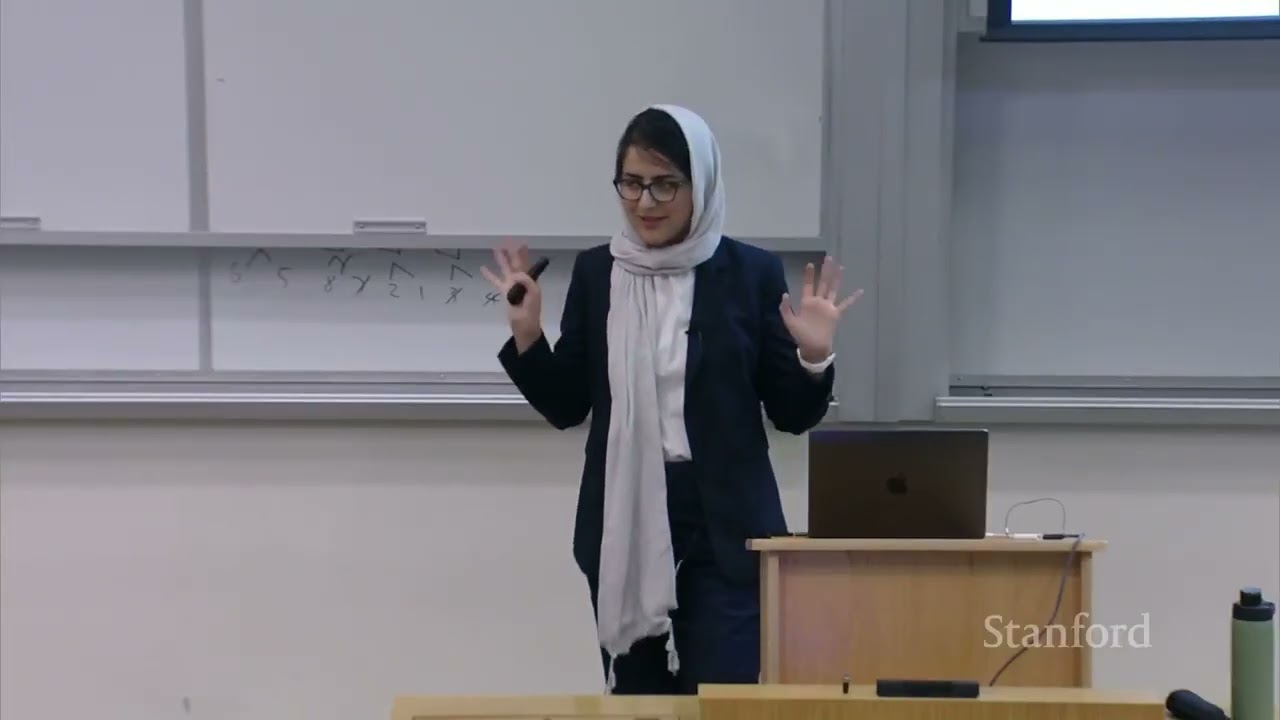
Stanford Robotics Seminar ENGR319 | Spring 2026 | Interactive Autonomy
Keywords
Summary
167 words
Critical Evaluation
The seminar provides a comprehensive and well-articulated overview of the challenges and solutions in interactive autonomy for robotics. Negar Mehr’s presentation is logically structured, starting with motivating examples, then formalizing the problem, and finally presenting her lab’s contributions. The use of game theory, specifically potential games, is a strong theoretical foundation that offers computational advantages, as demonstrated by the 20x speedup in solving for equilibria. The experimental validations on quadcopters and quadruped robots add credibility to the claims. However, the talk is primarily a high-level overview; some technical details are glossed over, and the audience is assumed to have a background in control theory and optimization. The speaker does not delve into the limitations of the potential game approach, such as scenarios where the assumptions of symmetry or potential structure may not hold. Additionally, while the talk mentions learning methods, it does not provide concrete results or comparisons. The sources cited are limited to the seminar schedule and general Stanford pages, but the speaker references her own published work without providing specific citations. Overall, the content is scientifically sound and valuable for researchers in robotics and multi-agent systems, but it could benefit from more depth and explicit references. The title accurately reflects the content, and the presentation quality is high.
210 words
Title / Content Match
The title accurately reflects the content: a seminar on interactive autonomy in robotics, covering multi-agent interaction, game-theoretic planning, and learning.
Quality & Reliability
8/10
Presentation by a recognized academic (UC Berkeley professor) with clear theoretical foundations (game theory, potential games) and practical demonstrations. Claims are supported by references to published work, though not all details are provided. The talk is well-structured and technically sound.
Key Moments
Markers derived by PSI from the transcript: the creator did not define chapters.
- Introduction to the problem of robots interacting in unstructured environments, with examples of failures.
- Explanation of the need for joint prediction and planning, and the concept of theory of mind.
- Formalization of multi-agent interactions as dynamic games and introduction of Nash equilibria.
- Discussion of the computational challenges in finding equilibria and the introduction of potential games.
- Demonstration of the potential game approach on quadcopters, with performance benchmarks.
- Extension to constrained problems, such as two robots transporting a rigid object.
- Overview of learning methods for interactive domains, including imitation and reinforcement learning.
- Discussion of safety and perception challenges in interactive autonomy.
- Conclusion and future research directions.
Cited Sources
- Stanford Online Graduate Education — Mentioned as a resource for Stanford's graduate programs.
- Stanford Robotics Seminar Schedule — Provided as a link to follow along with the seminar schedule.
Concurring Sources
- Potential game - Wikipedia — Supports the theoretical foundation of potential games.
- Nash equilibrium - Wikipedia — Supports the game-theoretic solution concept.
Contribution & Novelties
The talk presents a novel perspective on using potential games to simplify the computation of Nash equilibria in multi-agent robotic systems, achieving significant speedups. It also extends the approach to handle constraints and discusses learning methods for interactive domains.
Pour aller plus loin :
- Potential game - Wikipedia — Provides background on potential games, a key concept in the talk.
- Nash equilibrium - Wikipedia — Fundamental concept in game theory used in the talk.
- Reinforcement learning - Wikipedia — Relevant to the learning methods discussed.
- Imitation learning - Wikipedia — Relevant to the learning methods discussed.
96 words
Radar Profile
The radar profile shows high scores in quantity and quality of information, with a moderate technical level. The reliability is strong, reflecting the speaker's expertise and the soundness of the presented research.
💬 Très positif. Sur les 30 commentaires analysés, la grande majorité exprime une admiration et un enthousiasme pour la conférence, saluant la clarté de l'exposé et la pertinence des travaux présentés.