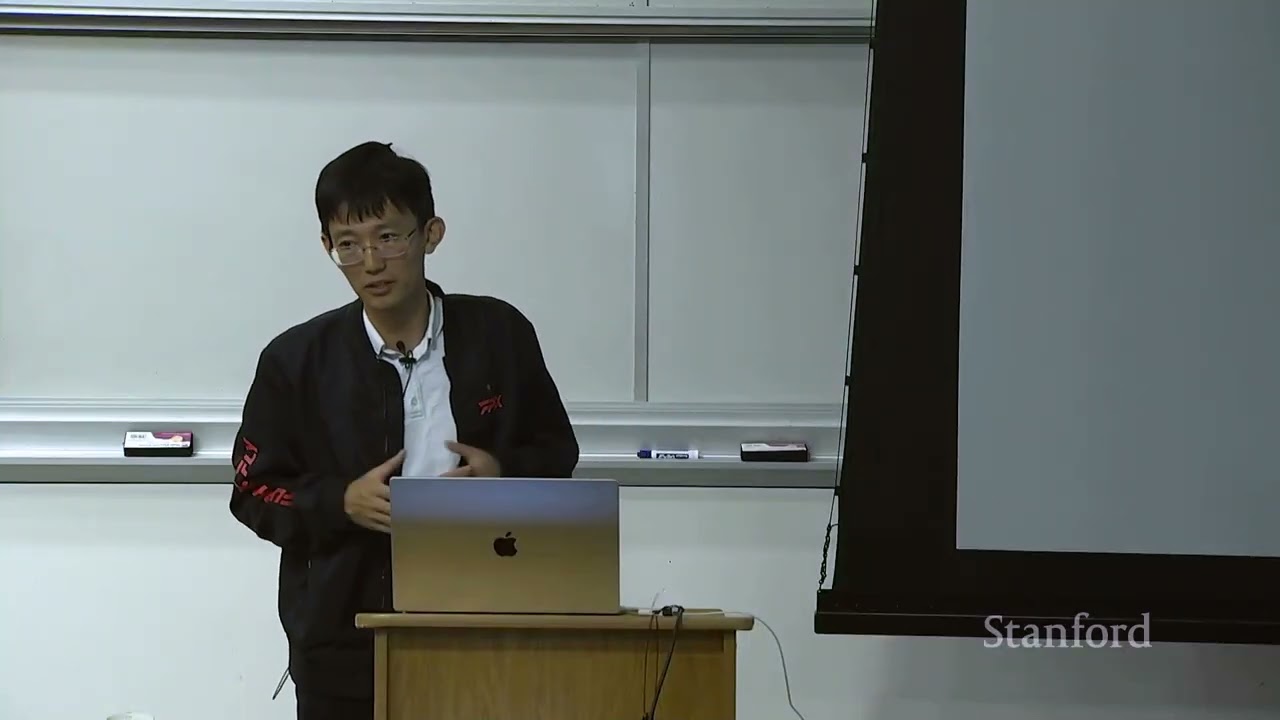
Stanford CS229 Machine Learning | Spring 2026 | Lecture 1: Introduction
Keywords
Summary
179 words
Critical Evaluation
The lecture serves as a solid introduction to the CS229 course, providing essential administrative information and a high-level overview of machine learning. The instructor, Tengyu Ma, is a Stanford professor with expertise in deep learning theory and AI for science, lending credibility to the content. The lecture is well-structured, starting with practical course details and then moving to conceptual foundations. The use of classic definitions (1959 and Tom Mitchell’s 1998) grounds the discussion in established literature, though no specific sources are cited beyond the course website. The explanation of Mitchell’s definition is clear, breaking down experience, tasks, and performance measures, and relating them to modern contexts like synthetic data and general-purpose models. The taxonomy of supervised, unsupervised, and reinforcement learning is presented as a reasonable view, acknowledging the lack of consensus due to the field’s rapid evolution. The house price prediction example effectively illustrates supervised learning and introduces notation and the regression/classification distinction. However, the lecture is introductory and does not delve into technical depth, which is expected for a first lecture. The AI tools policy is discussed, but the instructor’s stance is somewhat ambiguous, and the policy’s details are deferred to the website. The lecture’s strength lies in its clarity and accessibility, making it suitable for students new to ML. The title accurately reflects the content. Overall, the lecture is informative and sets appropriate expectations for the course, though it lacks in-depth scientific content and external references.
238 words
Title / Content Match
The title accurately reflects the content: a first lecture introducing the course and basic ML concepts.
Quality & Reliability
8/10
Lecture by a Stanford professor, part of a renowned course. Content is introductory but accurate, with references to classic definitions and course materials. No citations to external sources beyond course website.
Key Moments
Markers derived by PSI from the transcript: the creator did not define chapters.
- Introduction and course logistics: teaching staff, prerequisites, and course structure.
- Discussion of AI tools policy and its rationale.
- Introduction to machine learning definitions, including 1959 and Tom Mitchell's 1998 definitions.
- Breakdown of Mitchell's definition: experience, tasks, and performance measure.
- Taxonomy of machine learning: supervised, unsupervised, and reinforcement learning.
- Example of supervised learning: house price prediction, introducing notation and regression vs. classification.
- Preview of upcoming lectures on fitting functions, optimizers, and loss functions.
Cited Sources
- CS229 Course Website — Course syllabus and materials
- Stanford AI Programs — Information about Stanford's AI professional and graduate programs
Concurring Sources
- CS229 Course Website — Official course materials align with lecture content.
Contribution & Novelties
This lecture provides a clear and accessible introduction to machine learning, emphasizing foundational definitions and a taxonomy of learning paradigms. It bridges classic concepts with modern developments, such as synthetic data and general-purpose models. The discussion of AI tools policy reflects contemporary considerations in education.
Pour aller plus loin :
- Machine Learning (Wikipedia) — Overview of the field and its history.
- Tom Mitchell’s definition of machine learning — Source of the 1998 definition.
- Supervised learning (Wikipedia) — Detailed explanation of supervised learning.
- Reinforcement learning (Wikipedia) — Overview of reinforcement learning.
90 words
Radar Profile
The radar profile shows high scores in quality of information and reliability, reflecting the authoritative source and accurate content. The quantity of information and technical level are moderate, consistent with an introductory lecture. Overall, the lecture is well-balanced for its purpose.