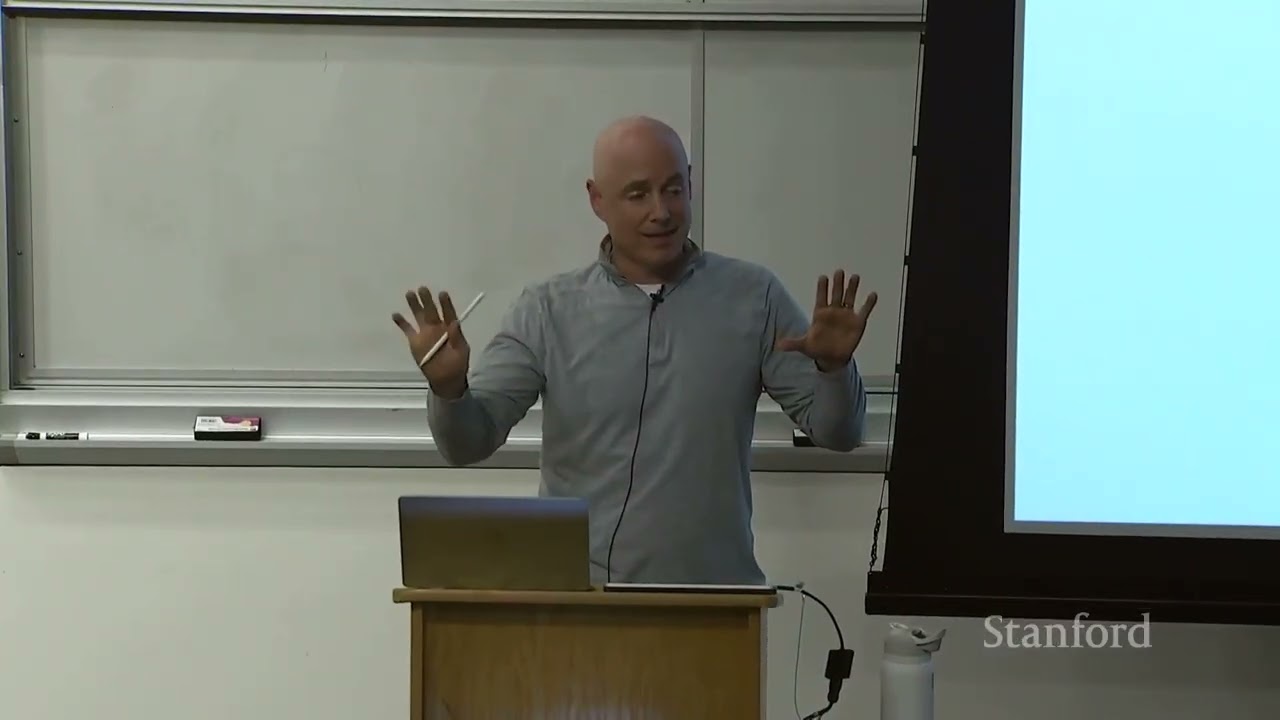
Stanford CS229 Machine Learning | Spring 2026 | Lecture 2: Supervised Learning Setup
Keywords
Summary
206 words
Critical Evaluation
The lecture provides a solid introduction to supervised learning, with clear explanations of key concepts such as hypothesis, training set, and generalization. The instructor’s emphasis on the simplicity of gradient descent and its scalability is well-justified, as these methods have indeed driven much of modern machine learning. The mathematical presentation is rigorous but accessible, with notation introduced gradually. However, the lecture lacks depth in certain areas: for instance, the concept of generalization is only briefly touched upon, and the discussion of bias-variance tradeoff is absent. The sources cited are limited to course materials, which is appropriate for a lecture but does not provide external validation. The title accurately reflects the content, and the lecture is well-structured. The pacing is appropriate, and the instructor encourages questions, fostering engagement. Overall, the lecture is informative and serves as a good foundation for the course, though it could benefit from more concrete examples and a deeper discussion of the underlying theory.
157 words
Title / Content Match
The title accurately reflects the content: a lecture on supervised learning setup, covering hypothesis, training set, and linear regression.
Quality & Reliability
8/10
Lecture by a Stanford professor, part of a well-established course, with clear mathematical exposition and references to course notes. However, no external sources are cited beyond course materials, and the content is introductory.
Key Moments
Markers derived by PSI from the transcript: the creator did not define chapters.
- Introduction to supervised learning and course structure
- Definition of hypothesis and examples of input/output spaces
- Explanation of training set and supervised learning setup
- Introduction to linear regression and cost function
- Derivation of gradient descent and its variants
- Discussion on normal equations and matrix notation
- Advice on course resources and data visualization
Cited Sources
- CS229 Course Website — Course materials, syllabus, and notes
- Stanford AI Programs — Information about Stanford's AI professional and graduate programs
Concurring Sources
- CS229 Course Notes — Comprehensive course notes that complement the lecture
Contribution & Novelties
This lecture provides a clear and structured introduction to supervised learning, emphasizing the importance of simple algorithms like gradient descent in scaling to large models. It serves as a foundation for understanding more advanced topics in machine learning.
Pour aller plus loin :
- Linear Regression — Provides a comprehensive overview of linear regression, including its mathematical formulation and applications.
- Gradient Descent — Explains the optimization algorithm in detail, including variants like stochastic gradient descent.
- Ames Housing Dataset — The dataset used in the lecture, available for practice and exploration.
89 words
Radar Profile
The radar profile shows high scores in information quality and reliability, with moderate technical depth and information quantity. This indicates a well-structured lecture that is reliable but may not delve deeply into advanced topics.