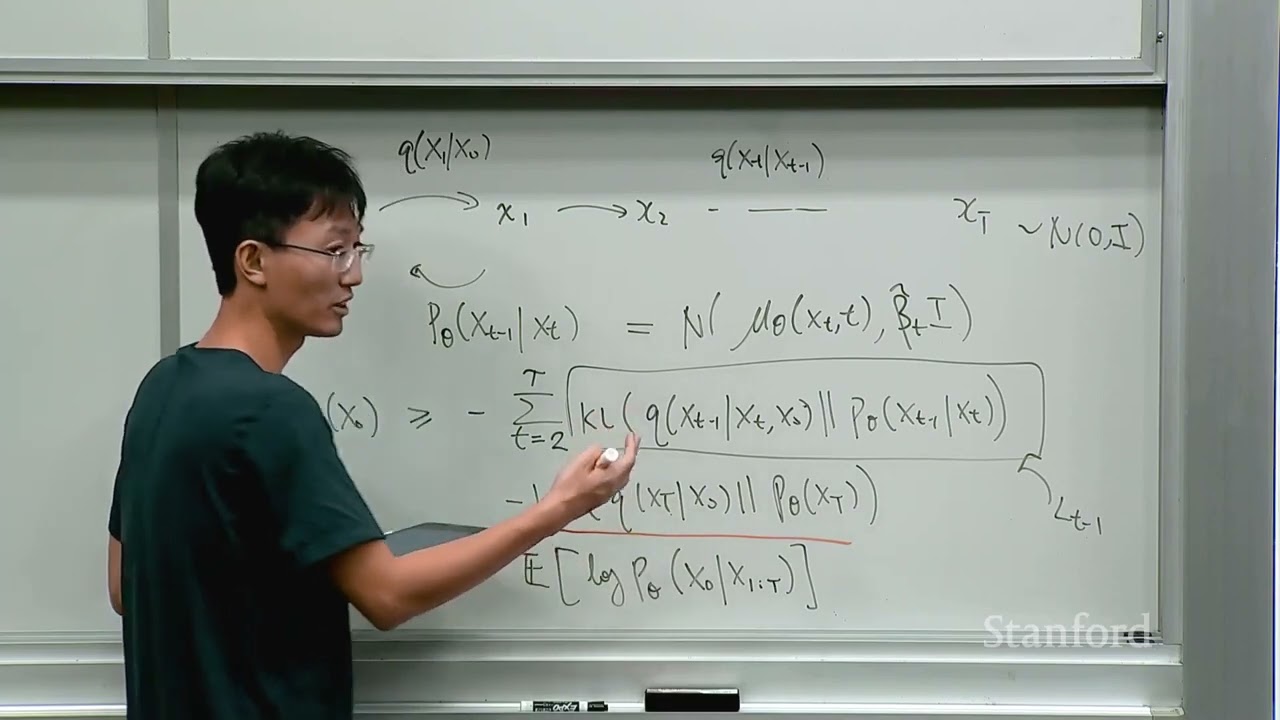
Stanford CS229 Machine Learning | Spring 2026 | Lecture 12: Representation Learning
Keywords
Summary
137 words
Critical Evaluation
The lecture provides a solid, mathematically rigorous derivation of the diffusion model training objective. The instructor carefully explains the ELBO, the KL divergence terms, and the simplification to the mean-squared error loss. The explanation of why the L1 term can be unified with the other terms is particularly insightful. However, the lecture is limited in scope: it only covers the loss function derivation and does not discuss practical implementation details, sampling, or architectural choices. The transition to the course roadmap is brief and lacks depth. The title ‘Representation Learning’ is misleading, as the lecture focuses on diffusion models and only briefly mentions foundation models. The instructors are clearly knowledgeable, and the content is accurate, but the lecture feels like a fragment of a larger course rather than a self-contained lesson. The lack of citations or references to external sources is a minor weakness, but typical for a lecture. Overall, the lecture is valuable for students already familiar with the basics of generative models, but it may be too advanced for beginners.
171 words
Title / Content Match
The title mentions 'Representation Learning' but the lecture primarily covers diffusion models and introduces foundation models. The title is somewhat misleading.
Quality & Reliability
8/10
Lecture from a prestigious university, presented by established professors. Content is technical and rigorous, but limited to a subset of the course material. No external sources cited within the video itself.
Key Moments
Markers derived by PSI from the transcript: the creator did not define chapters.
Cited Sources
- CS229 Course Website — Course materials and syllabus
- Stanford AI Professional Programs — Information about Stanford's AI programs
Concurring Sources
- Denoising Diffusion Probabilistic Models — Original paper on DDPMs, which the lecture's content is based on.
Contribution & Novelties
The lecture provides a clear and rigorous derivation of the diffusion model loss function, emphasizing the unification of the L1 term with the other terms. It also sets the stage for a series of lectures on foundation models and large language models.
Pour aller plus loin :
- Diffusion Models — Overview of diffusion models.
- Variational Bayesian methods — Background on variational inference.
- Kullback-Leibler divergence — Mathematical foundation for the loss.
- Foundation models — Context for the upcoming lectures.
78 words
Radar Profile
The radar profile shows high scores in technical level and information quality, but lower in quantity of information and global reliability due to the limited scope and lack of external references.