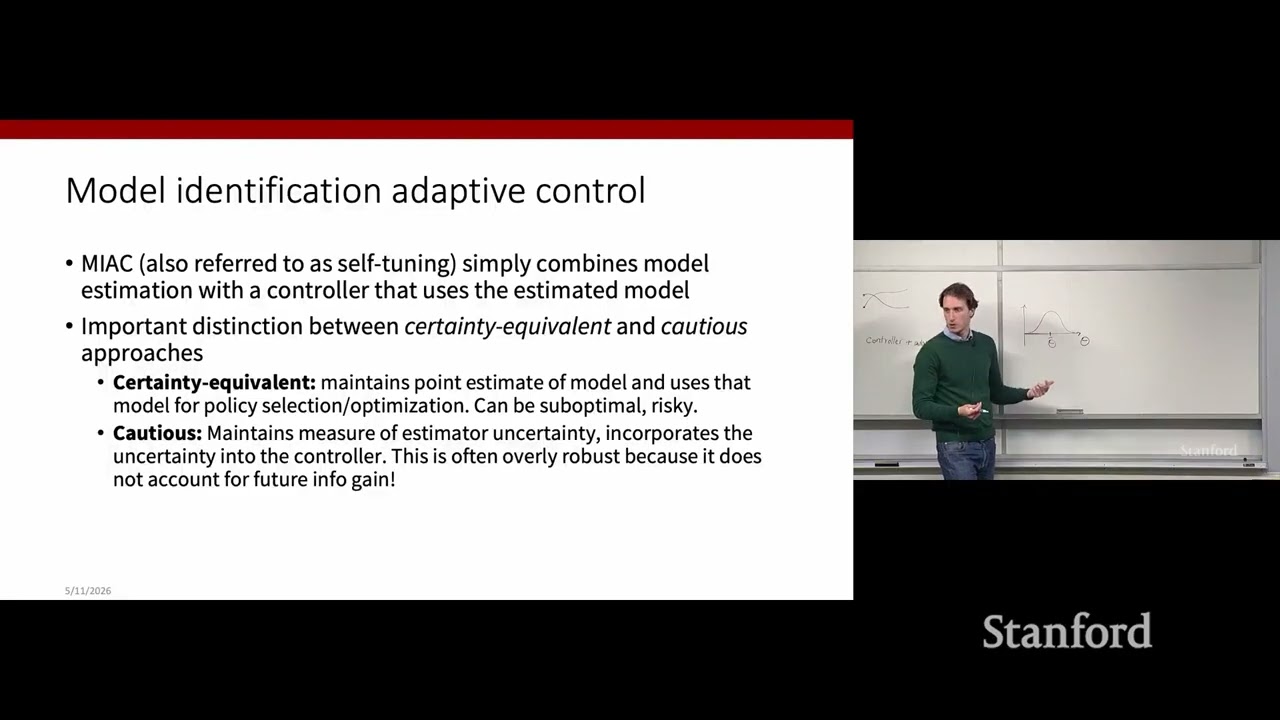
Stanford AA203 Optimal and Learning-Based Control | Spring 2026 | Lecture 14: Intro to IL and RL
Keywords
Summary
166 words
Critical Evaluation
Value of the Information & Strength of the Argument
The lecture provides a solid conceptual foundation for understanding IL and RL in the context of control. It clearly explains the motivation for moving from model-based to learning-based approaches, and systematically contrasts IL and RL, highlighting their respective strengths and limitations. The argumentation is logical and well-supported with examples, such as autonomous driving and robot manipulation. The instructor also addresses student questions, clarifying nuances like the performance ceiling in IL and the potential for combining IL and RL. The content is up-to-date, referencing recent trends in foundation models and end-to-end learning, making it relevant to current research and industry practice.
Scientific Rigor, Source Quality, Title Accuracy
The lecture is scientifically rigorous, drawing on established concepts from control theory and machine learning. The instructor references the course textbook ‘Principles of Robot Autonomy’ and mentions the standard RL textbook by Sutton and Barto, both reputable sources. The title accurately reflects the content, which is an introductory lecture on IL and RL. The presentation is well-structured, with clear definitions and examples. The instructor’s credentials and affiliation with Stanford and AI4I lend credibility to the content. No commercial or promotional content was present.
198 words
Title / Content Match
The title accurately reflects the content: a lecture introducing imitation learning and reinforcement learning within the context of optimal and learning-based control.
Quality & Reliability
8/10
Lecture from a Stanford graduate course, presented by a researcher with a PhD in machine learning and optimization, affiliated with Stanford and the Italian Institute of AI. The content is rigorous, well-structured, and aligns with established literature in control and learning. The presentation is clear and includes interactive Q&A, enhancing its educational value.
Key Moments
Markers derived by PSI from the transcript: the creator did not define chapters.
- Recap of learning-based control: system identification and adaptive control (MRAC, MIAC).
- Transition to imitation learning and reinforcement learning; motivation from recent robotics progress.
- Introduction to supervised learning formalism and maximum likelihood estimation.
- Definition of imitation learning and its two main families: behavior cloning and inverse reinforcement learning.
- Discussion on behavior cloning: direct policy learning from demonstrations.
- Introduction to inverse reinforcement learning: inferring reward functions from expert behavior.
- Comparison of IL and RL, and discussion on combining them in a layered training pipeline.
Cited Sources
- AA203 Course Page — Course information and enrollment details.
- Principles of Robot Autonomy — Companion textbook for the course.
- AA203 Course Schedule and Syllabus — Course schedule and syllabus.
- Lecture Slides (Lecture 4) — Slides for this lecture.
- AA203 Full Playlist — Playlist of all course lectures.
Concurring Sources
- Reinforcement Learning: An Introduction — Mentioned in the lecture as a key reference for reinforcement learning.
Contribution & Novelties
This lecture provides a clear and accessible introduction to imitation learning and reinforcement learning, specifically tailored for a control-oriented audience. It bridges classical optimal control with modern learning-based approaches, emphasizing the conceptual shift from model-based to data-driven methods. The lecture’s value lies in its pedagogical clarity, making complex topics approachable while maintaining technical rigor. It also highlights the practical relevance of these methods in current robotics and autonomous systems, referencing recent industry trends.
Pour aller plus loin :
- Reinforcement Learning: An Introduction (Sutton & Barto) — The standard textbook on reinforcement learning, providing a comprehensive foundation.
- Imitation Learning: A Survey of Learning Methods — A survey of imitation learning techniques, offering a broader perspective.
- Inverse Reinforcement Learning — The seminal paper by Ng and Russell on inverse reinforcement learning, foundational to the topic.
133 words
Radar Profile
The radar profile shows a balanced performance across all dimensions, with slightly higher scores in information quantity and quality, reflecting the lecture's comprehensive and well-structured content. The technical level is appropriate for a graduate course, and the overall reliability is high due to the instructor's expertise and the use of reputable sources.
💬 No comments were provided for analysis.