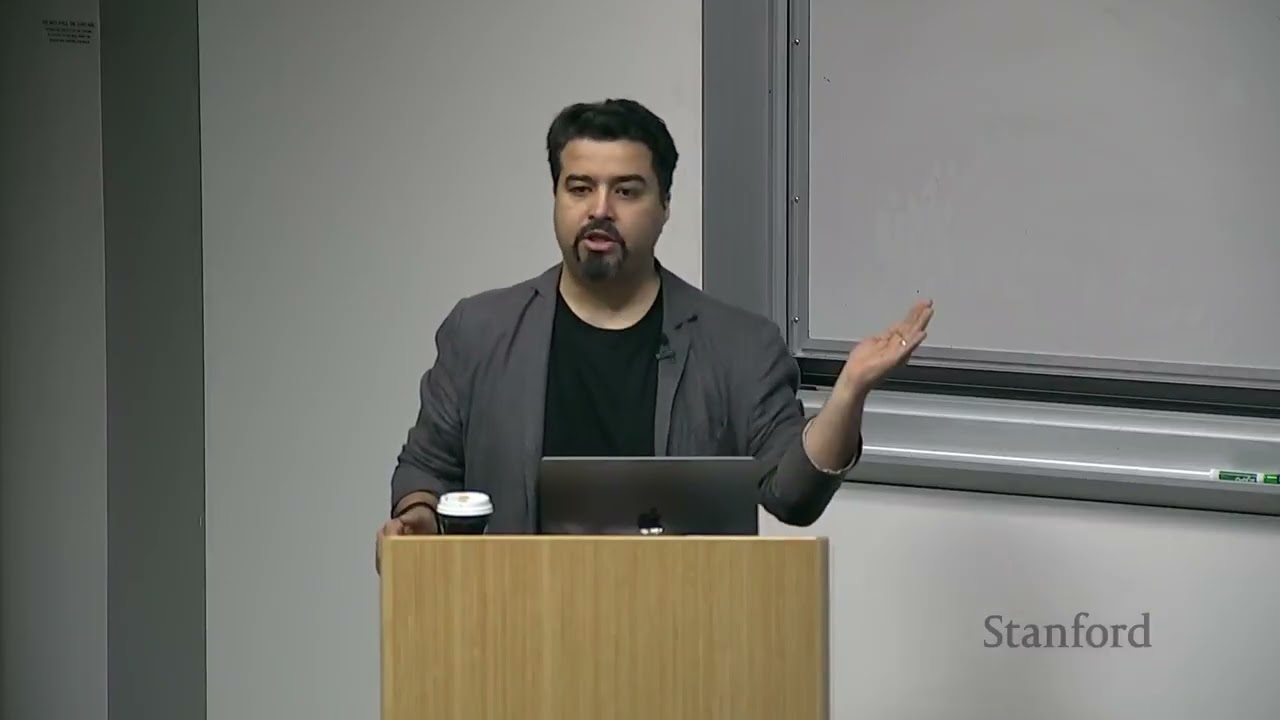
Stanford CS231N | Spring 2025 | Lecture 12: Self-Supervised Learning
Keywords
Summary
183 words
Critical Evaluation
The lecture provides a solid introduction to self-supervised learning, covering both classical pretext tasks and modern contrastive approaches. The instructor, Ehsan Adeli, is an assistant professor at Stanford, lending credibility. The content is well-structured, starting with motivation and then systematically presenting methods. The explanation of pretext tasks is clear, with concrete examples like rotation prediction and jigsaw puzzles. The discussion of contrastive learning is particularly valuable, as it connects to recent advances in the field. However, the lecture is an overview rather than a deep dive; some technical details, such as specific loss functions or architecture choices, are glossed over. The sources cited are primarily the course materials and general Stanford pages, not specific papers, which limits the ability to verify claims. The lecture does not include any public comments, so no analysis of audience reception is possible. Overall, the lecture is accurate and informative, suitable for students with some background in deep learning. The title accurately reflects the content. The main strength is the clear pedagogical approach, while the main weakness is the lack of detailed references and the brevity of some explanations.
184 words
Title / Content Match
The title accurately reflects the content, which is a lecture on self-supervised learning within the CS231N course.
Quality & Reliability
8/10
Lecture from Stanford University, presented by an assistant professor, covering established concepts in self-supervised learning with references to published papers. The content is accurate and well-structured, though it is an educational overview rather than a peer-reviewed source.
Key Moments
Markers derived by PSI from the transcript: the creator did not define chapters.
- Introduction and motivation for self-supervised learning
- Definition of pretext task and downstream task
- Examples of pretext tasks: rotation, jigsaw, completion, colorization
- Evaluation criteria for self-supervised learning
- Rotation prediction example and results on CIFAR-10
- Transition to contrastive learning
- Contrastive learning: positive and negative pairs
- Discussion of loss functions and data augmentation
- Impact of self-supervised learning on language models and robotics
Cited Sources
- CS231N Course Website — Course syllabus and materials
- Stanford Online CS231N Course Page — Course enrollment information
- XCS231N Professional Education — Professional education version of the course
- Stanford AI Programs — Overview of Stanford's AI programs
- Course Playlist — Full lecture playlist
Concurring Sources
- Self-Supervised Learning on Wikipedia — General overview of self-supervised learning
Contribution & Novelties
This lecture provides a comprehensive overview of self-supervised learning, synthesizing classical pretext tasks and modern contrastive methods. It is particularly valuable for its clear explanation of the motivation and evaluation criteria, making it accessible to students. The lecture also highlights the broad applicability of SSL beyond computer vision, such as in NLP and robotics.
Pour aller plus loin :
- Self-supervised learning on Wikipedia — Overview of the concept and its applications.
- SimCLR paper — A key contrastive learning framework.
- MoCo paper — Momentum contrast for unsupervised visual representation learning.
- BYOL paper — Bootstrap Your Own Latent, a contrastive method without negative pairs.
102 words
Radar Profile
The radar chart shows a balanced profile with high scores in information quantity, quality, and reliability, and a slightly lower but still solid technical level. This indicates a well-rounded lecture that is both informative and credible.