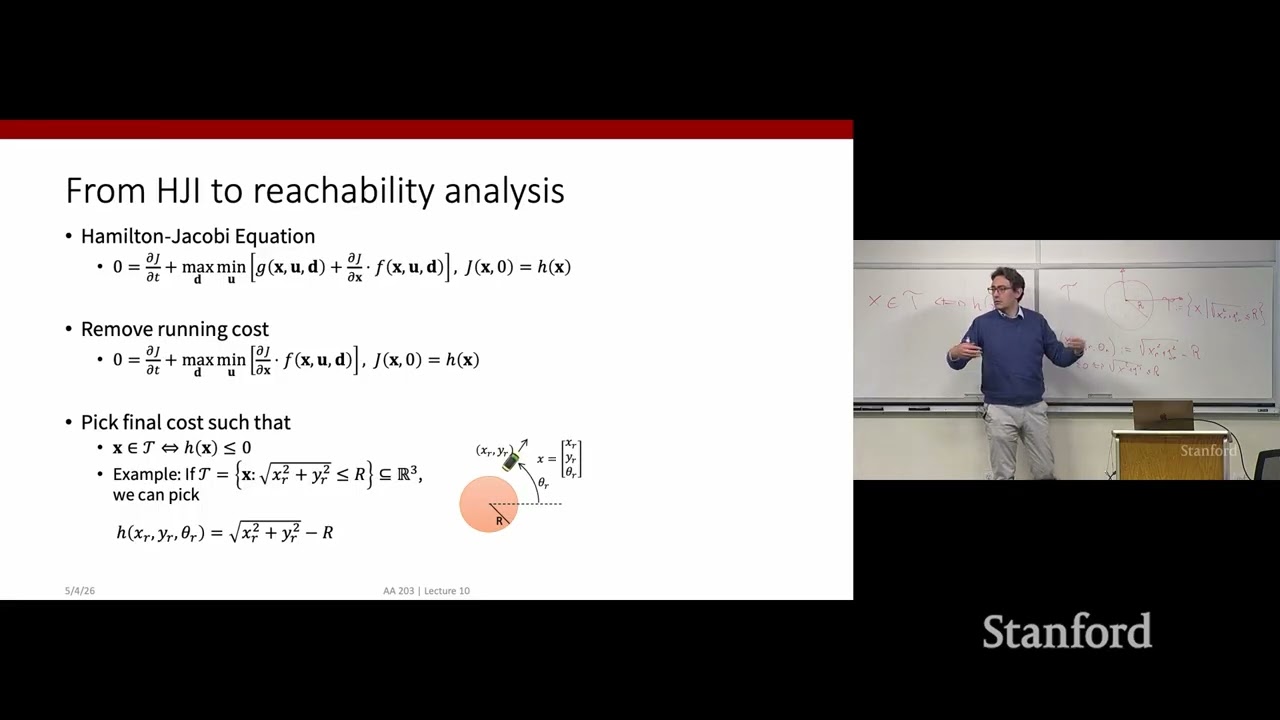
Stanford AA203 Optimal and Learning-Based Control | Spring 2026 | Lecture 11: Introduction to MPC
Keywords
Summary
149 words
Critical Evaluation
Value of the Information & Strength of the Argument
The lecture provides high-value information by bridging theoretical concepts (HJ reachability) with practical applications (collision avoidance). The argumentation is solid: the instructor builds from definitions, explains the mathematical formulation step-by-step, and uses a concrete example to illustrate the results. The discussion of reachable tubes adds depth, addressing a common limitation of point-wise safety. The transition to MPC is logical, highlighting its role in real-time control. The instructor’s expertise is evident, and the content is well-structured, making complex topics accessible without oversimplifying.
Scientific Rigor, Source Quality, Title Accuracy
The lecture demonstrates scientific rigor through precise mathematical derivations and references to established methods. The instructor cites the companion textbook ‘Principles of Robot Autonomy’ and provides lecture slides, which are reliable sources. The title accurately reflects the content: the lecture introduces MPC after covering reachability, which is a prerequisite for understanding MPC’s safety guarantees. The content is consistent with the course’s academic level and the instructor’s credentials. No external sources are cited beyond the course materials, but the depth of explanation and use of standard techniques support the lecture’s credibility.
186 words
Title / Content Match
The title accurately reflects the content: the lecture introduces Model Predictive Control (MPC) after a detailed discussion of reachability, which is a prerequisite for understanding MPC's safety guarantees.
Quality & Reliability
9/10
Lecture by a renowned expert (Prof. Marco Pavone) from Stanford, with clear mathematical derivations and references to established methods (HJ reachability). The content is rigorous and well-structured, though it is a lecture rather than peer-reviewed research.
Key Moments
Markers derived by PSI from the transcript: the creator did not define chapters.
- Introduction and recap of reachability theory
- Definition of avoidance and reachable sets
- Encoding set membership as terminal cost for HJ reachability
- Example of unicycle dynamics and target set as circle
- Discussion of reachable tubes and safety over full trajectory
- Aircraft collision avoidance example with HJ reachability
- Interpretation of reachable set shapes and time evolution
- Transition to Model Predictive Control (MPC) introduction
Cited Sources
- AA203 Optimal and Learning-Based Control course page — Course information and enrollment details
- Principles of Robot Autonomy (companion textbook) — Free online textbook referenced for further reading
- Course schedule and syllabus — Course schedule and syllabus
- Lecture slides for Lecture 11 — Slides used in the lecture
- Full playlist of AA203 lectures — Playlist of all lectures in the course
Concurring Sources
- Principles of Robot Autonomy — Companion textbook that likely covers similar topics in more depth.
- Lecture slides — Slides align with the lecture content.
Contribution & Novelties
The lecture provides a clear and rigorous introduction to HJ reachability and its application to safety-critical control, culminating in a transition to MPC. It offers a unique pedagogical approach by connecting theoretical concepts to a practical aircraft collision avoidance example. The discussion of reachable tubes adds depth, addressing a common limitation of point-wise safety. The lecture also highlights the importance of computing both the reachable set and the associated optimal control policy.
Pour aller plus loin :
- Hamilton–Jacobi–Bellman equation — Foundational to optimal control and reachability.
- Model predictive control — The main topic introduced at the end of the lecture.
- Reachability analysis — General concept of reachable sets in control theory.
- Differential game — Framework used for reachability computations.
119 words
Radar Profile
The radar profile shows high scores across all dimensions, indicating a well-balanced and comprehensive lecture. The strongest aspects are information quantity and quality, with slightly lower technical depth, reflecting the introductory nature of the lecture. Overall, this is an excellent resource for learning about reachability and MPC.