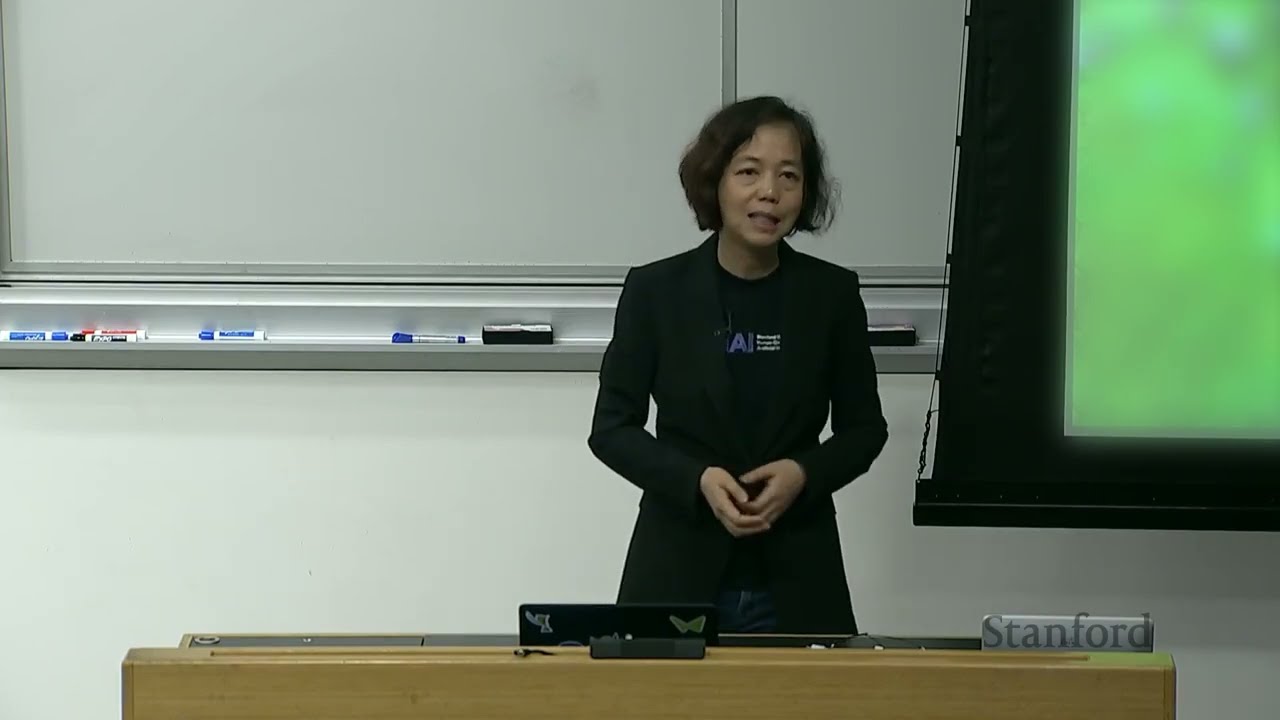
Stanford CS231N Deep Learning for Computer Vision | Spring 2025 | Lecture 1: Introduction
Keywords
Summary
205 words
Critical Evaluation
The lecture is an excellent introduction to the field of computer vision and deep learning, delivered by two leading experts. Fei-Fei Li’s presentation is engaging and provides a compelling narrative that connects the evolutionary origins of vision to the modern challenges in computer vision. The historical overview is well-researched and accurately highlights key milestones, such as Hubel and Wiesel’s Nobel Prize-winning work on the visual cortex and David Marr’s influential book. The discussion of the ill-posed nature of vision is particularly insightful, as it underscores the fundamental difficulty of the problem and sets the stage for the deep learning approaches that will be covered in the course. The contrast between vision and language is also thought-provoking, providing a philosophical perspective that enriches the technical content. Ehsan Adeli’s portion on course logistics is clear and informative, outlining the expectations for assignments, projects, and grading. The lecture is well-structured and accessible, making it suitable for both beginners and those with some background in the field. The sources cited are credible, including references to seminal papers and the course website. The only minor criticism is that the lecture is introductory and does not delve into technical details, but this is appropriate for a first lecture. Overall, this is a high-quality lecture that effectively sets the stage for the rest of the course.
219 words
Title / Content Match
The title accurately reflects the content: a lecture introducing the CS231N course, covering computer vision overview, course overview, and logistics.
Quality & Reliability
9/10
Lecture by renowned experts from Stanford University, providing a well-structured introduction to computer vision and deep learning. Content is based on established scientific knowledge and historical developments, with references to seminal works. High credibility due to institutional affiliation and expertise.
Key Moments
Markers derived by PSI from the transcript: the creator did not define chapters.
- Introduction by Fei-Fei Li, positioning computer vision within AI.
- Discussion of the Cambrian explosion and the evolutionary importance of vision.
- Overview of the history of computer vision, from camera obscura to modern cameras.
- Hubel and Wiesel's experiments on the visual cortex and the hierarchical nature of vision.
- Larry Roberts' PhD thesis and the birth of computer vision as a field.
- David Marr's book and the concept of primal sketch and 2.5D representation.
- Discussion on the ill-posed nature of vision and the challenge of 3D reconstruction.
- Contrast between vision and language, and implications for generative AI.
- Ehsan Adeli begins course overview, covering logistics and expectations.
- Details on assignments, projects, and grading for the course.
Cited Sources
- CS231N Course Website — Official course website with syllabus and materials.
- Stanford Online CS231N Course Page — Information about enrolling in the graduate course.
- XCS231N Professional Education Course — Details about the professional education version of the course.
- Stanford AI Programs — Overview of Stanford's online AI programs.
- CS231N Lecture Playlist — Playlist of all lectures for the course.
Concurring Sources
- CS231N Course Website — Course materials and syllabus align with the lecture content.
Contribution & Novelties
This lecture provides a comprehensive and engaging introduction to computer vision and deep learning, emphasizing the historical and evolutionary context. It offers a unique perspective on the ill-posed nature of vision and the differences between vision and language, which are crucial for understanding modern AI. The lecture sets the stage for the technical content of the course, making it an invaluable resource for learners.
Pour aller plus loin :
- Hubel and Wiesel’s Nobel Prize work — Foundational research on visual processing.
- David Marr’s book ‘Vision’ — Seminal work on computational vision.
- Cambrian explosion — Evolutionary event discussed in the lecture.
100 words
Radar Profile
The radar profile shows high scores in quality and reliability, with moderate scores in quantity and technical level, reflecting an introductory lecture that is well-produced and credible but not deeply technical.