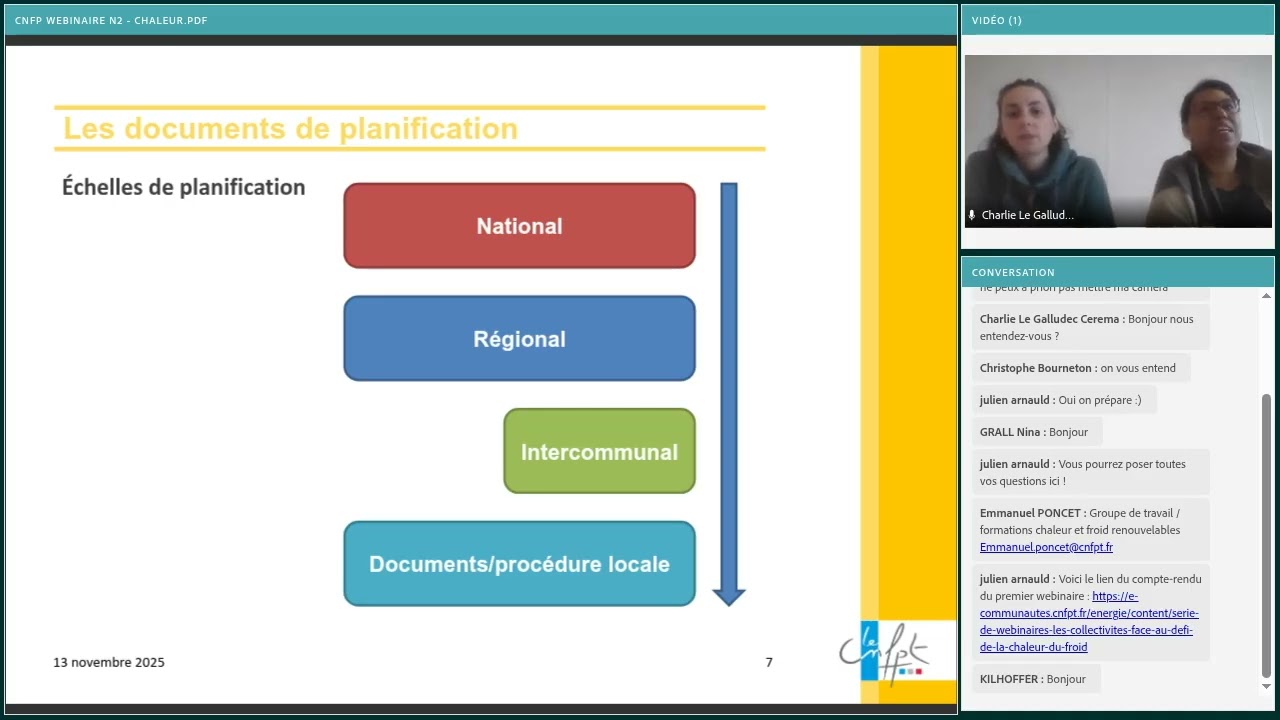
Les collectivités face au défi de la chaleur & du froid renouvelables 2/4 : solutions et soutiens
Keywords
Summary
177 words
Critical Evaluation
Value of the Information & Strength of the Argument
The webinar provides valuable, practical information for local authorities, detailing regulatory frameworks and financial support. The argumentation is solid, based on official documents and expert knowledge. The case study adds a concrete example, enhancing the credibility of the presented solutions.
Scientific Rigor, Source Quality, Title Accuracy
The webinar demonstrates scientific rigor by referencing official regulations, such as the LTECV and the PPE, and by involving experts from ADEME and CEREMA. The sources are credible and directly relevant. The title accurately reflects the content, which focuses on solutions and support. No public comments were provided for analysis.
105 words
Title / Content Match
The title accurately reflects the content, which focuses on solutions and support for local authorities in developing renewable heating and cooling.
Quality & Reliability
7/10
The webinar features experts from ADEME and CEREMA, providing detailed regulatory and technical information. The content is well-structured and based on official frameworks, though it is primarily a presentation of existing tools and support mechanisms rather than new research.
Key Moments
Markers derived by PSI from the transcript: the creator did not define chapters.
- Introduction and welcome by Vanessa, presentation of the webinar structure.
- Emmanuel Poné presents training sessions and a call for participation in a working group.
- Charlie Lecludec and Cindy Melfort begin their presentation on planning tools, starting with the importance of local energy planning.
- Overview of national objectives for renewable heat and current status of heating and cooling networks.
- Detailed explanation of the PCAET, its four components, and examples of territorial diagnostics.
- Introduction of the new local heating and cooling plans (plans locaux chaleur et froid) and their integration into PCAET.
- Simon Toin from ADEME presents financial support mechanisms for renewable heating and cooling projects.
- Jean-Christophe Boclet shares a case study of a geothermal project in Saint-Aubin-de-Touberville.
- Q&A session with the audience, addressing questions about the presented topics.
Cited Sources
- ADEME — Mentioned as the organization providing financial support mechanisms and represented by Simon Toin.
- CEREMA — Mentioned as the organization presenting planning tools and represented by Charlie Lecludec and Cindy Melfort.
- France Chaleur Urbaine — Mentioned as a platform for information on heating networks.
Concurring Sources
- ADEME — The financial support mechanisms presented align with ADEME's official programs.
- CEREMA — The planning tools and regulatory information are consistent with CEREMA's publications.
Contribution & Novelties
The webinar provides a comprehensive overview of planning tools and financial support for renewable heating and cooling, specifically tailored for local authorities. It introduces the upcoming local heating and cooling plans, which are a new regulatory requirement. The case study offers a practical example of geothermal implementation.
Pour aller plus loin :
- PCAET - Wikipedia — Overview of the French territorial climate plan.
- ADEME - Chaleur renouvelable — ADEME’s page on renewable heat.
- CEREMA - Chaleur et froid renouvelables — CEREMA’s resources on renewable heating and cooling.
87 words
Radar Profile
The radar profile shows high scores in quantity of information and technical level, indicating a content-rich webinar. The quality and reliability scores are moderate, reflecting the practical nature of the presentation. The overall balance suggests a solid educational resource for local authorities.