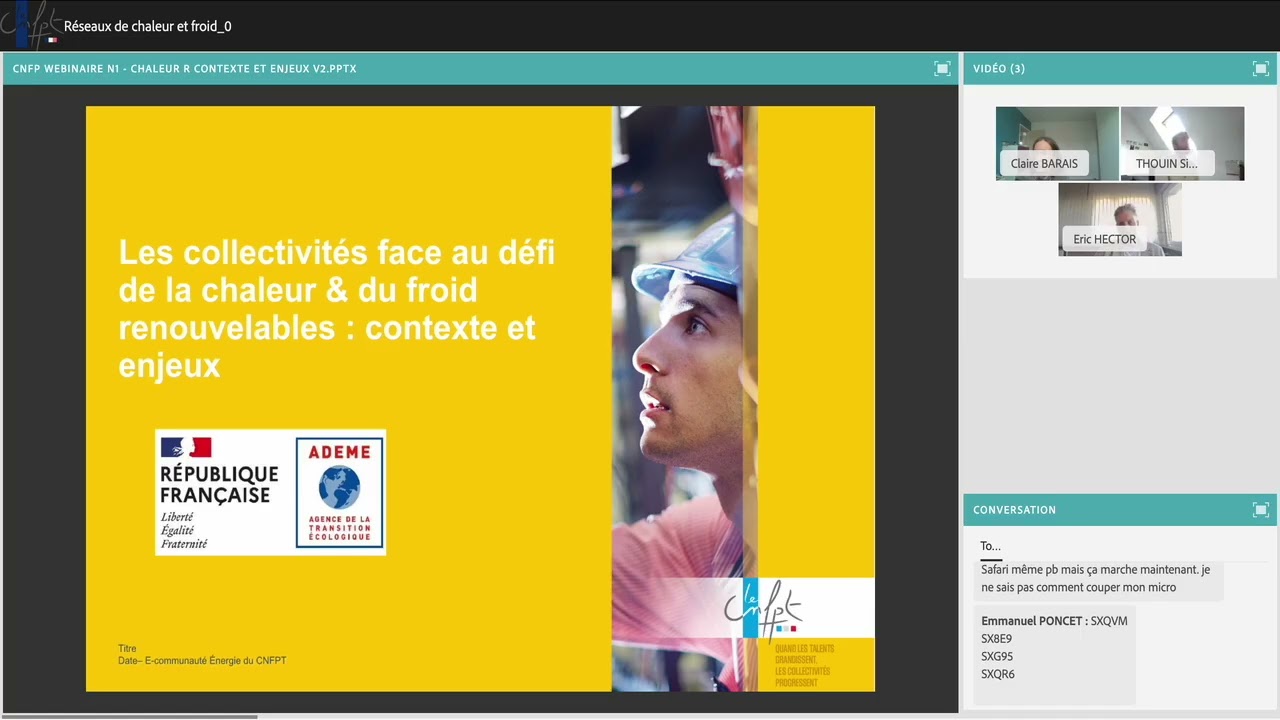
Les collectivités face au défi de la chaleur & du froid renouvelables 1/4 : contexte et enjeux
Keywords
Summary
193 words
Critical Evaluation
Value of the Information & Strength of the Argument
The webinar provides valuable introductory information on renewable heat and cold for local authorities, covering a wide range of technologies and strategic considerations. The argumentation is coherent, emphasizing the importance of reducing energy demand, mutualizing through networks, and prioritizing local resources. The speakers present clear benefits such as environmental, economic, and social advantages, and support their points with national objectives and statistics. However, the depth is limited, and some topics are only briefly touched upon, leaving room for more detailed exploration in subsequent webinars.
Scientific Rigor, Source Quality, Title Accuracy
The scientific rigor is adequate for an introductory webinar, with references to national policies like the Climate and Energy Law and the Multiannual Energy Programming. The sources are primarily institutional (ADEME) and the presentation is consistent with current knowledge. The title accurately reflects the content, which focuses on context and challenges. The webinar does not delve into controversial topics, and the information is presented in a balanced manner. No specific external sources are cited beyond the institutional context.
177 words
Title / Content Match
The title accurately reflects the content, which focuses on the context and challenges of renewable heat and cold for local authorities.
Quality & Reliability
7/10
The webinar is presented by experts from ADEME and a local authority representative, providing a solid overview of renewable heat and cold technologies. However, it is largely introductory and lacks detailed technical depth or critical analysis. The information is reliable but not exhaustive.
Key Moments
Markers derived by PSI from the transcript: the creator did not define chapters.
- Introduction by the CNFPT moderator, welcoming participants and outlining the webinar series.
- Simon Toin introduces the topic, highlighting that heat and cold represent nearly half of France's final energy consumption.
- Discussion of national objectives: 33% renewable energy by 2030 and 38% renewable heat, with a goal to multiply heat network distribution by 5.
- Presentation of the main renewable heat technologies: biomass, geothermal, solar thermal, and heat recovery.
- Emphasis on the importance of reducing energy needs and mutualizing through heat networks before choosing a technology.
- Overview of project stages: emergence, studies, design, financing, and operation, with mention of ADEME support.
- Detailed focus on biomass energy: types of fuel, boiler operation, and key success factors.
- Introduction to shallow geothermal energy and its advantages for heating and cooling.
- Brief overview of deep geothermal and other technologies like thalassothermy.
- Claire Barré presents solar thermal energy, its applications, and potential for local authorities.
Cited Sources
- ADEME Heat Fund — Mentioned as a key financial support mechanism for renewable heat projects.
- French Multiannual Energy Programming (PPE) — Referenced for national targets on renewable heat development.
Concurring Sources
- ADEME — The main source of information, providing data and support for renewable heat projects.
- French Ministry of Ecological Transition — Official government sources for energy policies and targets.
Contribution & Novelties
The webinar provides a comprehensive introduction to renewable heat and cold for local authorities, emphasizing the strategic importance of these solutions. It offers a structured approach to project development, from needs reduction to technology selection. The inclusion of a local authority testimonial adds practical perspective.
Pour aller plus loin :
- Heat networks in France — Overview of district heating systems, relevant to the discussion on mutualization.
- Biomass energy — General information on biomass as an energy source.
- Geothermal energy — Background on geothermal technologies, including shallow and deep systems.
- Solar thermal energy — Explanation of solar thermal technologies and applications.
100 words
Radar Profile
The radar profile shows moderate scores across all dimensions, with slightly higher scores in information quantity and quality, reflecting the webinar's comprehensive but introductory nature. The technical level is lower, indicating accessibility for a general audience.
💬 Sur les 0 commentaires analysés, aucune tendance n'a pu être dégagée.