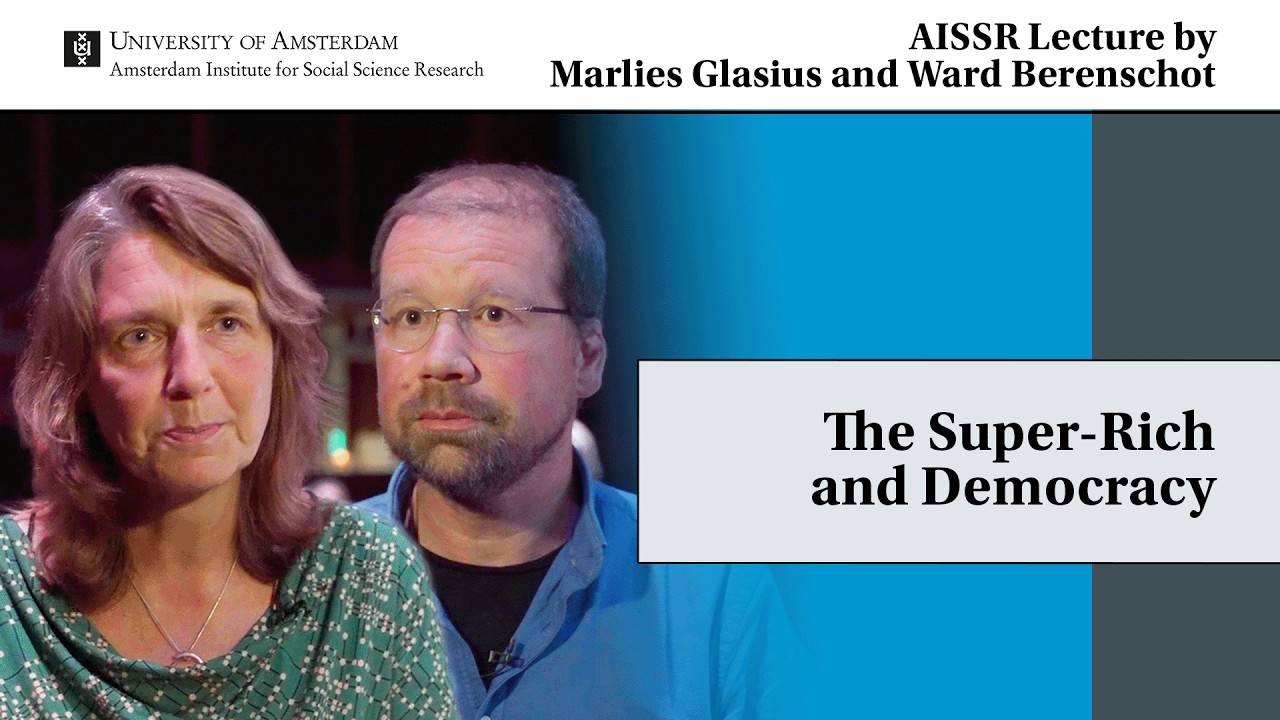
AISSR Lecture Marlies Glasius and Ward Berenschot | The Super-Rich and Democracy
Keywords
Summary
172 words
Critical Evaluation
Value of the Information & Strength of the Argument
The lecture provides valuable insights into the underexplored topic of the super-rich and democracy. Glasius and Berenschot offer a nuanced perspective, moving beyond simplistic narratives about billionaires supporting populist leaders. They introduce a relational definition of the super-rich that is context-sensitive and empirically grounded. The argumentation is solid, supported by data from the World Inequality Database, case studies from Indonesia and India, and references to academic works. The speakers acknowledge the limitations of their data and the preliminary nature of some theoretical concepts, which enhances credibility. The lecture effectively combines empirical evidence with theoretical innovation, making a compelling case for the systemic threat posed by concentrated wealth to democratic institutions.
Scientific Rigor, Source Quality, Title Accuracy
The lecture demonstrates strong scientific rigor. The speakers cite specific data sources (World Inequality Database, Forbes) and academic works (Alfani’s ‘Gods Among Men’, Mutluer et al., Credit Suisse). They are transparent about the limitations of their data, particularly regarding Dutch wealth statistics. The title accurately reflects the content, and the lecture is well-structured, with clear definitions and logical progression. The use of case studies and quantitative data strengthens the argument. However, some claims, such as the ‘democratic exhaustion spiral’ and ‘autocracy paradox’, are presented as unpublished ideas, which limits their verifiability. Overall, the sources are appropriate and the title-content alignment is strong.
227 words
Title / Content Match
The title accurately reflects the content: a double lecture on the super-rich and democracy, covering definitions, empirical cases, and theoretical insights.
Quality & Reliability
8/10
The lecture is delivered by two established professors in political science and political anthropology, drawing on their own research and citing specific data sets (World Inequality Database) and academic works (Alfani). The content is well-structured, with clear definitions and empirical examples. However, some claims are presented without direct citations in the talk, and the theoretical frameworks (democratic exhaustion spiral, autocracy paradox) are acknowledged as unpublished, reducing the overall certainty.
Key Moments
Markers derived by PSI from the transcript: the creator did not define chapters.
- Introduction: The rise of the super-rich and the question of their impact on democracy.
- Glasius debunks the 'Trump-Musk fallacy' and discusses the diversity of the super-rich.
- Definition of the super-rich: relational definition based on top 0.001% and wealth threshold.
- Channels of influence: formal (campaign finance, lobbying) and informal (media, philanthropy, legal action).
- Berenschot on Indonesia: case study of a mining tycoon and politician, and the 'green box' campaign donation.
- Data on polycratization: 45% of Indonesian parliamentarians have business links; Indian parliamentarians' wealth increased by 2000%.
- Theoretical concepts: 'democratic exhaustion spiral' and 'autocracy paradox'.
- Discussion on the super-rich in Europe and the Netherlands, and potential remedies.
Cited Sources
- World Inequality Database — Used for wealth inequality data and the 2026 report.
- Forbes Billionaires List — Cited for the number and wealth of global billionaires.
- Alfani, Guido. 'Gods Among Men' — Referenced for the historical perspective on the rich and the definitional approach.
- Mutluer et al. (research on politicians' wealth) — Cited for findings on politicians' average wealth being higher than citizens'.
- Credit Suisse (research on billionaires entering politics) — Cited for the statistic that 11% of billionaires enter politics.
Concurring Sources
- World Inequality Report 2022 — Provides data on global wealth inequality, consistent with the lecture's claims.
- Piketty, Thomas. 'Capital in the Twenty-First Century' — Seminal work on wealth inequality and its political implications.
Dissenting Sources
- Citizens United v. FEC (dissent) — The lecture criticizes the decision, but some legal scholars argue it protects free speech.
Contribution & Novelties
The lecture offers a novel relational definition of the super-rich, moving beyond absolute wealth thresholds. It synthesizes empirical evidence from diverse contexts (US, Indonesia, India, Europe) to argue that the super-rich pose a systemic threat to democracy through both formal and informal channels. The introduction of the concepts ‘democratic exhaustion spiral’ and ‘autocracy paradox’ provides a new theoretical lens. The lecture also highlights the under-researched area of strategic lawsuits by the super-rich.
Pour aller plus loin :
- World Inequality Database — Primary data source for wealth inequality.
- Citizens United v. FEC — Landmark Supreme Court case on campaign finance.
- Oligarchy — Concept central to the lecture.
- Wealth inequality — Background on the topic.
113 words
Radar Profile
The radar profile shows high scores across all dimensions, indicating a well-rounded and reliable lecture. The strongest aspects are the quantity and quality of information, with slightly lower scores on technical level and global reliability due to the preliminary nature of some theoretical concepts.