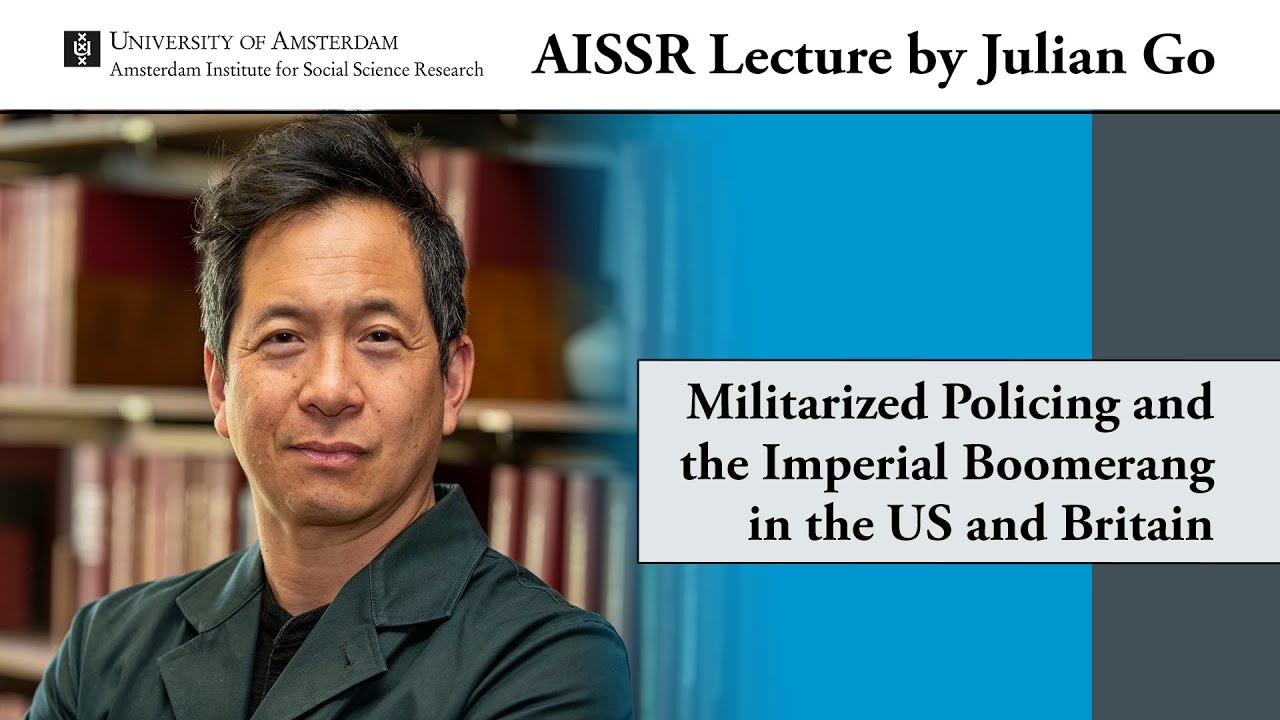
AISSR Lecture Julian Go | Militarized Policing and the Imperial Boomerang
Keywords
Summary
191 words
Critical Evaluation
Value of the Information & Strength of the Argument
The lecture provides a compelling and original argument that challenges conventional narratives of police militarization as a recent phenomenon. Go’s use of historical evidence is thorough, and he effectively demonstrates the colonial origins of modern policing. The argument is well-structured, moving from the founding of the London Met to broader theoretical implications. However, the lecture is primarily interpretive and does not engage with potential counterarguments or alternative explanations in depth. The reliance on a limited set of historical examples may leave some questions about generalizability.
Scientific Rigor, Source Quality, Title Accuracy
Go demonstrates strong scholarly rigor, drawing on established historians and theorists. He explicitly references Foucault, Arendt, Césaire, and Padmore, and his historical narrative is supported by archival evidence. The title accurately reflects the content, and the lecture stays focused on the stated topic. The sources are credible, though the lecture does not provide a full bibliography, relying on verbal citations. The adéquation between title and content is excellent.
168 words
Title / Content Match
The title accurately reflects the content, focusing on militarized policing and the imperial boomerang concept.
Quality & Reliability
8/10
The lecture is based on extensive historical research and references to established scholars (Foucault, Arendt, Césaire, Padmore). The argument is well-structured and supported by historical evidence, though it is an interpretive thesis rather than a systematic empirical study.
Key Moments
Markers derived by PSI from the transcript: the creator did not define chapters.
- Introduction: Go sets the stage by discussing contemporary militarized policing in the US and UK.
- Definition of militarization and the puzzle of the civil police.
- Historical background: the founding of the London Metropolitan Police in 1829.
- Colonial influences: Peele's experience in Ireland and the model of the Irish Constabulary.
- The beat system and its colonial origins in slave patrols and light infantry.
- Introduction of the concept of the imperial boomerang and its theoretical roots.
- Racialization as a driver: the Irish as a perceived threat and the racialization of crime.
- Discussion of the coloniality of policing versus militarization.
- Conclusion: implications for understanding contemporary policing and the need for historical sociology.
Cited Sources
- Society Must Be Defended — Michel Foucault's lectures where he alludes to the boomerang effect of colonialism.
- The Origins of Totalitarianism — Hannah Arendt's work discussing the boomerang effect in relation to colonialism and totalitarianism.
- Discourse on Colonialism — Aimé Césaire's work where he names the boomerang effect in the context of European colonialism.
- Colonial Fascism — George Padmore's concept of colonial fascism, which Go references.
Concurring Sources
- The Origins of Totalitarianism — Arendt's discussion of the boomerang effect aligns with Go's argument.
- Discourse on Colonialism — Césaire's naming of the boomerang effect supports Go's framework.
Contribution & Novelties
The lecture offers a novel theoretical framework by introducing the concept of the ‘imperial boomerang’ to explain police militarization. This moves beyond traditional analyses that focus solely on military influences, highlighting the colonial and racial dimensions. Go’s historical approach provides a deeper understanding of the continuity of militarization since the 19th century. The lecture also contributes to the literature by emphasizing the role of racialization in bringing colonial policing methods back to the metropole.
Pour aller plus loin :
- Coloniality of power — Relevant to understanding the enduring structures of colonial domination.
- Militarization of police — Provides an overview of the phenomenon and its debates.
- Michel Foucault — For his lectures on biopolitics and the boomerang effect.
117 words
Radar Profile
The radar profile shows high scores in information quantity, quality, and reliability, with a slightly lower technical level. This indicates a well-researched and credible lecture that is accessible to a broad academic audience.