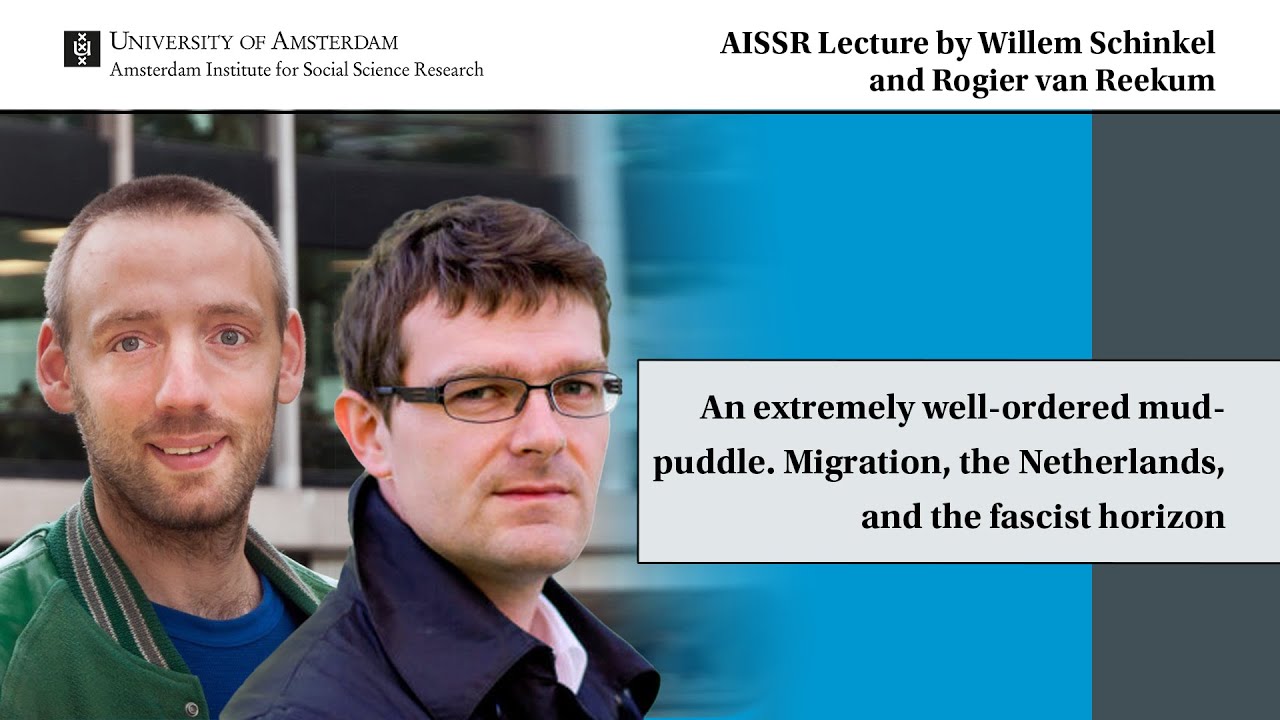
AISSR Lecture Willem Schinkel & Rogier van Reekum | Am Extremely Well-Ordered Mud-puddle
Keywords
Summary
138 words
Critical Evaluation
Value of the Information & Strength of the Argument
The lecture offers a highly original and provocative argument that migration is not about mobility but about state accounting and the production of ‘surplus’ populations. The speakers effectively use theoretical frameworks from Du Bois and Robinson to deconstruct common assumptions about migration and nationhood. The argumentation is coherent and well-supported, though it is heavily theoretical and may not appeal to those seeking empirical evidence. The value lies in its critical perspective that challenges mainstream migration studies and political science.
Scientific Rigor, Source Quality, Title Accuracy
The lecture demonstrates strong scientific rigor in its theoretical grounding, referencing canonical thinkers like Du Bois and Robinson, as well as historical figures like Johan Huizinga. However, specific sources are not explicitly cited in the video, and the argumentation relies on theoretical reasoning rather than empirical data. The title, quoting Du Bois, is apt and sets the tone for the lecture’s focus on the Netherlands. The content aligns well with the title, though it is more expansive than the title suggests.
175 words
Title / Content Match
The title is a quote from W.E.B. Du Bois, which is central to the lecture's theme. It is somewhat cryptic but accurately reflects the content's focus on the Netherlands and its 'well-ordered' yet 'muddy' character.
Quality & Reliability
8/10
The lecture is based on the speakers' academic work, drawing on established theorists like W.E.B. Du Bois and Cedric Robinson. The argumentation is rigorous and well-structured, though it presents a specific theoretical perspective rather than empirical data. The sources are not explicitly cited in the video, but the theoretical framework is credible.
Key Moments
Markers derived by PSI from the transcript: the creator did not define chapters.
- Introduction to the lecture and speakers
- Discussion of Du Bois's quote and the Netherlands as a 'mud-puddle'
- Introduction of the concept of 'migration as accounting'
- Analysis of the 'native scenario' and counterfactual accounting
- Discussion of 'conquest completed' and its implications
- Critique of Dutch exceptionalism and Huizinga's conception of Dutchness
- Introduction of the 'fascist horizon' and definition of power
- Conclusion and implications for understanding migration and fascism
Cited Sources
- W.E.B. Du Bois — Referenced for his characterization of the Netherlands as a 'well-ordered mud-puddle' and his theoretical work on race.
- Cedric Robinson — Referenced for his critique of Europe as a continent and his work on racial capitalism.
- Johan Huizinga — Referenced for his essay on Dutch mentality and its critique of fascism.
Concurring Sources
- W.E.B. Du Bois — His work on race and double consciousness aligns with the lecture's critique of racialized accounting.
- Cedric Robinson — His concept of racial capitalism supports the argument that migration is a racialized economic and political issue.
Dissenting Sources
- Mainstream migration studies — The lecture explicitly challenges conventional migration studies that focus on mobility and integration, arguing instead that migration is a state-produced category.
Contribution & Novelties
The lecture provides a novel theoretical framework for understanding migration as a product of state accounting and racialized infrastructure, rather than as a neutral description of human mobility. It challenges conventional migration studies and political science by arguing that migration is constitutive of liberal democracy and its fascist tendencies. The concept of a ‘fascist horizon’ offers a new way to analyze contemporary politics.
Pour aller plus loin :
- W.E.B. Du Bois — Foundational thinker on race and sociology.
- Cedric Robinson — Theorist of racial capitalism.
- Johan Huizinga — Dutch historian and cultural theorist.
93 words
Radar Profile
The radar profile shows high scores in information quantity and quality, reflecting the lecture's dense theoretical content and rigorous argumentation. The technical level is also high, indicating a specialized audience. The overall reliability is strong, though the lack of explicit citations slightly reduces the score.
💬 Sur les 0 commentaires analysés, aucune tendance n'est disponible.