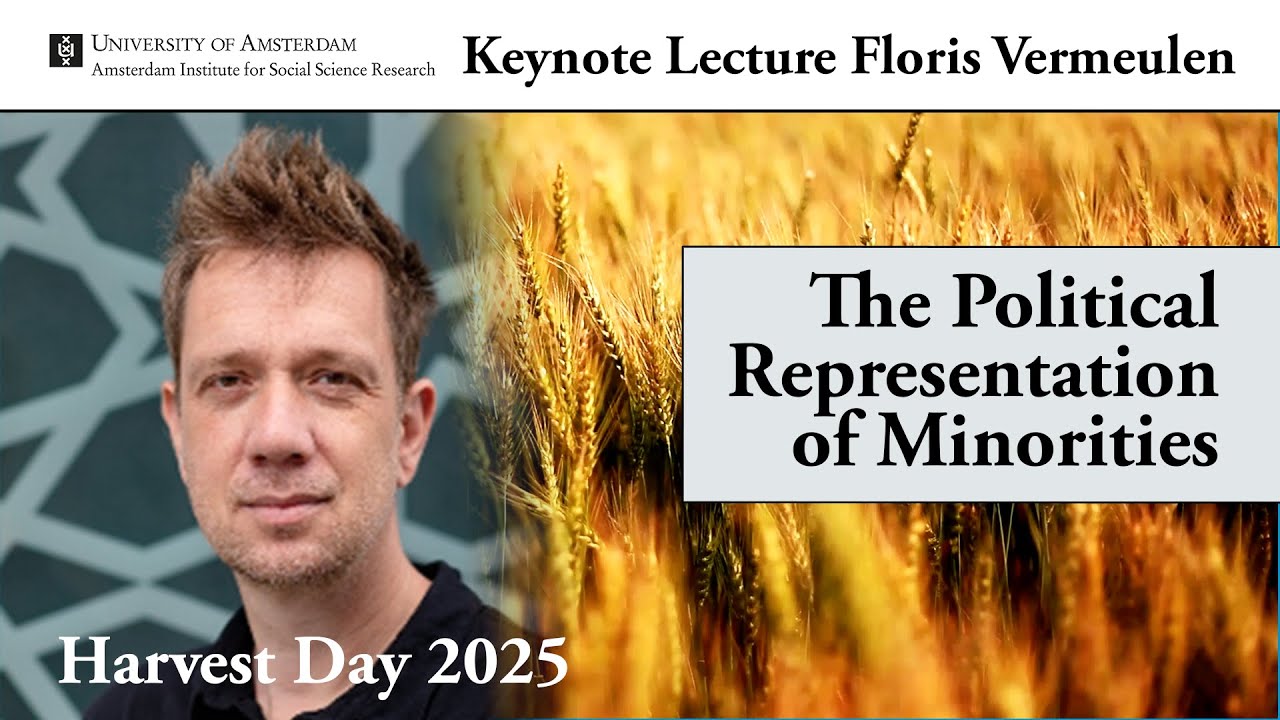
Harvest Day 2025 | Keynote Floris Vermeulen
Keywords
Summary
202 words
Critical Evaluation
Value of the Information & Strength of the Argument
The presentation offers valuable insights into the long-term dynamics of minority political representation, drawing on a substantial body of research. The argumentation is solid, logically moving from theoretical concepts to empirical findings and then to implications. Vermeulen effectively uses data on turnout, voting patterns, and descriptive representation to support his claims. He also acknowledges the complexity of the issue, noting that social capital can both include and exclude. The discussion with Younes Douari adds a practical perspective, bridging academic research and grassroots activism. However, the presentation is a summary of existing research rather than presenting new original data, and some arguments could benefit from more detailed evidence for specific claims.
Scientific Rigor, Source Quality, Title Accuracy
The keynote demonstrates high scientific rigor, referencing numerous studies conducted by the Institute for Migration and Ethnic Studies over 30 years. Vermeulen cites specific articles and reports, and the presentation is grounded in established political science theories (e.g., social capital, descriptive representation). The title accurately reflects the content. The description provides context and mentions the aftertalk with Younes Douari. No comments were provided for analysis.
190 words
Title / Content Match
The title accurately reflects the content: a keynote presentation at the Harvest Day event, delivered by Floris Vermeulen.
Quality & Reliability
8/10
The keynote is based on 30 years of research by the Institute for Migration and Ethnic Studies, with over 10 PhD theses and 50 academic articles. The speaker is a recognized expert in the field. The presentation is well-structured, cites specific studies and data, and includes a critical discussion with a practitioner. However, it is a keynote, not a peer-reviewed publication, and some claims lack detailed methodological transparency.
Key Moments
Markers derived by PSI from the transcript: the creator did not define chapters.
- Introduction: focus on political representation of minorities in Amsterdam, based on 30 years of research.
- Theoretical framework: descriptive representation, perceived representation, and the importance of formal politics.
- Demographic changes in Amsterdam: migration background now nearly 60% of population.
- Institutional context: local voting rights, proportional representation, low threshold for council seats.
- Research overview: social capital approach, turnout rates of different immigrant groups.
- Findings on descriptive representation: Turkish-Amsterdammers overrepresented, Surinamese less so.
- Social capital leads to both inclusion and exclusion; parties as gatekeepers.
- Increasing turnout inequality: affluent vs. poor neighborhoods, below 20% in some areas.
- Explanations for low participation: discrimination, distrust, feeling not heard.
- Conclusion: disappointing overall picture, but positive signs; future research directions.
- Aftertalk with Younes Douari: grassroots campaigns, acknowledging exclusion, and optimism.
Cited Sources
- Political participation and political trust in Amsterdam (article by Mani) — Cited as the starting point of the research program, focusing on social capital and political participation.
- Article by Laura Mishon and Floris Vermeulen (10 years ago) — Cited for the finding that social capital leads to both political inclusion and exclusion.
- Report on politicization and discrimination (with colleagues from NINE and Plumbo) — Cited for the correlation between perceived discrimination and political distrust.
- Article in Huna Amsterdam on Represent Jezelf — Cited as an example of collaboration and understanding of grassroots strategies.
Concurring Sources
- Political Participation of Immigrants in Europe — Provides comparative context on immigrant political participation in Europe.
- Descriptive Representation and Political Trust — Academic article supporting the link between descriptive representation and trust.
Dissenting Sources
Contribution & Novelties
This keynote synthesizes 30 years of research, providing a comprehensive overview of minority political representation in Amsterdam. It highlights the persistent gap between descriptive and substantive representation, and the growing participatory inequality. The discussion with a practitioner adds a practical dimension, connecting academic findings to real-world interventions.
Pour aller plus loin :
- Descriptive representation — Key concept in political science.
- Social capital — Theoretical framework used in the research.
- Political participation of immigrants — Related topic.
- Turnout inequality — General context on voter turnout disparities.
85 words
Radar Profile
The radar profile shows high scores in quantity and quality of information, reflecting the extensive research base. The technical level is moderate, suitable for an academic audience but accessible. Global reliability is high due to the speaker's expertise and the established research program.