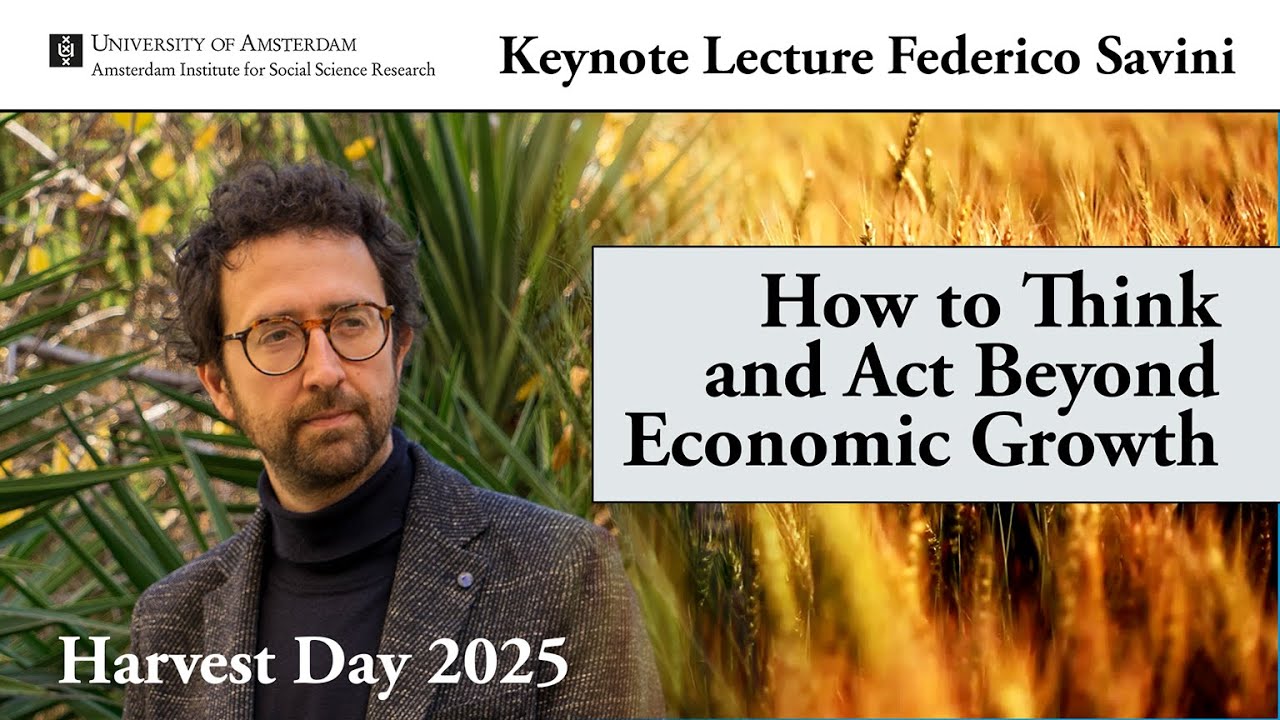
Harvest Day 2025 | Keynote Federico Savini
Keywords
Summary
184 words
Critical Evaluation
Value of the Information & Strength of the Argument
The lecture provides a clear and compelling argument for degrowth, supported by empirical data on emissions inequality and the failure of decoupling. Savini effectively critiques green growth and offers a coherent framework for rethinking urban sustainability. The argumentation is solid, though it is presented from a specific ideological stance and may not fully address counterarguments. The discussion with the city official adds practical perspective, but the focus remains on advocacy rather than neutral analysis.
Scientific Rigor, Source Quality, Title Accuracy
The lecture references several studies and data sources, such as Oxford research on emissions inequality and the Amsterdam ‘Brede Welvaart’ monitor, but does not provide specific citations. The title accurately reflects the content. The discussion with a city official adds credibility, but the lack of detailed references limits the scientific rigor. The content is well-structured and the speaker is an academic, but the presentation is more of an expert opinion than a systematic review.
163 words
Title / Content Match
The title accurately reflects the content: a keynote lecture on degrowth in urban context.
Quality & Reliability
7/10
The lecture is based on established research and data, but it is an opinion piece advocating for degrowth. The speaker is an academic, and the content is well-structured, but it lacks detailed citations and is presented from a specific ideological perspective.
Key Moments
Markers derived by PSI from the transcript: the creator did not define chapters.
- Introduction to the lecture and reasons for interest in degrowth.
- Evidence of decoupling failure and inequality in emissions.
- Definition of green growth, postgrowth, and degrowth.
- Cities as infrastructures of capital circulation and consumption funds.
- Pitfalls of mainstream urban sustainability policies.
- Proposals for a degrowth urban agenda and public-common partnerships.
- Discussion with Nienke van Renssen on housing cooperatives and policy.
Cited Sources
- Oxford research on emissions inequality — Referenced in the lecture to show that the top 10% of income earners emit 60% of global emissions.
- Amsterdam Brede Welvaart monitor — Mentioned as a tool to measure well-being in Amsterdam, showing poor social performance.
Concurring Sources
- IPCC reports on climate change — Provide scientific evidence on the need for drastic emission reductions, supporting the degrowth critique.
- Research on decoupling by the European Environment Agency — Shows the limits of decoupling, aligning with the lecture's argument.
Dissenting Sources
- Critiques of degrowth from mainstream economists — Some economists argue that degrowth could harm well-being and that green growth is feasible with technological innovation.
Contribution & Novelties
The lecture offers a concise and accessible introduction to degrowth applied to urban studies, integrating social and ecological critiques. It provides a clear framework for understanding urban sustainability challenges and proposes concrete policy directions. The discussion with a city official adds a practical dimension, highlighting the challenges and opportunities of implementing degrowth ideas in local governance.
Pour aller plus loin :
- Degrowth (Wikipedia) — Overview of the degrowth movement and its principles.
- Doughnut Economics (Wikipedia) — Related framework for sustainable development.
- Public-common partnerships (article) — Academic discussion of public-common partnerships in urban governance.
93 words
Radar Profile
The radar profile shows high scores in information quantity and quality, with moderate technical level and reliability. This indicates a well-informed lecture with a strong evidence base, but with a focus on advocacy rather than neutral analysis.
💬 No comments were provided for analysis.