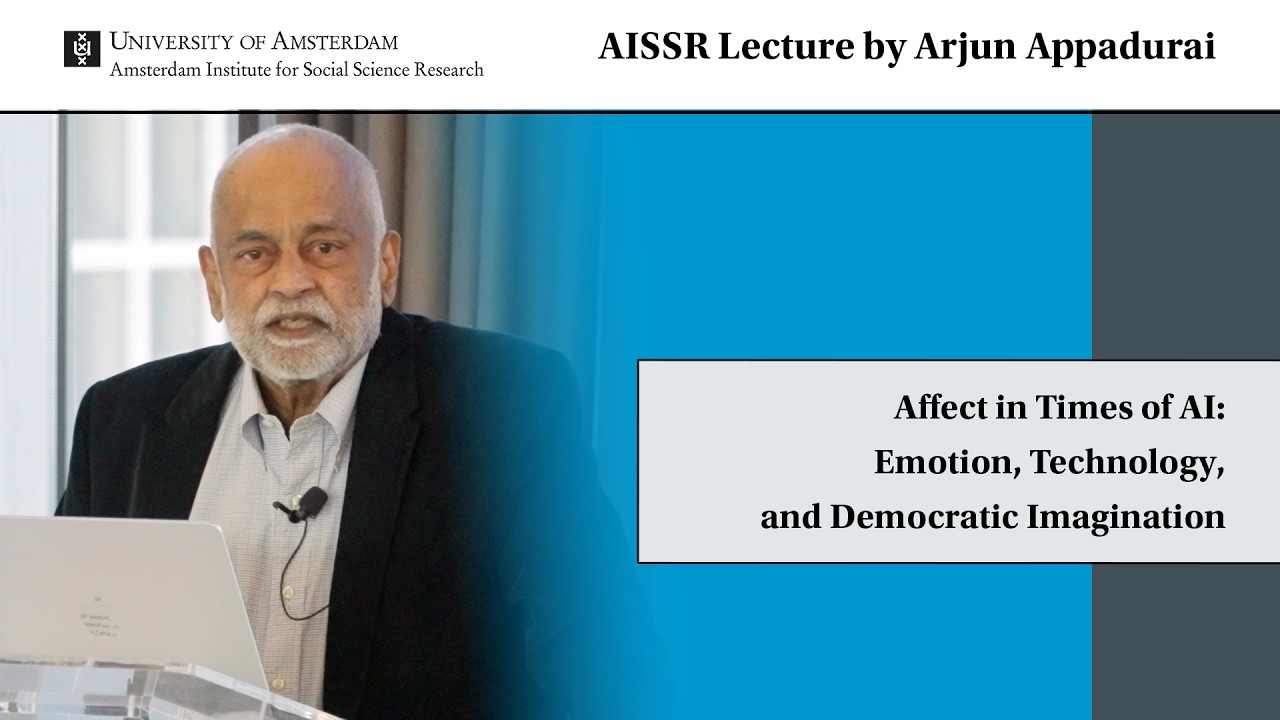
AISSR Lecture Arjun Appadurai | Affect in Times of AI: Emotion, Technology & Democratic Imagination
Keywords
Summary
147 words
Critical Evaluation
Value of the Information & Strength of the Argument
The lecture offers valuable insights into the affective dimensions of politics, challenging the dominance of rationalist approaches. Appadurai’s argument is well-structured, moving from specific examples (Modi, Trump) to theoretical frameworks (Marcuse, Freud, Marx). He provides a novel perspective on how the right has captured affect through the idea of ’the people’ as a pre-political entity, and how social media amplifies this. The argument is persuasive, though it relies on theoretical reasoning rather than empirical evidence. The speaker is transparent about his limited expertise on AI, which adds credibility. The call for a sensory approach to democracy is original and thought-provoking, though the practical implementation remains vague.
Scientific Rigor, Source Quality, Title Accuracy
The lecture demonstrates scientific rigor by grounding arguments in established theories (Marcuse, Freud, Marx) and referencing contemporary scholars (Sara Ahmed, Ruth Wodak). However, specific sources are not cited in detail, and no empirical data is presented. The title accurately reflects the content, focusing on affect, technology, and democratic imagination. The lecture is well-structured and coherent, with a clear thesis. The speaker’s acknowledgment of his limitations on AI enhances credibility. Overall, the scientific quality is high, but the lack of explicit citations and empirical evidence slightly reduces the score.
209 words
Title / Content Match
The title accurately reflects the content, focusing on affect, technology, and democratic imagination, with AI as a concluding theme.
Quality & Reliability
8/10
Lecture by a prominent anthropologist, drawing on established theories (Marcuse, Freud, Marx) and contemporary examples. The speaker acknowledges his limited expertise on AI, but the argument is coherent and well-grounded in social science literature. No empirical data presented, but the theoretical framework is robust.
Key Moments
Markers derived by PSI from the transcript: the creator did not define chapters.
- Introduction and personal history with Amsterdam
- Introduction of 'sensory democracy' concept
- Critique of liberal left's reliance on rational argumentation
- Analysis of Modi and Trump's affective appeal
- Discussion of Herbert Marcuse and polymorphous perversity
- Role of social media in enhancing networks of emotions
- Call for reclaiming affect through aesthetic practices
- Reflections on AI and the algorithmic self
- Q&A on fear vs. hope in political emotions
Cited Sources
- Herbert Marcuse - One-Dimensional Man — Referenced for ideas on repressive tolerance and surplus repression
- Sara Ahmed - The Cultural Politics of Emotion — Mentioned as a scholar on emotions and affect
- Ruth Wodak - The Politics of Fear — Mentioned as a scholar on right-wing populism and affect
Concurring Sources
- The Cultural Politics of Emotion - Sara Ahmed — Supports the importance of emotions in politics
- The Politics of Fear - Ruth Wodak — Supports the analysis of right-wing populism and affect
Dissenting Sources
- Rationalist approaches to democracy — The lecture criticizes the overemphasis on rationality, which some scholars might defend.
Contribution & Novelties
The lecture contributes a novel framework of ‘sensory democracy’ that integrates affect and bodily experience into democratic theory, challenging the dominance of rationalism. It offers a fresh analysis of right-wing populism by focusing on the capture of affect and the concept of ’the people’ as a polymorphous perverse entity. The discussion on AI’s tendency to make humans more machine-like highlights a neglected dimension of technological development.
Pour aller plus loin :
- Affect theory — Provides background on the theoretical framework used.
- Herbert Marcuse — Key thinker referenced for repressive tolerance and polymorphous perversity.
- Sensory ethnography — Related methodological approach to studying sensory experiences.
103 words
Radar Profile
The radar profile shows high scores in quality of information and reliability, reflecting the speaker's expertise and coherent argumentation. The quantity of information is moderate, as the lecture is theoretical rather than data-heavy. The technical level is moderate, accessible to a general academic audience.