NIH 101: An Introduction to the National Institutes of Health
Keywords
Summary
228 words
Critical Evaluation
Value of the Information & Strength of the Argument
The video provides valuable insights into the NIH’s structure and funding mechanisms, which are often misunderstood. The speaker’s argumentation is solid, grounded in his extensive experience and supported by concrete examples, such as the drug approval study and the Research America poll. He effectively argues for the importance of basic research and the necessity of federal funding, using logical reasoning and analogies like the ‘plate of spaghetti’ to explain biological complexity. The presentation is persuasive and well-supported, though it is primarily an expert opinion rather than a systematic review.
Scientific Rigor, Source Quality, Title Accuracy
The speaker demonstrates scientific rigor by referencing specific studies and reports, such as the PNAS paper on drug approvals and the Research America poll. He also cites Vannevar Bush’s ‘Science: The Endless Frontier’ and the National Academy of Sciences committee on precision medicine. The title accurately reflects the content, which is an introductory overview. The video is a formal presentation to a congressional audience, and the speaker’s credentials add to its credibility. However, as a single expert’s perspective, it may not cover all aspects of NIH operations.
191 words
Title / Content Match
The title accurately reflects the content, which provides a comprehensive introduction to the NIH, its structure, funding mechanisms, and peer review process.
Quality & Reliability
8/10
The speaker is a distinguished scientist and policy expert, providing accurate and well-structured information about NIH operations, peer review, and funding priorities. The content is consistent with known facts about NIH, though it is an expert opinion rather than a systematic review.
Key Moments
Markers derived by PSI from the transcript: the creator did not define chapters.
- Introduction by Congresswoman Jackie Speier
- Dr. Yamamoto begins his talk, outlining the three P's: priorities, peers, and payments
- Overview of NIH's budget and its economic impact
- Explanation of the NIH's structure as a federation of 27 institutes and centers
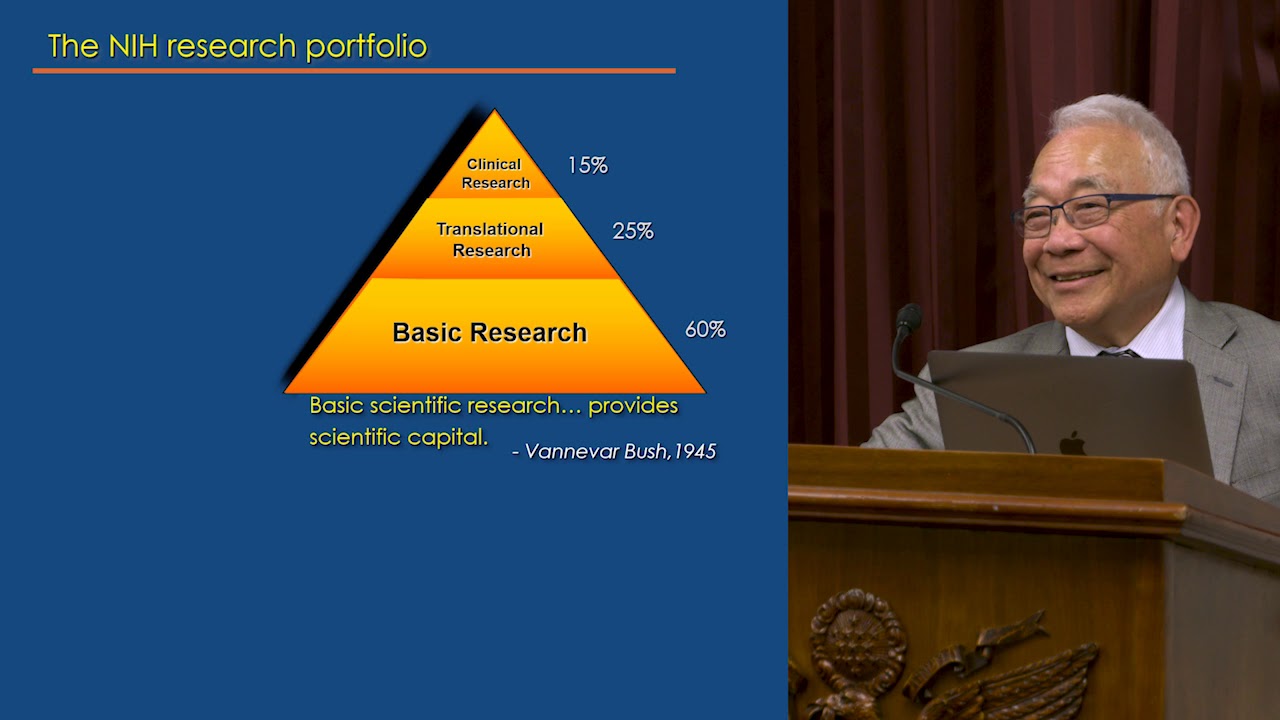
- Discussion on the importance of basic research and the complexity of biology
- Example of NIH-funded research leading to drug approvals
- Introduction to precision medicine and its potential
- Explanation of the peer review process and study sections
- Details on scoring criteria and the review process
- Conclusion and final remarks
Cited Sources
- Science: The Endless Frontier — Referenced as a foundational essay on the importance of basic research.
- Research America poll — Cited as a recent poll showing public support for federally funded basic research.
- PNAS paper on drug approvals — Referenced as a study showing NIH funding contributed to all 210 drugs approved between 2010 and 2016.
Concurring Sources
- NIH budget and economic impact — Official NIH data on budget allocation and economic impact.
- NIH peer review process — Official description of the peer review process.
Contribution & Novelties
The video provides a clear and authoritative explanation of NIH’s funding priorities and peer review process, which is valuable for a non-specialist audience. It emphasizes the importance of basic research and introduces precision medicine as a future direction. The speaker’s use of analogies makes complex concepts accessible.
Pour aller plus loin :
- National Institutes of Health (NIH) — Official website for further information on NIH structure and funding.
- Peer review at NIH — Details on the peer review process at the Center for Scientific Review.
- Precision Medicine Initiative — Information on NIH’s precision medicine efforts.
95 words
Radar Profile
The radar chart shows high scores in quantity and quality of information, with a moderate technical level. This indicates a well-balanced presentation that is informative and reliable, but not overly technical, making it suitable for a general audience.
💬 Sur les 0 commentaires analysés, aucune tendance n'est disponible.