Zika Virus: What Is It and Can We Stop It?
Keywords
Summary
223 words
Critical Evaluation
Value of the Information & Strength of the Argument
The presentation provides valuable, up-to-date information on the Zika virus, synthesizing epidemiological data, vector biology, and public health implications. The speaker’s expertise is evident, and he supports his claims with specific examples (e.g., Yap Island, French Polynesia, Brazil) and references to ongoing research. He presents two hypotheses for the recent emergence—viral mutation versus increased exposure in naive populations—and explains the evidence for each, demonstrating balanced scientific reasoning. He also addresses practical challenges in diagnostics and vaccine development, offering a realistic assessment of the situation. The argumentation is logical and well-structured, moving from basic virology to complex public health issues.
Scientific Rigor, Source Quality, Title Accuracy
The speaker is a distinguished virologist with direct research experience on Zika and other arboviruses, lending high credibility. He references the CDC’s updated mosquito distribution maps and mentions collaborative studies with Yale and the Fiocruz Institute in Brazil. The talk is a congressional briefing, indicating a level of official scrutiny. The title accurately reflects the content, which covers the nature of the virus and potential control measures. The presentation is scientifically rigorous, though some information has been superseded by later findings (e.g., sexual transmission details).
199 words
Title / Content Match
The title accurately reflects the content: the speaker explains what Zika virus is, its history, transmission, health impacts, and discusses prevention and control strategies.
Quality & Reliability
8/10
Presentation by a distinguished virologist with extensive research experience on arboviruses, including direct studies on Zika in Senegal. The content is scientifically accurate and up-to-date as of April 2016, but some information has since evolved (e.g., sexual transmission details, vaccine development).
Key Moments
Markers derived by PSI from the transcript: the creator did not define chapters.
- Introduction to emerging diseases and factors driving their spread, including air travel and urbanization.
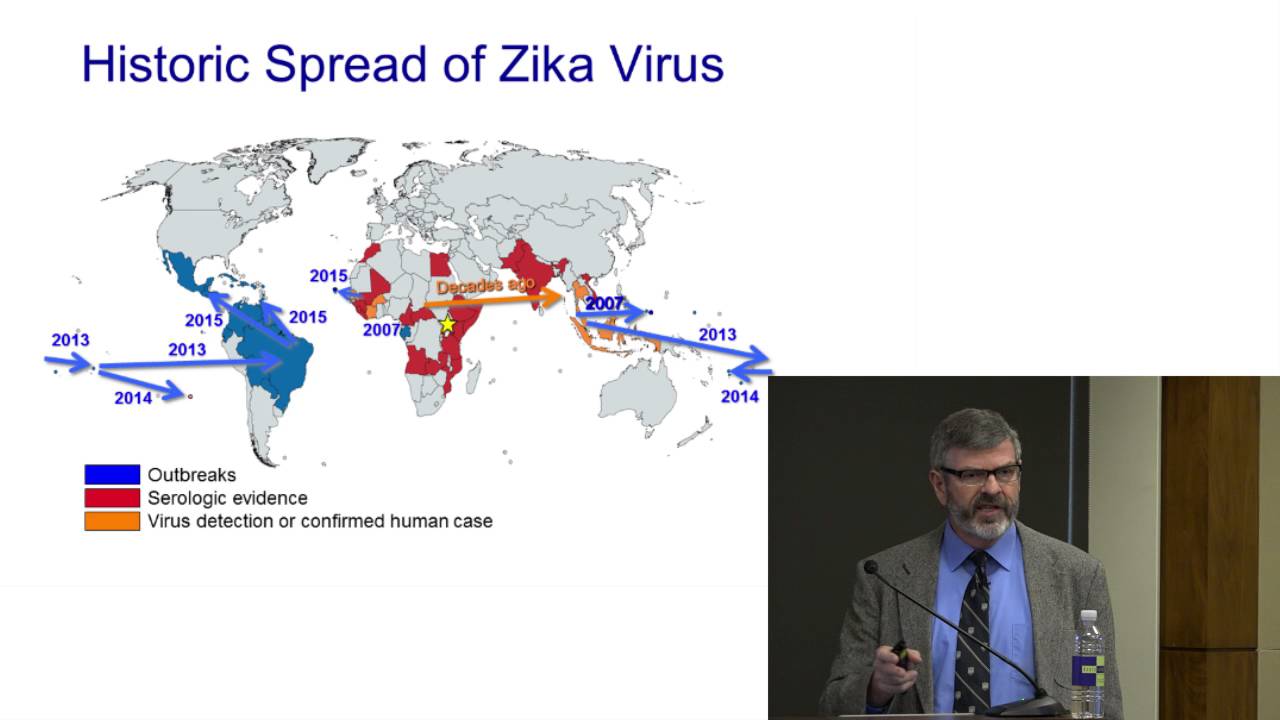
- History of Zika virus: discovery in Uganda, spread to Asia, and early evidence of urban transmission.
- Transmission cycle: forest cycle with monkeys, urban cycle with Aedes aegypti and Aedes albopictus, and role of air travel.
- Phylogenetic tree of flaviviruses and relationship of Zika to dengue, West Nile, and yellow fever.
- Outbreaks in Yap Island (2007), French Polynesia (2013), and introduction to Brazil (late 2013).
- Current situation: 33 countries affected, estimated 1.5 million cases in Brazil, and challenges in diagnostics.
- Health complications: microcephaly and Guillain-Barré syndrome, with evidence linking Zika.
- Risk of spread in the US, comparison with chikungunya, and prevention strategies including mosquito control and vaccine development.
Cited Sources
- CDC Zika Virus — Referenced for updated mosquito distribution maps and diagnostic recommendations.
- University of Texas Medical Branch — Speaker's affiliation and research institution.
Concurring Sources
- WHO Zika Virus Fact Sheet — Provides global epidemiological data and health information consistent with the briefing.
Dissenting Sources
- Later studies on sexual transmission — The speaker mentions six cases of sexual transmission; later research found more cases and longer persistence in semen, but this does not contradict the core content.
Contribution & Novelties
This briefing provides a comprehensive overview of the Zika virus as of April 2016, synthesizing current knowledge on its history, transmission, and public health impact. It highlights the challenges in diagnostics due to cross-reactivity with dengue and the urgent need for vaccine development. The speaker’s firsthand research experience adds depth to the discussion of transmission cycles and hypotheses for emergence.
Pour aller plus loin :
- Zika virus - Wikipedia — General overview and updated information.
- Microcephaly - Wikipedia — Condition linked to Zika infection during pregnancy.
- Guillain-Barré syndrome - Wikipedia — Neurological condition associated with Zika.
- Aedes aegypti - Wikipedia — Primary mosquito vector for Zika.
- Flaviviridae - Wikipedia — Virus family to which Zika belongs.
116 words
Radar Profile
The radar profile shows high scores across all dimensions, indicating a well-rounded and reliable presentation. The content is rich in information, technically sound, and delivered by a credible expert, making it a valuable resource for understanding the Zika virus.
💬 No comments were provided for analysis.