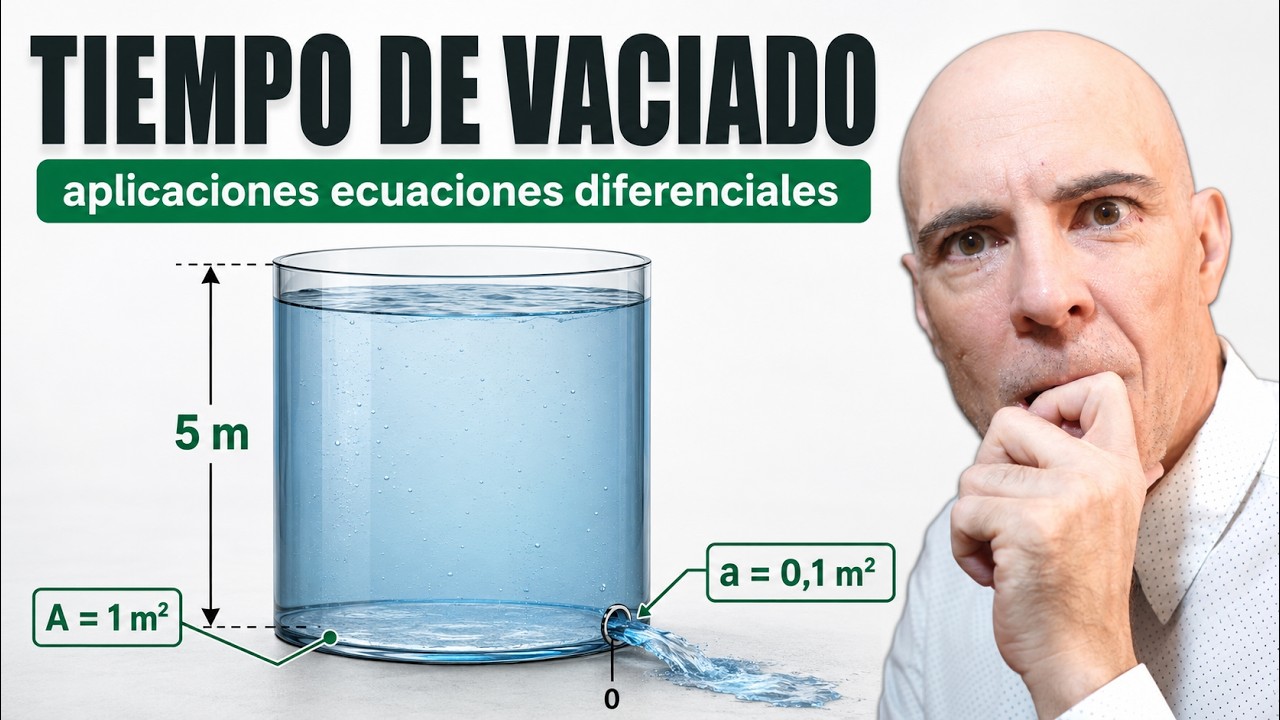
¿CUÁNTO TARDA EN VACIARSE UN DEPÓSITO? | Aplicaciones Ecuaciones Diferenciales
Keywords
Summary
159 words
Critical Evaluation
Value of the Information & Strength of the Argument
The video provides a clear and valuable demonstration of how differential equations can model a real physical system. The argumentation is logically structured: starting from physical principles (volume conservation and energy conservation), it derives the governing differential equation and solves it step-by-step. The explanation is rigorous and easy to follow, making it a useful educational resource. The choice of a separable differential equation simplifies the solution, and the final numerical result is correctly computed. The video effectively shows the power of mathematical modeling in physics.
Scientific Rigor, Source Quality, Title Accuracy
The scientific rigor is high: the derivation is based on well-established physical laws (conservation of volume and mechanical energy). The video does not cite external sources, but the methodology is standard and correct. The title accurately reflects the content, and the video fulfills its promise of applying differential equations to a practical problem. The presentation is clear and well-organized, with no apparent errors in the mathematical steps.
167 words
Title / Content Match
The title accurately reflects the content: the video solves the problem of how long it takes to empty a tank using differential equations.
Quality & Reliability
8/10
The video presents a clear, step-by-step derivation of the differential equation for tank draining, based on fundamental physical principles (volume conservation and mechanical energy conservation). The mathematical steps are correct and the final numerical result is consistent with the given data. The explanation is rigorous and accessible, with no apparent errors.
Key Moments
Markers derived by PSI from the transcript: the creator did not define chapters.
- Introduction to the problem: calculating the emptying time of a tank using differential equations.
- Statement of the problem: cylindrical tank with base area 1 m², initial height 5 m, orifice area 0.1 m².
- Sketch of the tank and identification of variables.
- Setting up the volume conservation equation: rate of decrease of volume equals outflow rate.
- Introduction of variable height h(t) and expression for volume in the tank.
- Expression for the volume of water that has left the orifice.
- Derivation of outflow velocity using conservation of mechanical energy: v = √(2gh).
- Formulation of the differential equation for the height h(t).
- Identification of the equation as a first-order, nonlinear, separable differential equation.
- Separation of variables and setting up the integrals.
- Substitution of numerical values and calculation of the emptying time.
- Final result: T ≈ 10.1 seconds.
Cited Sources
- 50 ecuaciones diferenciales — Referenced as a complementary class for practicing differential equations.
- Aplicaciones de las ecuaciones diferenciales (playlist) — Referenced as a playlist with more applications of differential equations.
- Tiza líquida (material) — Referenced as the liquid chalk used in the video.
Concurring Sources
- Torricelli's law — The velocity of efflux formula v = √(2gh) is a direct application of Torricelli's law, which is consistent with the video's derivation.
Contribution & Novelties
The video provides a clear and concise tutorial on applying differential equations to a classic physics problem, making it accessible to students. It demonstrates the step-by-step process of modeling a real-world scenario and solving the resulting equation. The main novelty is the pedagogical approach, emphasizing the practical utility of differential equations.
Pour aller plus loin :
- Torricelli’s law — Directly related to the outflow velocity formula used in the video.
- Differential equation — General concept of differential equations and their applications.
- Separable differential equation — The specific type of equation solved in the video.
94 words
Radar Profile
The radar profile shows high scores in quality of information and global reliability, with moderate scores in quantity and technical level. This indicates a focused, well-executed tutorial that provides solid content but may not cover a broad range of topics or advanced technical depth.