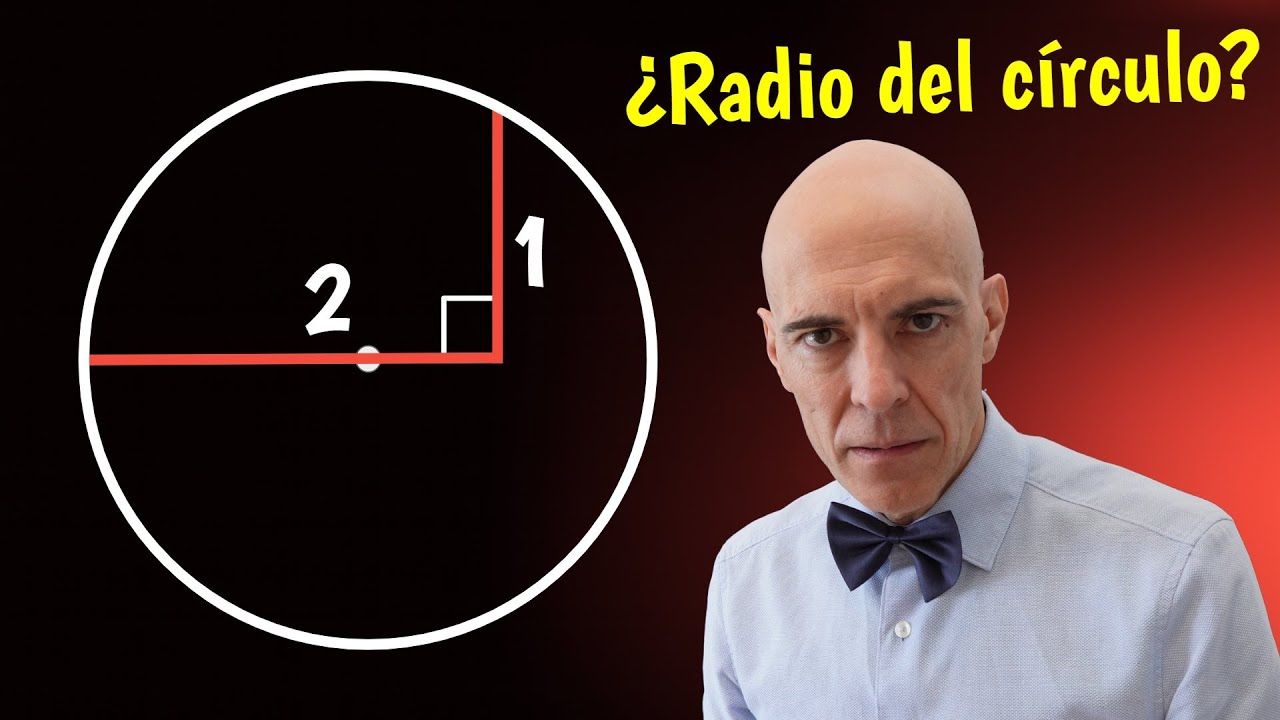
Muy pocos saben el valor del radio del círculo🤯
Keywords
Summary
158 words
Critical Evaluation
The video is a well-executed tutorial on a fundamental geometry problem. The mathematical reasoning is rigorous and correct. The instructor clearly explains each step, from setting up the right triangle to applying the Pythagorean theorem and solving the resulting equation. He also takes time to explain the algebraic expansion of (2 - R)^2, which is beneficial for students who may struggle with this concept. The use of visual aids, such as drawing the circle and labeling segments, enhances understanding. However, the video contains several digressions, including self-promotion and comments about his appearance, which may distract from the core content. The title is somewhat sensationalized, but the content matches the promise of solving for the radius. The lack of citations to external sources is not a major issue for a basic math problem, as the solution is self-contained and verifiable. Overall, the video is a valuable resource for students learning geometry, offering a clear and methodical approach to problem-solving.
158 words
Title / Content Match
The title is somewhat clickbait but accurately reflects the content: solving for the radius of a circle given two perpendicular segments.
Quality & Reliability
8/10
The video presents a clear, step-by-step geometric solution using the Pythagorean theorem and algebraic manipulation. The reasoning is sound and the result is correct. The explanation is pedagogically effective, though it includes some digressions and self-promotion. No external sources are cited, but the mathematical content is verifiable and accurate.
Key Moments
Markers derived by PSI from the transcript: the creator did not define chapters.
- Introduction of the problem: finding the radius of a circle given two perpendicular segments of lengths 2 cm and 1 cm.
- Drawing the circle and identifying the center, diameter, and the given segments.
- Constructing a right triangle by drawing a radius to the intersection point of the segments.
- Labeling the unknown radius as R and the remaining segment as x, establishing x = 2 - R.
- Applying the Pythagorean theorem: R^2 = 1^2 + (2 - R)^2.
- Expanding (2 - R)^2 using the algebraic identity.
- Simplifying the equation and solving for R, obtaining R = 5/4 cm.
- Discussion on the importance of algebraic identities and freedom of thought in mathematics.
- Promotion of the geometry playlist and channel merchandise.
- Presentation of a similar problem for viewers to solve in the comments.
Cited Sources
- Matemáticas con Juan - Official Website — The instructor's website, mentioned in the video description, likely contains additional resources and exercises.
- Basic Geometry Playlist — A playlist of basic geometry exercises referenced in the video description, providing further practice problems.
Concurring Sources
- Pythagorean theorem — The theorem is correctly applied to solve for the radius.
Contribution & Novelties
The video provides a clear, step-by-step solution to a classic geometry problem, emphasizing the use of the Pythagorean theorem and algebraic manipulation. It is particularly useful for students who need to see the process of setting up equations from geometric figures. The instructor’s emphasis on algebraic identities and the freedom of thought in mathematics adds pedagogical value.
Pour aller plus loin :
- Pythagorean theorem — The fundamental theorem used in the solution.
- Circle — Basic properties of circles, including radius and diameter.
- Quadratic equation — The type of equation solved in the video.
93 words
Radar Profile
The radar profile shows high scores in quality of information and reliability, reflecting the correctness and clarity of the mathematical solution. The quantity of information is moderate, as the video focuses on a single problem. The technical level is appropriate for a basic geometry audience, not too advanced but not overly simplistic.